


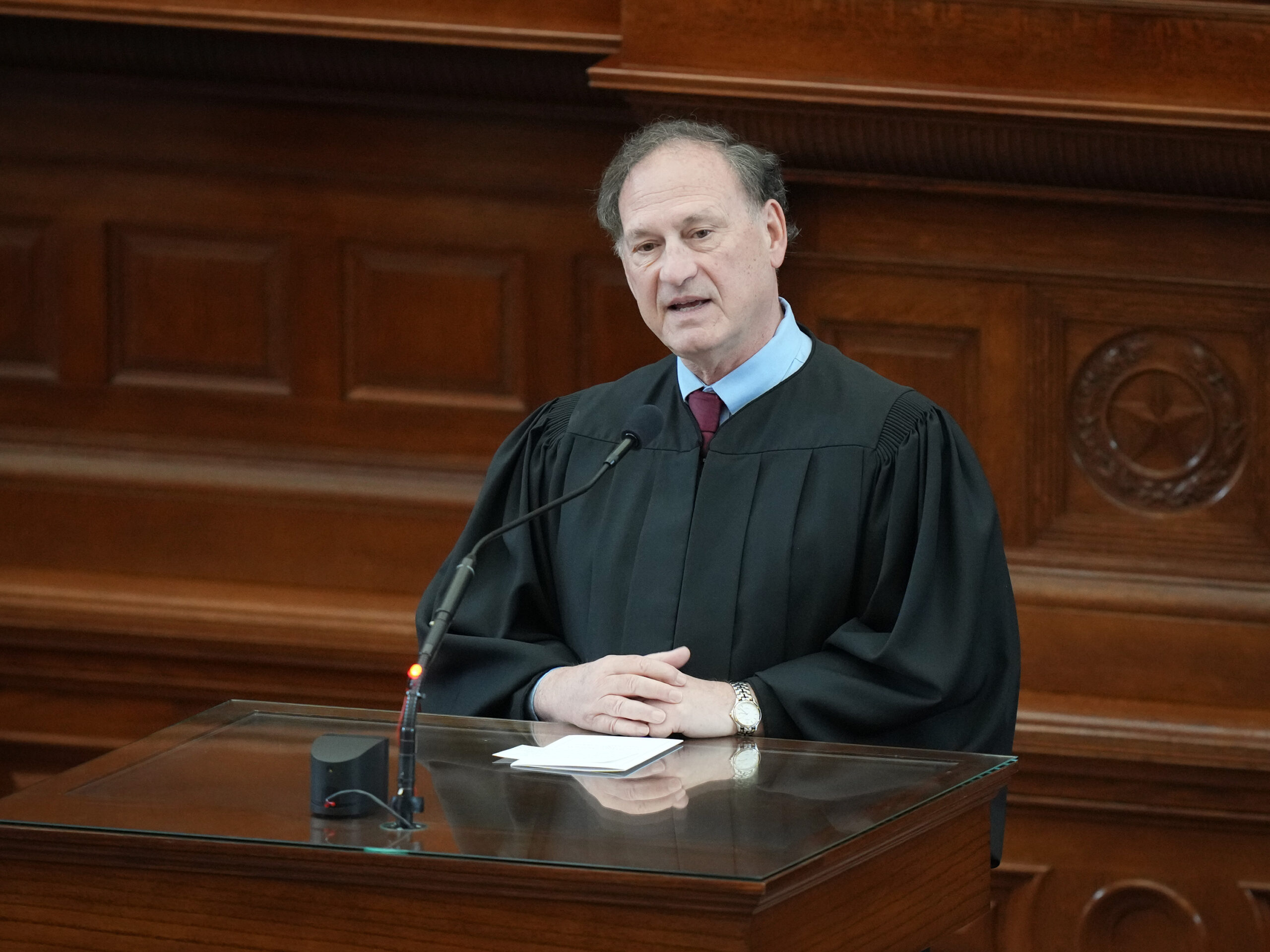
Justice Samuel Alito decided Monday to sit out one of the most consequential climate change cases to reach the Supreme Court, but legal experts expected continuing ramifications due to his ownership of individual corporate stocks, including in the fossil fuel industry.
After months of resisting calls for his recusal, Alito reversed himself one week before the Supreme Court is set to open its term by hearing the oil industry’s bid to block Boulder, Colorado’s lawsuit to recover costs related to climate change. The clerk of the court sent a brief letter to the lawyers in the case saying, without explanation, that Alito would no longer participate.
Alito does not own stock in the two companies involved in the Boulder case—ExxonMobil and the Canadian oil giant Suncor—and through a court spokesperson earlier this year conveyed that the court’s legal counsel said his recusal was not required. But Alito does own stock in companies that face lawsuits that will hinge directly on the Supreme Court’s decision.
State court judges, in fact, have stayed 11 such cases in recent months pending the outcome of Suncor v. Boulder. Those include cases from which Alito has recused himself in the past.
The cases seek to recover damages from oil companies for the costs state and local governments already are incurring and are expected to face in the future due to extreme weather, drought, wildfire and other impacts of climate change.
The oil industry should bear financial responsibility, they argue, because of evidence that they knew the climate impact of their products for years and misled the public about the risks. The county and city of Boulder sued Exxon and Suncor in 2018, five years after historic flooding destroyed 1,800 homes, tore up more than 100 miles of roadway and caused billions of dollars of damage.
Three years later, the most destructive fire in Colorado history swept across the region, killing two people, burning 6,000 acres and again burdening communities with costs from an event that scientists say was worsened by climate change.
A Supreme Court ruling for the oil companies could provide the kind of blanket immunity from liability over climate change that the industry has sought for years. Exxon and Suncor told the court that energy companies were facing lawsuits seeking “billions of dollars in damages” and urged the Supreme Court to take the case “to prevent dozens of climate change cases from improperly barreling ahead in state court.”
A coalition of 30 environmental, watchdog and advocacy groups, including the League of Conservation Voters, the Revolving Door Project and urged the Senate Judiciary Committee in a May letter to investigate whether Alito was violating the law or the judicial ethics code that the Supreme Court adopted in 2023.
The group Consumer Watchdog earlier this month released research detailing how the two biggest oil companies in Alito’s portfolio, ConocoPhillips and Phillips 66, warned investors about the material risks they face due to the litigation. Consumer Watchdog’s review also found that Alito holds stock in companies involved in every climate case identified as currently stayed pending the outcome of Suncor v. Boulder, including lawsuits by California, New Jersey, Delaware and eight California cities and counties.
“Justice Alito’s recusal from Suncor v. Boulder is the right decision, and one he should have made from the start,” said Alexandra Nagy, organizing director with Consumer Watchdog, in a statement. “The public should not have to wonder whether a justice’s personal investments could benefit from a ruling that shields the fossil-fuel industry from liability.”
The situation brought front and center the kind of ethics controversy at the Supreme Court that Chief Justice John Roberts has sought to quell for at least the past 15 years. In 2011, in a year-end report devoted to ethics issues, Roberts defended the system in which justices decide for themselves—without review of the rest of the Supreme Court—whether to recuse themselves.
The Vote to Take the Boulder Case
“I have complete confidence in the capability of my colleagues to determine when recusal is warranted,” Roberts wrote.
Alito, the only justice who owns an extensive portfolio of stocks in individual large corporations that regularly litigate in the federal courts, has recused himself more often than any other justice in recent years, according to research by the watchdog group Fix the Court.
Because Alito participated in the case conference during which the Supreme Court decided to take the Boulder case in February, there remains a lingering question of whether his vote already was decisive in ensuring that Suncor and Exxon would get a Supreme Court hearing. Although the court decides in secrecy which cases it will hear among the thousands of petitions it receives each year, by longstanding practice it requires that at least four of the court’s members must agree before a so-called writ of certiorari is granted.
Between 2023 and 2025, the Supreme Court denied petitions by oil companies in nine cases to consider essentially the same issue in the Boulder case—whether federal law preempted state and local governments from seeking damages against the oil industry in state court lawsuits. Alito had recused himself from the case conferences for all but one of those cases.
Without naming Alito, ExxonMobil made reference to the recusal problem when it told the Supreme Court back in 2022 that the Boulder case was the “ideal vehicle” for resolving the legal issues the industry had raised.
“It involves a smaller set of defendants … and is thus less likely to present recusal issues,” Exxon said in its brief.
Although the Supreme Court didn’t take the Boulder case back then (Alito had recused himself “inadvertently,” a court spokesperson later told NBC), the oil industry finally will get to make its case to the high court on Monday.
Advocates for the state and local governments suing the oil industry see the Exxon brief as laying out a roadmap for the justices who were inclined to grant cert on the preemption issue.
“In a lot of ways, Exxon and Suncor proposed this maneuver to Justice Alito three years ago,” said Mike Meno, spokesman for the nonprofit Center for Climate Integrity, in an interview before Alito announced he would recuse himself. “People have a very cynical view of this court, and actions like this only reinforce the public’s concerns about the court’s integrity.”
When the Supreme Court unanimously adopted its first-ever code of conduct in 2023, it laid out the circumstances that call for recusal—including holding a financial interest in a party litigating before the court. But legal experts note that it never addressed a more basic question: Should Supreme Court justices hold individual stocks at all?
Should Justices Own Stocks?
According to his latest financial disclosure, released in August, Alito holds stocks in more than 25 corporations, seven of them in the fossil fuel industry, as well as a mineral interest worth as much as $250,000 in Oklahoma. His holdings have not changed since the previous year, even though they created controversy last term when he belatedly recused himself from a case over Louisiana wetlands destruction involving ConocoPhillips. (The only other justice who holds individual stocks is Roberts, who has shares in a semiconductor services company and a biotech firm.)
Louis Virelli, a law professor at Stetson University and author of a book on the Supreme Court and recusal, interviewed before Alito made his recusal decision, said that he believed the questions raised go beyond the Suncor case and what is required by the letter of the law.
“We spend too much time talking about what is required of the justices,” Virelli said. “We should be talking about the right thing to do, because the justices owe us all an ethical duty and they owe us an institutional duty.
This story is funded by readers like you.
Our nonprofit newsroom provides award-winning climate coverage free of charge and advertising. We rely on donations from readers like you to keep going. Please donate now to support our work.
“The real question to me is: Why does any justice hold stock in an individual company that is part of an industry that is going to appear before the court?” Virelli said.
Arthur Hellman, professor emeritus and legal ethics expert at the University of Pittsburgh, said he is “baffled” why Alito continues to own individual corporate stocks. He notes that Alito himself discussed the importance of all nine members of the Supreme Court hearing cases in a 2023 memorandum where he explained why he was resisting calls to recuse himself from a tax case. “If we recused in such cases, we would regularly have less than a full bench, and the Court’s work would be substantially disrupted and distorted,” Alito wrote at the time.
Said Hellman: “Justice Alito will no longer be open to criticism for participating in the Suncor case, but his recusal does nothing to address the concerns about disruption of the Court’s work that he voiced in his … memorandum.”
In a laudatory biography of Alito released this year that relied on interviews with people close to the justice, conservative author Mollie Hemingway wrote that the individual stocks were holdings that his wife, Martha-Ann, had inherited from her parents. “They hold not just financial value for her but sentimental value as well, making her disinclined to sell them,” Hemingway wrote.
Hellman said as long as Alito maintains those financial interests, he will raise recusal issues for himself and put the court’s ethics practices under public scrutiny.
“People will wonder, ‘Isn’t there a downstream effect of whatever the court decides in Suncor on … other fossil fuel companies?’” Hellman said. “It just seems to me no emotional attachment can override all of those concerns.”
About This Story
Perhaps you noticed: This story, like all the news we publish, is free to read. That’s because Inside Climate News is a 501c3 nonprofit organization. We do not charge a subscription fee, lock our news behind a paywall, or clutter our website with ads. We make our news on climate and the environment freely available to you and anyone who wants it.
That’s not all. We also share our news for free with scores of other media organizations around the country. Many of them can’t afford to do environmental journalism of their own. We’ve built bureaus from coast to coast to report local stories, collaborate with local newsrooms and co-publish articles so that this vital work is shared as widely as possible.
Two of us launched ICN in 2007. Six years later we earned a Pulitzer Prize for National Reporting, and now we run the oldest and largest dedicated climate newsroom in the nation. We tell the story in all its complexity. We hold polluters accountable. We expose environmental injustice. We debunk misinformation. We scrutinize solutions and inspire action.
Donations from readers like you fund every aspect of what we do. If you don’t already, will you support our ongoing work, our reporting on the biggest crisis facing our planet, and help us reach even more readers in more places?
Please take a moment to make a tax-deductible donation. Every one of them makes a difference.
Thank you,

Bureau Chief, Washington, D.C.
Marianne Lavelle is the Washington, D.C. bureau chief for Inside Climate News. She has covered environment, science, law, and business in Washington, D.C. for more than two decades. She has won the Polk Award, the Investigative Editors and Reporters Award, and numerous other honors. Lavelle spent four years as online energy news editor and writer at National Geographic. She spearheaded a project on climate lobbying for the nonprofit journalism organization, the Center for Public Integrity. She also has worked at U.S. News and World Report magazine and The National Law Journal. While there, she led the award-winning 1992 investigation, “Unequal Protection,” on the disparity in environmental law enforcement against polluters in minority and white communities. Lavelle received her master’s degree from Columbia University Graduate School of Journalism, and is a graduate of Villanova University.
