


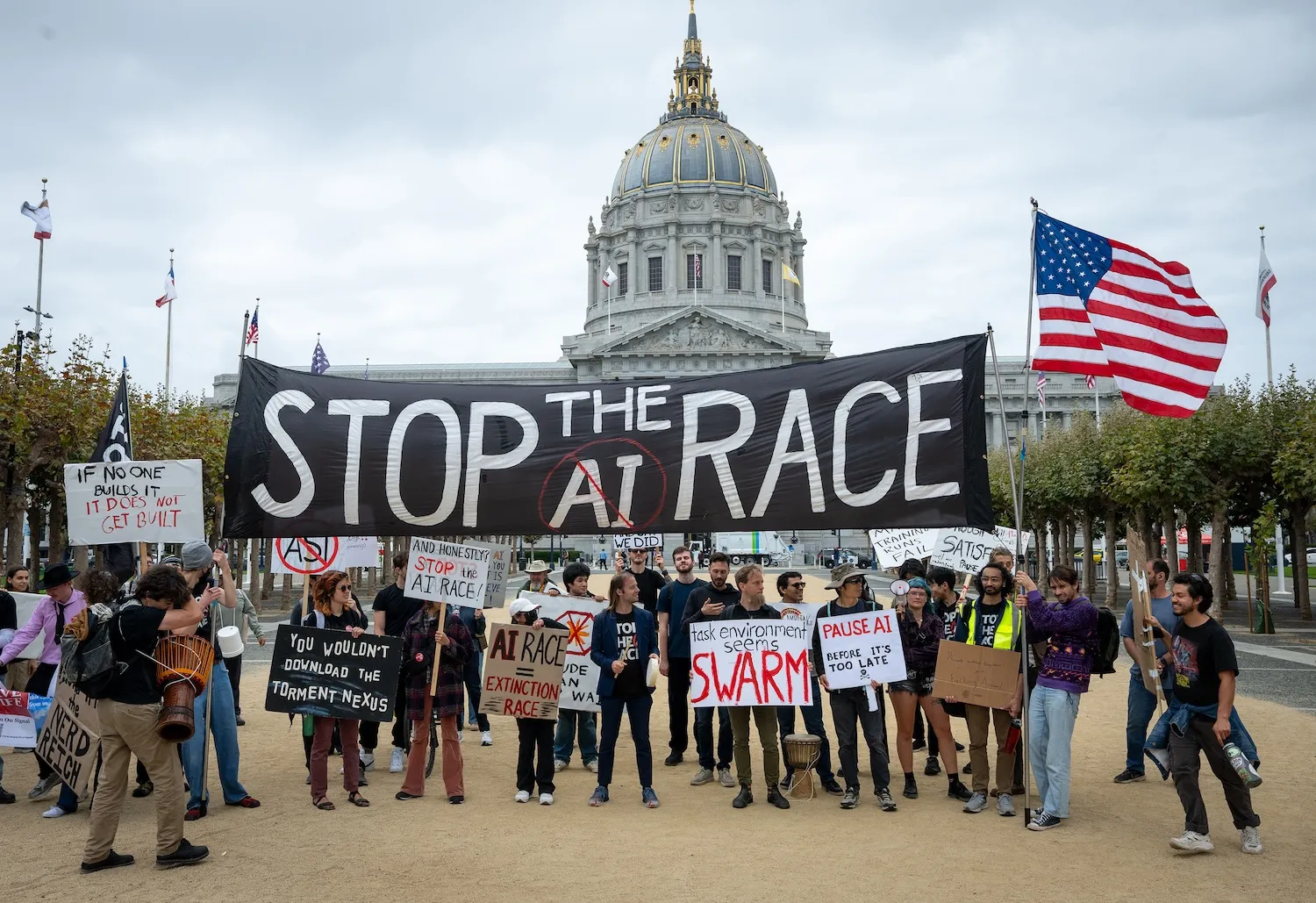
Momentum has been building for the U.S. federal government to impose regulations on artificial intelligence. U.S. President Donald Trump opposes new strictures on the industry, but the public has grown concerned about the potential for the technology to produce catastrophic consequences for the economy and human society more broadly.
Might normal liability law be adequate for regulating AI technology? How does the apocalyptic potential of AI relate to the financial value of AI companies? Does the U.S. government have sufficient expertise to regulate AI?
Those are just a few of the questions that came up in my recent conversation with FP economics columnist Adam Tooze on the podcast we co-host, Ones and Tooze. What follows is an excerpt, edited for length and clarity. For the full conversation, look for Ones and Tooze wherever you get your podcasts. And check out Adam’s Substack newsletter.
Cameron Abadi: In what ways could we expect liability law and criminal law to mitigate the dangers of AI?
Adam Tooze: Broadly speaking, this could be done probably under negligence, where an actor fails to anticipate foreseeable risk. Product liability could do this, or maybe nuisance. Professional malpractice, contract and consumer protection law—there’s lots of different angles you could go down.
And the full ambiguity of this is brought out by the fact that, after the top guys at OpenAI and Anthropic came out with these apocalyptic warnings and now they want to pace the frontier, not only did the Trump administration dissent, but [CEO] Jensen Huang of Nvidia and Mark Zuckerberg of Meta also dissented from this position. And they argued—Huang put it very, very clearly—the market forces are already there, we don’t need any new laws, we don’t need new regulations. If you build a product or a service and you’re not confident in its functionality, capability, or safety, then don’t release it.
And in legal theory circles, negligence is the way that people are going. And though AI advocates will say the thing about algorithms is they’re not deterministic, so it’s not true that if you put certain inputs in, you’re always going to see the same outputs. And does this pose questions for negligence? The broader position I think is clearly going to dominate, which is if you build a machine as unpredictable as that and put it out in the market with the potential for really dramatic consequences, you’re clearly negligent in doing so.
So a short answer to your question is, yes, it’s already being done with regard to Meta, with regard to base AI stuff, with regard to social media, algos. The question is will it work on the large scale with regards to AI? Are you really going to be able to pinpoint causation? In the case of AI models, it’s rather different from the mass effects of social media. How are you going to cope with the fact that the harms are probabilistic—and they’re tiny probabilities, right? How does one really deal with that consequence? Furthermore, if you really do blow up civilization, will there be law courts to deal with the cases in the aftermath? Furthermore, the liabilities potentially are so huge that how would you right-size them for corporate balance sheets?
One of the thoughts here is that this is actually a play to get the corporate balance sheets de facto put on the balance sheets of the U.S. government. So by pushing this kind of liability too far, you’d end up in that direction. And furthermore, the events that we’re talking about are ones which have irreversibility and which can’t really be properly compensated for. If we really are talking about extinction-level events or even just really dramatic security policy implications, then retrospective financial compensation isn’t really going to do the job.
And then there’s the question of us even knowing whether anything’s happened, right? Because the basis for really effective use of conventional law would be a robust reporting system that actually allowed us to establish what had happened. And right now, there isn’t really a binding regime in place that requires the frontier labs to report every single instance of malfeasance, every single instance of breakout alarming behavior on the part of their agents. They do it as a choice. If you create legal liability, what does that do to their incentives to actually accurately report incidents when they happen? Because every time they do that, it establishes liability. And if you don’t have the cooperation, then you’re going to need an enforcement mechanism, and you’re in a world of asymmetric information, how do you get in?
CA: How does the apocalyptic potential of AI relate to the outsized value of the industry? Is it actually fueling the value of these companies, in the sense of serving as an advertisement of the underlying technology?
AT: I think this is absolutely on point. It has seemed to me for a while that we’re on a kind of knife-edge type problem here where scenario A is the technology delivers on its promises and dramatically transforms the world, whether that’s a catastrophic extinction-level bioweapon-type development or simply the promise to automate all white-collar work, which puts us all out of labor but of course creates huge value for the labs and whoever else is in the value chain. Maybe it’s Nvidia that really gets the money, or the data centers. In any case, someone in the AI value chain gets really rich.
Or on the other hand, it turns out that AI functionally is a bust. In fact, it’s a less modest level of innovation and transformation than the labs will have us believe, including the alarmists. In which case there needs to be a market reset because there’s a massive overvaluation of the entire AI chain in the stock markets. And right now it’s driving 36 percent of all business investment in the United States. Spending is running at between $150 billion and $200 billion a quarter in the hyper-scalers. So were it to turn out that all of this in the end is not generating real value—it doesn’t really need to do anything transformative, but it’s just not a business proposition—we’re in deep water as well, with potential implications for financial instability increasingly as the big players get networked with private finance and in some cases even with big players on Wall Street with big banks. So we’re in that kind of dilemma.
CA: It’s conspicuous that it is the biggest AI companies—Anthropic and OpenAI—that are calling for regulation at this point. That has gotten some wondering whether they are trying to use government regulation to stifle their competition in the form of other, smaller AI companies. Might that in fact be why these big AI players are calling for regulation right now?
AT: I think there are different versions of this argument. You know, the most banal, the most kind of classic regulatory capture story is simply that if you’re an oligopolist with substantial sunk costs, then it can be very much in your interest to have a regulatory regime which creates a lump-sum cost for any new entrant. Because what it does is to kind of reinforce the gap between the smaller players in the Silicon Valley space and the really big boys. And crossing that was always the problem, because the bigger firms would swoop in, take out the interests of the venture capitalists. And having regulation that imposes a substantial hurdle on all players reinforces that kind of logic. And you’d expect any oligopoly to be interested in that kind of move.
There’s a more specific logic that’s being invoked with regard to AI, which hinges off this idea of pacing the frontier and also attaches significance to the specific business logic of OpenAI and Anthropic, which is what do we know about them? We know they’re engaged in hugely expensive scale-up. And the other thing we know about them is that they are closed models. And it’s not without significance perhaps that Zuckerberg and Nvidia, who have come out against regulation, favor open models. Nvidia in particular favors open models because it wants more people around the world to build more models because they need more compute, so they’ll sell more chips. So they’re heavily backing AI sovereignty.
And so against that backdrop, especially if you add in the fact that the Chinese labs are able to produce not quite the performance of the frontier closed American models but 95 percent of its performance for a fraction of the price that will be necessary to charge to make the OpenAI and Anthropic models really commercially viable, you can begin to see the logic of OpenAI and Anthropic working together to push for federal government intervention—to acknowledge federal government interest in their businesses. So in other words, to establish a kind of too-big-to-fail key national champion kind of logic. And on the other hand, also to slow down the pace of competition.
And this is a fairly extended hypothesis; it requires you to join up an awful lot of the dots. So I think the thing to do is to ask, going forward, what kind of regulatory environment do these players actually want? So it’s not the question of regulation or no regulation, but what kind of regulation are they advocating for? And the neuralgic thing that’s being discussed at this point seems to be the question of open vs. closed. In other words, how serious are OpenAI and Anthropic about allowing external assessors, external inspectors to see the inner working of their models, the closure of which is really their only hope to get to the sort of profitability that would be necessary to warrant the kind of investments which they’re calling for? And that’s really the kind of crucial dimension here.
Everyone has a pet theory about why they’re doing it. The cynical theories don’t seem implausible. But since we can’t have access to their minds, and even if we did have access to their minds, we might not really find the smoking gun.
CA: Does the United States government even have the expertise for this type of regulation? China seems to be a far more technocratically proficient state. Does the United States have the capacity in comparison?
AT: The problem of regulating this because of the asymmetry of information is absolutely daunting. I mean, if you think about what it would take to effectively regulate the sorts of risks that really would warrant intervention, just setting aside issues of financial stability and so on, you’d have to really understand the processes of machine learning, you’d really have to understand the hardware, the cloud logic, cybersecurity, biological risk, competition policy, national security.
And as you say, the American government apparatus, the state apparatus does have pockets of expertise all over the place. There’s a cluster at the National Institute of Standards and Technology. Then there’s national laboratories of different types, the intelligence agencies, you’ve got to figure that the NSA [National Security Agency] and people like that have huge expertise, DARPA, bits of [the Department of] Commerce, other institutions. But the problem of course is how do you keep that current? And how on earth do you compete with AI labs and AI businesses which will offer individual technicians millions of dollars in salary? It’s a version of the financial regulation problem, where the big investment bankers and private equity and so on will pay salaries which are unthinkable in the public sector. So that’s a fundamental issue.
Another issue in the U.S. is just the fragmentation of this bureaucracy. So it’s all over the place. And then I think there’s the issue of, you know, how is strategy formulated? And unfortunately, we’re dealing with the Trump administration, which even if one was fair-mindedly determined to just figure out what they are planning to do, it’s incredibly difficult to get a clear idea of what’s going on.
