


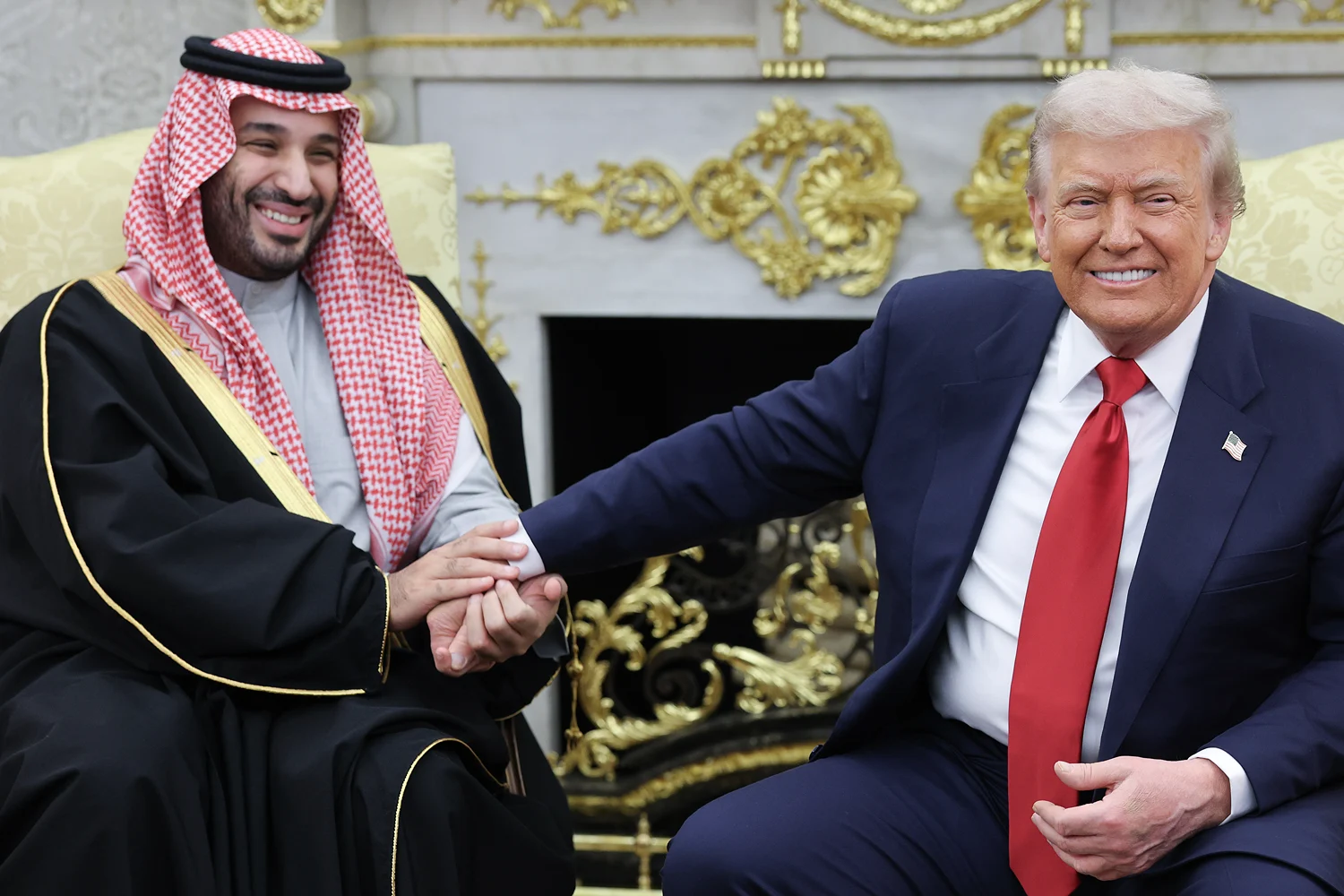
Saudi Arabia is in serious trouble. Its global influence primarily comes from its leading position as an oil producer and the money resulting from that role, but now the Middle East is on fire. Today, Saudi tankers are blocked in the Persian Gulf and under threat in the Red Sea, and the country’s biggest oil pipeline had to shut down after a drone attack. Yet Saudi Arabia’s biggest long-term problem may be that its longtime security guarantor, the United States, is unable to put out the fire and doesn’t seem especially interested in trying.
Since World War II and especially since the end of the Cold War, the Middle East has rested on a deal: U.S. military dominance provides relative stability, deterring and countering aggression, ensuring freedom of navigation, containing Iran, organizing air defense, and helping friendly governments to stay in power. In exchange, Saudi Arabia and the smaller Gulf Arab states—Kuwait, Bahrain, Qatar, and the United Arab Emirates—host U.S. bases, cooperate on counterterrorism, and maintain the smooth flow of oil. The clearest example of this working was in 1990-91, when a U.S.-led coalition prevented Iraq from taking any Saudi oil fields and pushed Iraqi forces out of Kuwait.
Saudi Arabia is in serious trouble. Its global influence primarily comes from its leading position as an oil producer and the money resulting from that role, but now the Middle East is on fire. Today, Saudi tankers are blocked in the Persian Gulf and under threat in the Red Sea, and the country’s biggest oil pipeline had to shut down after a drone attack. Yet Saudi Arabia’s biggest long-term problem may be that its longtime security guarantor, the United States, is unable to put out the fire and doesn’t seem especially interested in trying.
Since World War II and especially since the end of the Cold War, the Middle East has rested on a deal: U.S. military dominance provides relative stability, deterring and countering aggression, ensuring freedom of navigation, containing Iran, organizing air defense, and helping friendly governments to stay in power. In exchange, Saudi Arabia and the smaller Gulf Arab states—Kuwait, Bahrain, Qatar, and the United Arab Emirates—host U.S. bases, cooperate on counterterrorism, and maintain the smooth flow of oil. The clearest example of this working was in 1990-91, when a U.S.-led coalition prevented Iraq from taking any Saudi oil fields and pushed Iraqi forces out of Kuwait.
U.S. President Donald Trump’s attack on Iran broke that arrangement beyond repair, and Saudi Arabia doesn’t have a replacement.
The Saudi oil industry is under pressure from every direction. Much of its best oil fields and refineries are near the Gulf, where Iran is blocking exports via the Strait of Hormuz. But the Saudis had a contingency plan: the East-West pipeline, connecting the Gulf region to ports and refineries on the opposite side of the country, on the Red Sea.
This spring, that investment paid off. Before the war, the pipeline moved about 1 million barrels per day to the east. After Iran blocked Hormuz, that increased to 4-5 million.
But in July, the Iran-allied, Yemen-based Houthis announced a blockade of Saudi shipping in the Red Sea. They’ve fired at ships around the chokepoint in the south, the Bab el-Mandeb, and while the northern exit remains open to Saudi ships, the Suez Canal cannot accommodate the supertankers that make up about half the Saudi fleet.
Disasters are piling up. The Houthis recently captured the port city of Mokha and an island in the Bab el-Mandeb, increasing their ability to attack Saudi ships. Iran-backed militias in Iraq have fired drones into Saudi Arabia, damaging a pumping station enough to shut the East-West pipeline down, and it could take more than a month to get back online. On Sept. 15, trade sources told Reuters that Saudi Arabia had announced a suspension of oil loadings at the Red Sea port of Yanbu. That same week, Saudi Aramco reportedly told European refineries that there wouldn’t be deliveries for a while. This week, the Houthis expanded their attacks on Saudi Arabia, firing at the capital of Riyadh and its main international airport, along with oil facilities elsewhere.
Saudi Crown Prince Mohammed bin Salman reportedly called Trump twice after the pipeline hit, asking the United States to bomb the Houthis to slow their advancement. The White House declined, and when asked about Yemen at a press conference, the U.S. president said this: “The Houthis called us. They don’t want to fight with us. They let us know they don’t want to fight with us. They don’t want us to go after them. They would much prefer not having us involved, and they are letting most ships go through. There’s just one country they’re not too happy with.”
That may be Trumpian fantasy or an actual conversation where he chose to take the Houthis at their word. Either is terrible for Riyadh.
This must be frustrating for the Saudis because they’ve been paying Trump off for years, along with his son-in-law and international envoy Jared Kushner. The U.S.-Saudi relationship has always been transactional—but at the national level of security and oil, not personalist like this.
The Saudis appeared to welcome U.S. democratic backsliding and corruption, using their money to take advantage. After Trump won the presidency in 2016, they started spending a lot at his hotels. Trump made Saudi Arabia his first foreign destination as president, and they showered him with opulent flattery.
At first, it looked like a successful investment. On that trip, Trump signed an arms deal with Saudi Arabia worth $110 billion. When Mohammed bin Salman consolidated power in 2018, Kushner likely provided U.S. intelligence against Saudi family rivals to help, and the crown prince reportedly bragged that Kushner was “in his pocket.” Later that year, Trump withdrew the United States from the Iran nuclear deal—to Saudi approval—and publicly dismissed a CIA assessment that Mohammed bin Salman had ordered the murder of journalist Jamal Khashoggi.
After Trump’s first term, Saudi Arabia doubled down. The Saudi-backed LIV Golf league paid Trump-owned courses to host tournaments. State-connected Saudi companies made real estate deals with the Trump Organization, paying him millions of dollars in licensing fees, with the promise of more.
Most blatantly, the Saudi government gave $2 billion to Kushner’s new investment firm. Saudi sovereign wealth fund managers objected, a due diligence report found Kushner’s company “unsatisfactory in all aspects,” and the deal included unusually high fees, with Kushner and Co. pocketing $25 million of Saudi money every year regardless of fund performance. Mohammed bin Salman went through with it anyway.
With Trump president again and Kushner leading U.S. diplomacy on Gaza, it looked as if that money had been well spent. Then Trump attacked Iran.
Riyadh tried to publicly stay out of the conflict while privately urging Trump to go for regime change and then, as it became clear that wasn’t happening, backed a cease-fire and negotiations. When the U.S.-Iran memorandum of understanding fell apart this summer and Trump tried bombing Iran again, Iran activated allied militias in Yemen and Iraq, which they were apparently restraining earlier in the war, and those groups have attacked Saudi Arabia from multiple angles.
From the Saudi perspective: Trump caused attacks on their country and restrictions on their shipping by launching a war of choice, then wimped out on the actions that might win it—a ground invasion and real regime change—tried diplomacy instead, failed, and got Saudi Arabia attacked more.
Under assault by forces they can’t sufficiently counter on their own, the Saudis really need the United States, except their decades-long security patron can’t solve the problem. Saudi forces are bombing Yemen, responding to Houthi attacks. But they bombed Yemen and backed the local government for years in Yemen’s civil war without defeating the Houthis. Saudi Arabia has a large military budget but structurally weak armed forces with a record of poor performance, which both encourages and is partially due to its dependence on the United States.
Trump’s first response to the Houthi advance was a familiar one: pretending it’s not a problem and demanding everyone else pretend, too. That has been his main strategy for the Iran war since the original U.S.-Israeli assault failed to achieve regime change or “unconditional surrender” as he first demanded.
Trump has a clear way of war: big threats and grandiose declared aims, a casualty-averse aerial campaign, and then backing down and lying if the bluster and bombing don’t succeed. It’s failing against Iran, but it already failed against the Houthis.
In 2025, the Houthis were shooting at Red Sea shipping, claiming solidarity with Palestinians against Israel’s war in Gaza. That March, Trump launched airstrikes into Yemen, with U.S. Secretary of Defense Pete Hegseth vowing an “unrelenting” effort to restore freedom of navigation.
The United States tried an air-only campaign. A month and a half later, after burning through about $1 billion worth of munitions and losing a couple fighter jets while destroying some targets but failing to stop Houthi fire—and, in a display of Trump administration incompetence, accidentally leaking war plans via Signal—the United States quit, claiming that it was a great success.
That leaves Saudi Arabia in a tough position. Shipping lanes and pipelines are much easier to attack than reliably protect. The Saudis are trying to compensate with more tanker-to-tanker transfers off the coast of Oman, but there’s no way that can cover all the lost volume.
The one real positive return on Saudi Arabia’s Trump-Kushner investment this term is a nuclear deal that would facilitate Saudi uranium enrichment without the most intrusive international inspections. No previous U.S. president would do that, due to proliferation risks and it undermining the argument for stopping Iran’s uranium enrichment. But this U.S. president, the only one to get Saudi money deposited into his personal accounts, did. The White House recently submitted the deal to Congress, where Trump’s Republican Party controls both houses and has mostly acted as a rubber stamp.
But still, the Saudis might not get the nuclear benefits. Trying to parry criticism of weakness and corruption, Trump said the deal depends on recognizing Israel, and Saudi Arabia isn’t going to do that, at least not without a Palestinian state, which Israel won’t allow.
And even if it goes through, Democrats could reverse the deal whenever they next get power, not only due to the international security concerns but also because Trump’s private associates stand to corruptly profit. A poorer Saudi Arabia also means less money for lobbying in Washington to stop this.
It looks as if the Saudis believed that a corrupt U.S. government was in their interest, that they could get competence and relative stability without any of that pesky integrity, ethics, law, or human rights. But in reality, bribable usually means selfish and weak.
Bribable leaders are inherently irresponsible. Personalist and corrupt leaders, such as Ferdinand Marcos, Saddam Hussein, and Mobutu Sese Seko—or more recently, Viktor Orban—have a terrible record when it comes to national interests, whether their country’s or others’. We haven’t seen anything like this at the center of the world’s dominant military power before, at least in the modern era, but the U.S. descent into personalism has proved no less disastrous. A bribed leader might tell you what you want to hear, but that doesn’t mean they can deliver.
Corrupt leaders are good at breaking things, especially laws and norms, but bad at just about everything else. Saudi Arabia wrongly believed that Trump’s destruction could be limited to the United States itself and that a buyable Washington could keep serving it well.
