


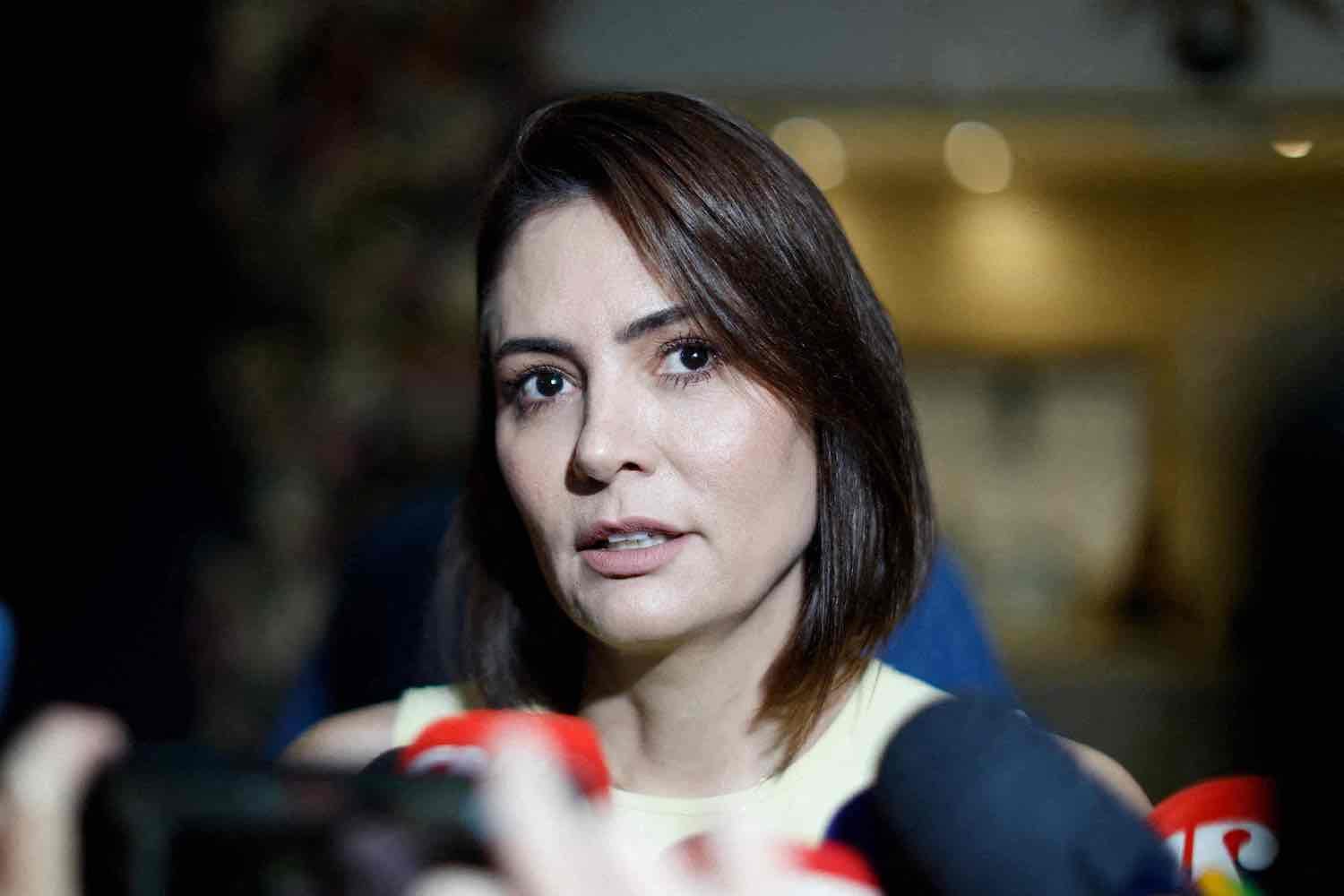
Brazil’s Oct. 4 presidential election is set to pit two men against each other. Far-right Sen. Flávio Bolsonaro is challenging leftist President Luiz Inácio Lula da Silva, with both expected to advance to a runoff. But a woman may play a key role in that contest: former first lady Michelle Bolsonaro, Flávio’s stepmother and the third wife of his father, convicted former President Jair Bolsonaro.
According to opinion polls, more Brazilian women prefer Lula over Flávio. Michelle’s influence could change that—and set an example for how far-right groups can attract women worldwide.
The Bolsonaro movement has spent years trying to strengthen its support among women, largely through Michelle. After Jair lost the 2022 election, his Liberal Party (PL) put Michelle in charge of its women’s organization, PL Mulher. She traveled across Brazil, recruiting new members and encouraging conservative women to enter politics. Bolsonaristas cast her as an ideal: devoted to her husband; guided by God; and, in Michelle’s own words, “feminine, not feminist.”
Michelle’s push far outpaced similar efforts on the left: According to PL Mulher, more than 72,000 women joined the group during her tenure, which ended in June. Between March 2023 and July 2024 alone, the PL added 51,263 female members—more than twice the number added by Lula’s Workers’ Party over the same period. During the 2024 municipal elections, 995 women backed by PL Mulher were elected. Michelle is now running for a Senate seat in Brasília and could eventually compete with Flávio over the Bolsonaro inheritance.
As Michelle’s network of politically engaged women grew, one message held it together: Women could enter public life without giving up their identities as wives, mothers, and Christians. They did not need to portray men as the enemy or embrace feminism to gain a platform.
Yet Michelle’s success revealed a tension within the Bolsonaro movement: Women were encouraged to lead as long as their leadership remained subordinate to men. Michelle has grown her political reach and leverage, but she does not necessarily have an independent base. Her role exists to support male power.
A recent conflict with Flávio revealed the limits of Michelle’s growing autonomy. In June, she opposed an agreement over election endorsements that Flávio and the PL leadership were negotiating in northeastern Brazil. The deal would have undermined conservative candidates who she supported. In a video posted on social media, she accused Flávio of disrespecting and humiliating her. She said he had dismissed her as inexperienced and told her to stay out of the negotiations. Six days later, Michelle resigned as president of PL Mulher.
Eduardo Bolsonaro, a former lawmaker and Jair’s youngest son with his first wife, called the video “immature,” while some Bolsonaro supporters derisively labeled Michelle a feminist. She and female allies who defended her, including Sen. Damares Alves, also faced misogynistic criticism. For the first time, Michelle publicly confronted the boundaries of her influence within her husband’s movement. The episode showed how quickly male right-wing voices can recast political disagreement by women in their camp as disloyalty or emotional instability.
Michelle, however, has something that Flávio needs: her ability to reach women and evangelical voters. Unlike Jair and his sons, who are Catholic, Michelle is a devout evangelical Christian. Much of Brazil’s evangelical leadership initially wanted São Paulo Gov. Tarcísio de Freitas to run as the PL’s presidential candidate, despite the fact that he is a practicing Catholic, with Michelle as his running mate; Flávio was not their first choice.
Soon after the endorsement dispute, Flávio publicly apologized to Michelle and asked her to help him on the campaign trail, and she accepted. Michelle said Flávio “can count on me on social media and he can count on the strength of women spread across Brazil.”
Some observers interpreted the episode as the political choreography typical of the Bolsonaros, who have often leveraged family drama for attention. But even if Flávio’s apology video served his campaign, it did not erase the power struggle within the Bolsonaro movement. If anything, it exposed it.
Michelle has built a large following by framing political participation and ambition in terms that are accessible to conservative women. The so-called tradwife movement—short for “traditional wife”—embraced by parts of the U.S. right has limited reach in Brazil, where women are the main breadwinners in 52 percent of households. Their priorities grow out of everyday concerns about healthcare, public safety, transportation, and income support programs. For millions carrying both financial and domestic responsibilities, there is no traditional household to return to.
In the 2022 book Feminism in Dispute, which I co-authored with Camila Rocha and Esther Solano, we found that many conservative Brazilian women rejected the feminist label while supporting policies long associated with feminism, including equal pay, protection from gender-based violence, and greater women’s political participation. Abortion remained the clearest dividing line, although divisions were accounted for more by age more than by ideology.
Michelle’s Senate campaign is an example of this strategy at work. At an August event, Michelle acknowledged how difficult politics are for women. “We are breaking paradigms,” she said, because women enter politics “to care, to turn their pain into policy.”
The next week, Alves also borrowed from feminist vocabulary, describing Michelle’s support for other women candidates as an act of “sisterhood … which means that one woman does not let go of another woman’s hand.” Alves also said Michelle “has to be the most-voted woman in Brazil.”
That is a plausible scenario. According to polls, Michelle leads her Senate race. In a separate national survey, 15.4 percent of respondents named her as Brazil’s most powerful woman, ahead of first lady Janja da Silva at 9 percent.
Michelle and her allies’ language of “care” and “sisterhood” should not be confused with a women’s rights agenda, however. She has long verbally attacked feminist activists and left-wing lawmakers, particularly in disputes over reproductive rights and gender roles.
Michelle opposes abortion and sexual freedom while defending the traditional family and a patriarchal hierarchy that places women’s authority below that of their husbands. Her public record on domestic violence is thin. In the public statements reviewed for this article, Michelle did not once mention the Maria da Penha Law, Brazil’s landmark 2006 legislation against domestic violence, during its much-commented-on 20th anniversary.
Michelle’s combination of female leadership and anti-feminist politics is part of a broader regional shift. A decade of feminist mobilization across Latin America brought violence against women, reproductive rights, and political representation to the center of public debate. But the far right gained power and pushed back against many of those gains.
The Brazilian left’s failure to produce a competitive woman leader since Dilma Rousseff has given Michelle additional room to grow. In next month’s presidential election, two contests will converge: one for the female electorate and another for the future of bolsonarismo. Michelle may allow the Bolsonaro family to keep a foothold on power even if Flávio doesn’t win. If elected to the Senate, she will gain votes in her own name, an eight-year mandate, and a platform from which she herself could run in the 2030 presidential election.
But that path is far from assured. Religious and socially conservative women are not necessarily Bolsonaro supporters, and many reject the idea that women should submit to men. To inherit the Bolsonaro movement, Michelle will need to build alliances with other conservative women, reach a broader swath of voters, and decide whether she can confront the misogyny within her camp without surrendering to its male hierarchy.
Otherwise, Michelle risks remaining what the Bolsonaro movement originally intended her to be: a woman whose ambitions and authority are limited by its male leaders.
