


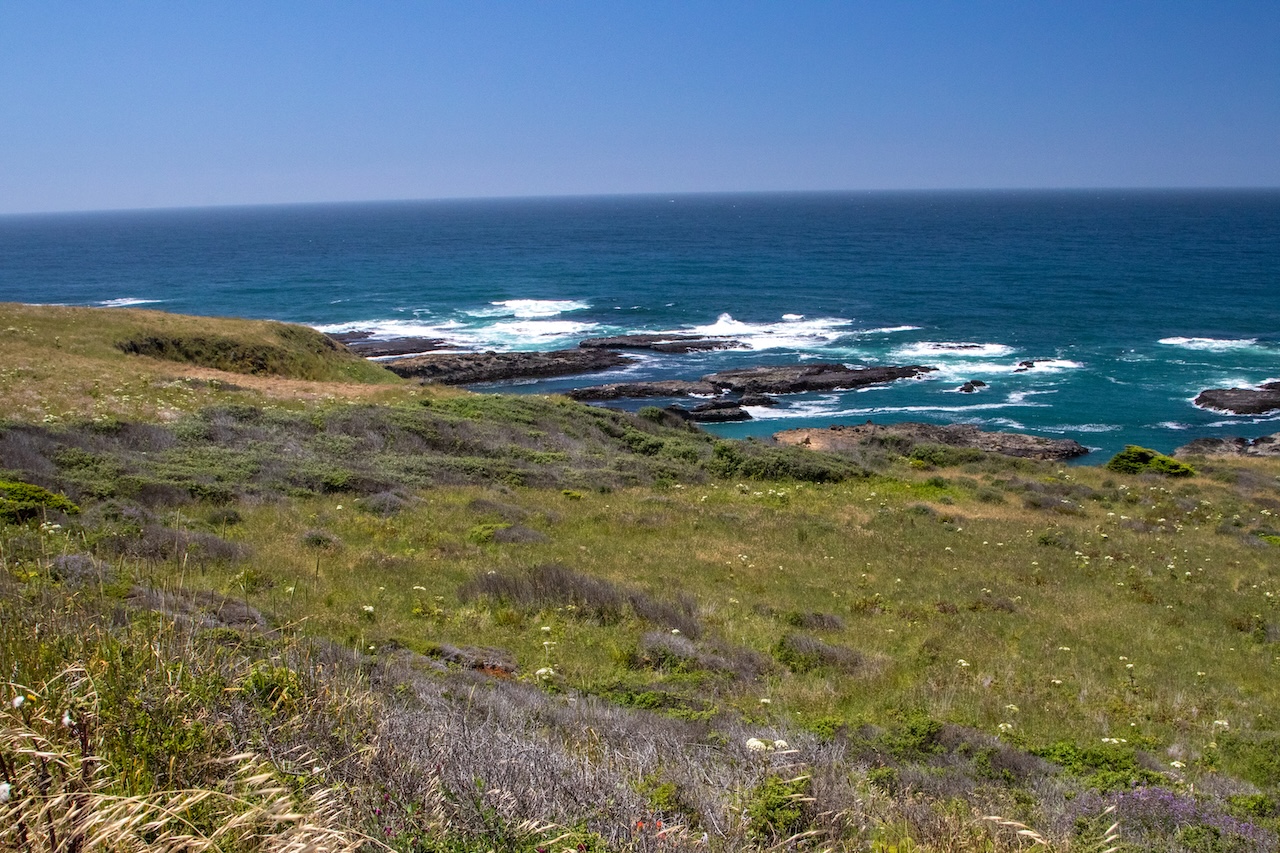
- The U.S. state of California has returned 55 hectares (136 acres) of Northern California coastline, including Blues Beach and the village site of K’etim, to three Coastal Yuki tribes.
- It is the first land Caltrans, the state transportation department, has ever returned to Indigenous ownership.
- Tribes first asked for the site in 2005, after learning looters were digging into archaeological sites and uncovering ancestral remains.
- The tribe hopes to use the land for education and gatherings, but the beach will remain open to the public.
On the Northern California coast, where the tall trees meet the sea, ancestors of the Coast Yuki people lie buried in an old village site above the bluffs in the U.S. state. Yet despite its cultural significance, the land has been owned by the California Department of Transportation (Caltrans) until very recently.
A deed recorded July 6 transferred 55 hectares (136 acres) of that coastline to Kai Poma, a nonprofit founded by representatives of the Coyote Valley Band of Pomo Indians, the Round Valley Indian Tribes and the Sherwood Valley Band of Pomo Indians, the Ancestral Descendants of Coastal Yuki and Yuki.
It is the first time land held by Caltrans has been returned to Indigenous ownership, according to Kai Poma.
“We always felt this was ours,” Eddie Knight, chairman of Kai Poma and historic preservation officer for Coyote Valley Band of Pomo Indians, who is of Coastal Yuki descent, told Mongabay. “It may have been owned privately by somebody, but we still knew it was ours.”
The property sits just south of the small community of Westport, California, about 187 miles (300 kilometers) north of San Francisco. Visitors know the beach here as Blues Beach, but a major village site there is called K’etim by the Coast Yuki and Pomo lineages.
K’etim, according to the tribe’s traditional stories, is “where Seaweed Woman who lived at Mussel Rock met and fell in love with Coyote,” Kai Poma explained in a press release. This origin story “explains the creation of the coastline and its people. These teachings remain alive through the descendants who continue to revere, gather, camp, commune with, and steward their ancestral places.”
In 2005, word reached Knight and others that looters were digging at K’etim and uncovering human and archeological remains. “K’etim has endured substantial damage from off-road vehicle activity and widespread looting of archaeological sites,” Kai Poma stated.
In response, members of Sherwood Valley and Coyote Valley wrote to Caltrans that year asking for stewardship of the site and were granted a meeting. When the land was not handed over, Knight said, “we just kept on being persistent and said ‘give it to us.’”
It took many years of relentless efforts and a new law to make the transfer a reality. In 2021, Senator Mike McGuire wrote Senate Bill 231, specifically authorizing Caltrans to transfer Blues Beach “at no cost to a qualified nonprofit corporation.”
The three tribes formed the non-profit organization Kai Poma to receive the land.
The law requires Kai Poma to keep the land open to the public free of charge, bars commercial development, and returns the land to Caltrans if the nonprofit fails to maintain it or dissolves.
“This is beyond huge,” J. Carlos Rivera, tribal chairman of the Sherwood Valley Band of Pomo Indians, told the Los Angeles Times. “It’s enormous from our tribal perspective that we are basically obtaining the land that our people once lived on before colonization.”
The land is made up of about a half mile (800 meters) of beach, a terrace above the beach of roughly 40 hectares (100 acres), “which has our archaeological sites under it,” Knight said, as well as 16 hectares (40 acres) of old grazing land sloping from Highway 1 down to the ocean.
The sloping ground is the part Kai Poma can build on. Future management plans still need to be agreed upon by the three tribes, but Knight raised the possibility of building a traditional roundhouse, holding ceremonies and hosting an educational program.
The beach will remain open to the public. Cars have been prohibited from the beach by Caltrans but that rule was not strictly enforced. Kai Poma is still deciding how they will manage these issues.

“We want to protect the natural habitat,” Knight said. And to educate youth on “how to harvest our native foods, our sea foods, our seaweeds, our kelps and how to fish. Allowing our youth to get an idea of how they can use it in the future and use it now. It’s going to take a little time, but we do have a plan.”
The nonprofit has held a grant since 2023 for an archaeological survey to identify every site on the property, but could not begin the work, Knight said, until they had secured the deed. Now they plan to move forward and are planning a celebration and ceremony for all eight bands in Mendocino County.
This deed transfer is part of a larger Land Back movement: The push to return land to tribes, Traditional Owners and ancestral descendants of the land.
California has returned tens of thousands of acres to tribes in the past two years. The Yurok Tribe reclaimed more than 19,000 hectares (47,000 acres) along the lower Klamath River, the largest land return in state history. The Tule River Indian Tribe regained 6,890 hectares (17,030 acres) in Tulare County, and the Washoe Tribe of Nevada and California reacquired 4,158 hectares (10,274 acres) of former Sierra Nevada ranchland.
“136 acres of coastal lands have now been officially transferred into tribal stewardship, forever protecting one of the most spectacular stretches of the Mendocino Coast,” McGuire said in a statement. “This agreement, the first of its kind in California, gives the Sherwood Valley Band of Pomo Indians, Round Valley Indian Tribes and Coyote Valley Band of Pomo Indians the rightful opportunity to reclaim sacred lands and cultural traditions on this special piece of earth. And it’s about damn time.”
Banner image of Blues Beach, California with vehicles parked. Image courtesy of Kai Pomo.
First ever U.S. Indigenous Marine Stewardship Area declared in California
FEEDBACK: Use this form to send a message directly to the author of this post. If you want to post a public comment, you can do that at the bottom of the page.
Cite this article
Liz Kimbrough (2026). California Tribes receive beach and ancestral village site back from transportation authority. Mongabay Conservation news. DOI: https://doi.org/10.66709/news-330494

