


- Researchers have designed a model to simulate how widely distributed rooftop rainwater collection tanks combined with smart rooftop sprinkler systems could help moderate urban heat island effects.
- The model used Tokyo as a case study and found temperature reduction benefits inside homes and outdoors during heat waves. The more rooftop sprinkler systems installed, the more significant the cooling benefits would be.
- The researchers say the model could be adapted to predict how the system would help reduce heat in cities around the globe, and serve as an economical natural defense against intensifying global warming. Field tests would be the next step.
It’s a hot summer day in the city. The sun beats down relentlessly on asphalt and concrete, while tall buildings mercilessly snuff out any hope of a cooling breeze, intensifying urban heat island impacts.
Urbanites around the world know the feeling well. And with an increasing number of potentially deadly heat wave days due to a warming climate, it’s only becoming more familiar.
But ask the same city dwellers how they feel when the barometer drops and a soft summer rain breaks the heat. That relief is something a group of researchers hope to artificially replicate using widely distributed rainwater collection tanks and smart rooftop sprinkler systems.
The team, led by Zhonghua Zheng, an associate professor of urban climate and environmental data science at the University of Manchester in the U.K., used machine learning and artificial intelligence to create a new model that can help cities bring down internal temperatures in buildings and even cool outdoors during heat waves. Their proposed system includes a rooftop rainwater collection tank and a sprinkler system that activates at a specific outdoor temperature threshold to water the roof.
Evaporation cools roof temperatures, Zheng explained in a Mongabay interview. “It has a dual benefit to cool both the indoor temperature and outdoor temperature.”
The researchers used Tokyo as a case study due to Japan’s temperate climate, seasonal changes, and leadership in rainwater collection. The model found that the strategy would indeed bring down high surface and air temperatures if widely adopted across an urban setting. The team’s findings were published in the journal Earth’s Future.
Moving forward, Zheng said, “we want to expand [this innovation] to cities all over the world.”
The approach is relatively simple and comparatively economical, using existing rainwater so as not to tax municipal water systems, and offering cooling via well-understood natural principles.
“People [are] already doing rainwater harvesting.” Zheng said. “Some cities are doing water sprinkling, although I don’t know where the water comes from. So then we’re thinking ‘Can we combine this as an integrated system?’”

Battling the heat island effect
Cities are among the areas most affected by climate change. That’s because urban heat islands (UHIs) are much hotter than the surrounding countryside — up to 7° Fahrenheit (5° Celsius) hotter on average in U.S. cities; highly developed urban areas at mid-afternoon can see temperatures 15-20°F (8-11°C) higher.
“Cities have a higher temperature than the natural land,” explained Xuhui Lee, a climate scientist at Yale University in the U.S., who wasn’t involved in the research. That extreme heat is due to “lack of evaporation. If you’re in a place with buildings, wind’s cut off. That’s an important part of warming. Another is human [heat] sources,” including air-conditioning, transportation, and industry, Lee added.
“We found [that the rooftop rainwater sprinkler system] can help to lower … temperatures,” said study co-author Junjie Yu, also from the University of Manchester.
The model found that the systems could lower the number of hours and days in extreme heat wave conditions within certain parameters. The degree of improvement depended on three main variables: Larger tanks meant more water could be used to fight heat. The intensity of the sprinkler system had less overall benefits past a low threshold, while the ambient temperature at which the system was triggered was critical in determining the level of benefit gained.

Rooftop rainwater sprinklers offer other benefits
This simple cooling method could save lives. Many people lack air-conditioning, Yu said. Older adults, people with preexisting health conditions, and the urban poor are disproportionately impacted by heat. A minimum of 35,000 excess deaths were recorded in Europe and thousands more became ill in Asia during heat waves this summer. In addition, Zheng noted that less electricity used for AC helps bring down greenhouse gas emissions.
Another benefit the researchers hope to study is the degree to which widely distributed rainwater collection tanks could decrease urban runoff and flooding due to climate change-intensified downpours. Such extreme precipitation events quickly overwhelm outdated combined sewer outflows, bypassing sewage treatment plants, and allowing raw sewage and other pollutants to flow directly into streams and estuaries in major cities including New York, Paris and London, threatening public health.
“Our integrated system can have different co-benefits,” Zheng said, though the researchers put their strongest emphasis on reducing the UHI effect: Cooler outdoor temperatures during heat waves, and better indoor cooling could save lives.
“There is kind of a chain,” Zheng added. “By using the device, we will reduce heat exposure. By reducing heat exposure, there’s a [positive] health impact.”

Further studies needed for global implementation
The new computer model can be adapted to calculate the impact for different cities in different climate zones, but implementation will take time and commitment.
“I think all the cities in the world can use this model,” Yu said. But he cautioned that rainwater sprinkler systems may not prove to be as helpful in tropical areas, where humidity is already high. “It’s really dependent on [a city’s] background climate.”
When it comes to adapting the systems for poor rural villages and the suburbs, questions remain: What are the costs of installation? How effective is the system if it’s individually installed on a home or building as opposed to being implemented community-wide?
“It’s going to be a local solution,” Lee said. “You need to bring it into the real world first. Set up a few houses and test it out. The idea is cool though.
“You need both big solutions to reduce greenhouse gases, and then you have little solutions to help with the warming that is going to happen in the next few decades,” Lee added.
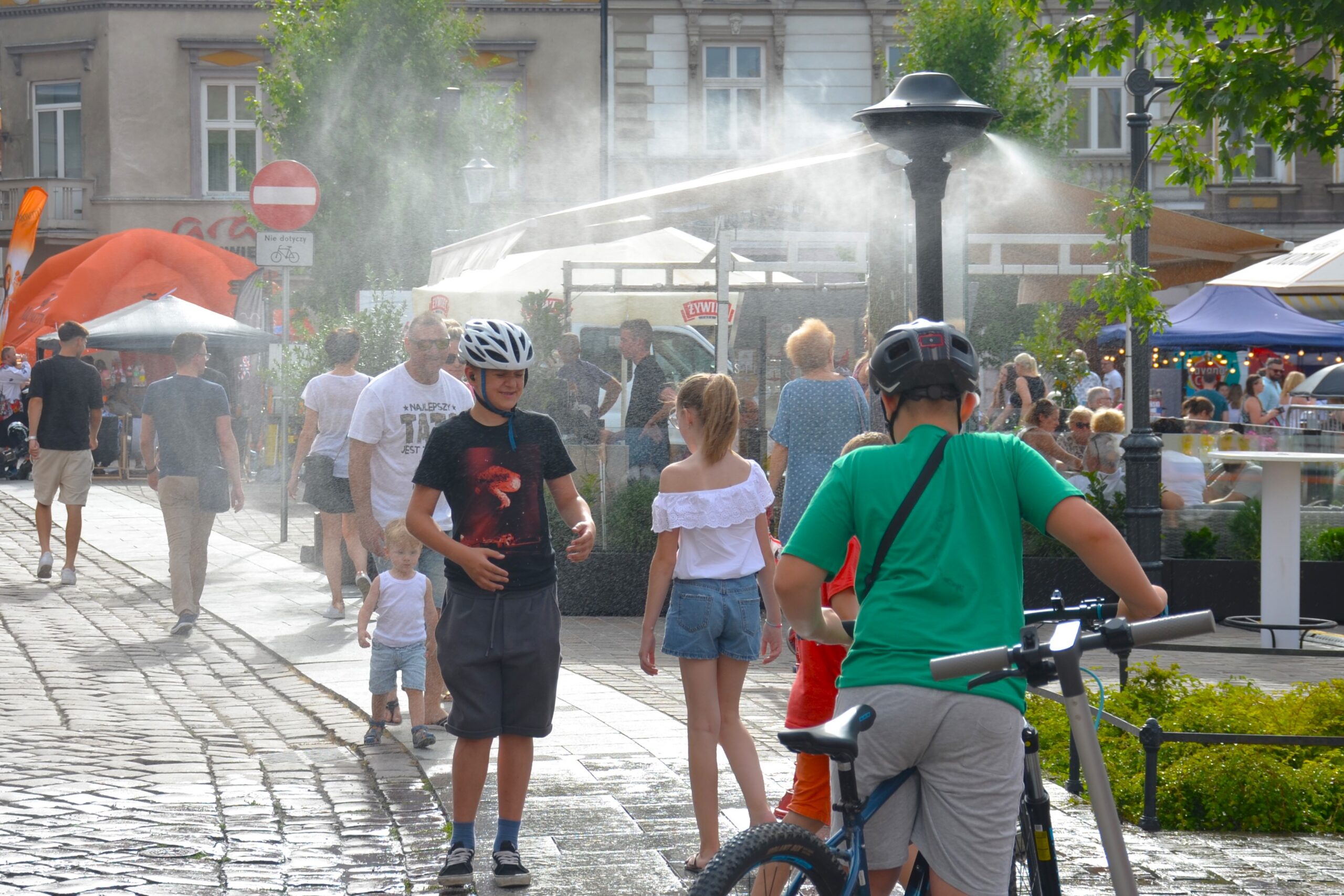
Banner image: Residents of Bielsko-Biała, Poland, walk through sprinklers to stay cool during a heat wave. Image by Silar via Wikimedia Commons (CC BY-SA 4.0).
Urban heat islands have solutions; many tropical cities can’t afford them
World must look to the past to prepare for likely unprecedented El Niño
Six things to know about Asia’s heatwave and the health impacts
Citation:
Yu, J., Oleson, K. W., Qin, Y., Zhao, L., Topping, D. O., & Zheng, Z. (2026). Optimizing the rainwater harvesting and roof sprinkling system to adapt to urban extreme heat. Earth’s Future, 14(8). doi:10.1029/2026ef008876
FEEDBACK: Use this form to send a message to the author of this post. If you want to post a public comment, you can do that at the bottom of the page.
Cite this article
Nick Ruggia (2026). Rooftop rainwater sprinkler systems could help cool warming cities, study says. Mongabay Conservation news. DOI: https://doi.org/10.66709/news-330065

