


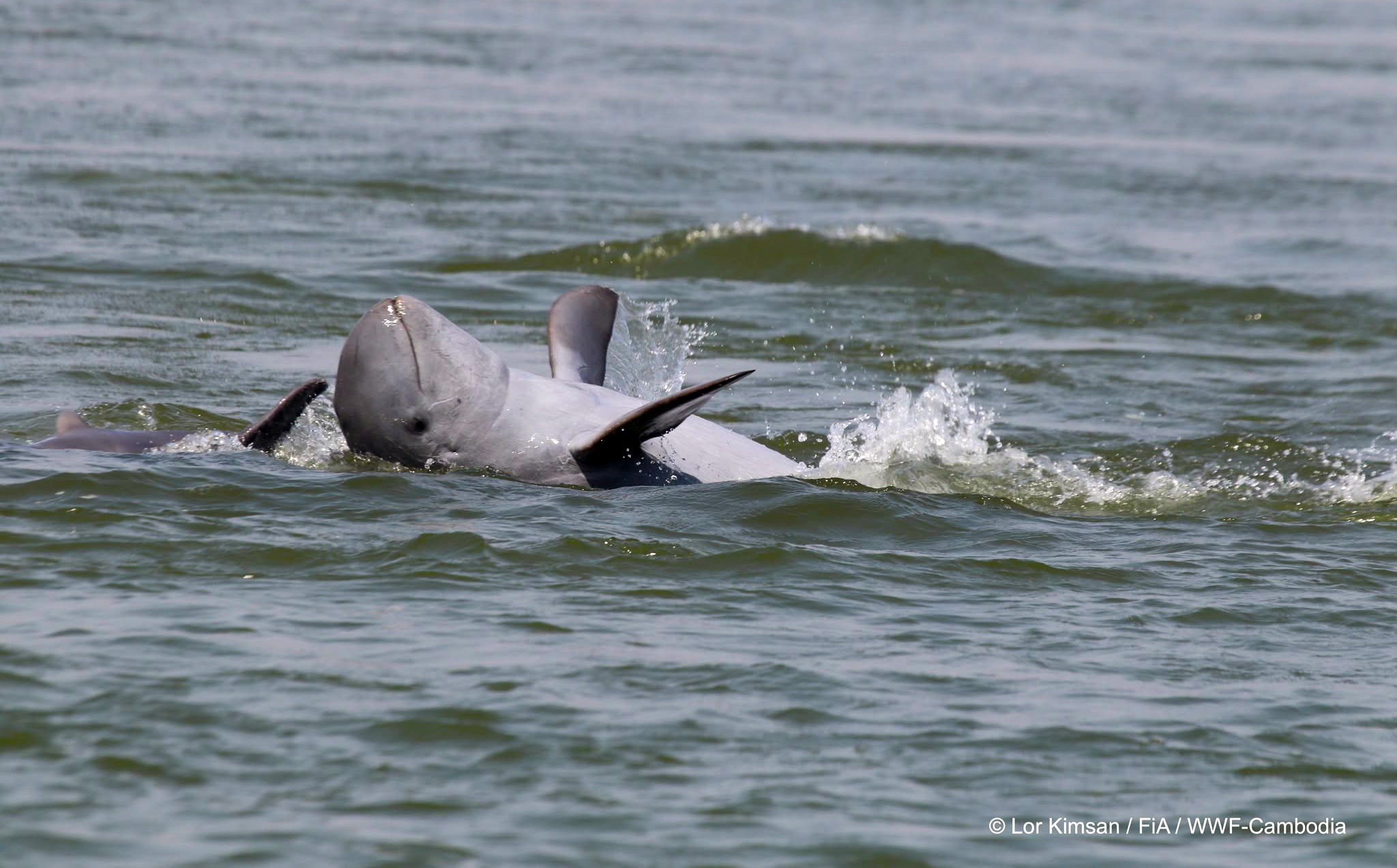
- Irrawaddy dolphins, the Mekong River’s sole cetaceans, are viewed as sacred animals by Mekong communities, and are also an important source of tourism revenue.
- The species’ population has dropped steeply since the 1990s, due to hunting, entanglement in fishing gear and habitat degradation.
- The Anlong Chheu Teal pool, along the Laos-Cambodia border stands as a cautionary tale: The pool’s last dolphin died in 2022, and tourism subsequently cratered.
- Six calves were confirmed to be born this year in Cambodia, increasing the population to 118 and bringing hope that the species can rebound if dolphins and their habitats are protected
KAMPI, Cambodia — At nine in the morning, the sun beats down on the Mekong River as Heang Koeurn turns off the motor of his boat and bobs on the water. He has done this every morning for 11 years, and he still leans forward the same way when he waits: elbows on his knees, eyes scanning the water for a gray curve to break the surface. Finally, he spots what he’s looking for: Irrawaddy dolphins, the river’s sole cetaceans.
Just meters away, a boat carries about half a dozen foreign tourists who squint and point as, one after another, the dorsal fins of a group of Irrawaddy dolphins (Orcaella brevirostris) crest above the water.
“Irrawaddy dolphins are very important for our community,” Koeurn says, drifting his boat slowly on the water. “People here can make more income from tourists by driving them to see the beauty of Irrawaddy dolphins.”
But the Mekong River, a lifeline for millions of people across Southeast Asia, is in ecological crisis, threatening the survival of Irrawaddy dolphins — and with it the livelihoods and traditions of communities along the river.
Habitat in tatters
The Mekong River cuts through northern Stung Treng province along Cambodia’s border with Laos, where deep pools shelter unique aquatic species such as the giant freshwater stingray.
The Kampi pool, a 60-meter- (nearly 200-feet-) deep stretch of the river in Cambodia’s Kratie province, is one of three deep pools that are home to the Mekong’s last surviving population of Irrawaddy dolphins.
The population of these dolphins in Cambodia’s stretch of the Mekong River has collapsed from an estimated 200 individuals in the late 1990s to a little over 100 today, with losses driven by hunting, bycatch in gillnets, and habitat degradation. The species has already been lost in most of its historic range, which once spanned the Mekong Delta, the Tonle Sap Lake and the Mekong’s tributaries.
“Dolphins are important for various reasons,” says Ian Baird, professor of geography at the University of Wisconsin-Madison, U.S., who has researched the impact of large dams in the Mekong. “They have economic value related to tourism. They also have value in relation to cultural and environmental heritage.”
“They are a source of Cambodian national and local pride,” he says. “They may also inspire people to protect the river and its tributaries from the impacts of more dams in the future.”
Irrawaddy dolphins are regarded as sacred animals in both Laos and Cambodia, with communities across the Mekong River in Cambodia treating the dolphins as representing the ancestral spirit of the river.

Despite ongoing conservation efforts and the species’ spiritual and economic importance, its future is at risk.
“The main threats are gillnets and electrofishing. Many people in our community are aware of the importance of conservation but people from other places tend to intrude into our community fishing grounds to commit these crimes,” Koeurn says.
The proliferation of dams has also profoundly changed the ecology of the river. To date, there are more than 160 operational dams along the Mekong River and its tributaries, including 13 dams on the mainstream. Baird says that upstream dams are not known to be directly killing Mekong’s Irrawaddy dolphins, but they are altering the river’s hydrology, degrading seasonally flooded forests and changing fish communities that dolphins depend on for food.

The fight against illegal fishing
Veang Tino, a patroller based at the Kampi Conservation Centre, says the main killer of Irrawaddy dolphins is not overt poaching for meat or trade, but accidental entanglement in fishing gear — especially gillnets and long-line hooks set illegally in core habitats. Calves are particularly vulnerable, often dying when their mothers become trapped or when they stray into nets themselves.
Electrofishing is banned throughout Cambodia, but gillnets are only prohibited within protected core habitat zones along a 180-kilometer (112-mile) stretch of the river in Kratie and Stung Treng provinces, established in 2012 to conserve the dolphins. In the same year, the fisheries department employed 72 river guards to patrol this part of the Mekong River to stop fishers from using illegal methods in the Irrawaddy dolphin habitat. By 2025, the Ministry of Land Management designated the habitat as state land.
The depth of the Kampi pool helps shelter the mammals from fishers’ nets, but they are more vulnerable when they enter surrounding waters, Tino explains.
Officials say law enforcement has improved but remains uneven. In 2022 alone, about 36,000 meters (118,110 feet) of gillnets, 7,000 fishing hook nets, and 500 m (1,640 ft) of mesh fishing nets were confiscated and destroyed in the protected zones.


“We cannot leave Irrawaddy dolphins behind as they are the Mekong River’s ecological treasure. The use of gillnets is the main threat to them. That is why conservation efforts must be enforced to combat the illegal fishing methods,” Tino says.
“We need everyone, from the local community themselves to the government, working in tandem with each other to conserve Irrawaddy dolphins,” he says. “Law enforcement does not have full capacity to address these issues.”
He adds that patrollers are generally concentrated around the Kampi pool, following the dolphins’ behavior patterns. But illegal fishers are able to observe and adapt to the patrollers’ patterns, while patrols have limited numbers and lack equipment.
At the Kampi river guard station, a sparse building on the river shore adorned with faded river maps and fish identification posters, patroller Kem Sophat says river guards face real physical risk when confronting illegal fishers, who sometimes carry weapons and have been known to use violence to protect their operations.
Sophat also complains about river guards’ low income from their taxing work. River guards, he adds, earn $5-$7.50 per day of patrolling, while using their own boats for patrols and paying for their own meals.
“We come from other parts of Kratie,” Sophat says. “It is quite far from where we are based to do patrolling. The income is small, but it is out of the goodness of our hearts we keep doing this job because we specialize in patrolling.”

‘Like losing a star from the sky’
“We should care about these dolphins for many reasons. Intrinsically they are a very beautiful part of nature,” says Frances Gulland, chair of the U.S.-based Marine Mammal Commission, an independent government agency. “We lose them, we lose a species, another species lost from the earth, which is like losing a star from the sky. For communities along the Mekong, they provide livelihoods through ecotourism.”
For one Cambodian village, the cost of failed conservation is impossible to ignore. Anlong Chheu Teal dolphin pool, which straddles the Laos-Cambodia border, lost its last Irrawaddy dolphin in 2022.
“Before, we didn’t have enough boats to drive to see Irrawaddy dolphins and Mekong treasures like the flooded forest, when there were still Irrawaddy dolphins, and the ecotourism was well organized,” says Phoy Vanna, community leader of Anlong Chheu Teal. “But the number of tourists has declined since the last Irrawaddy dolphin died in 2022.”
Vanna recalls that in 2007 there were eight dolphins in this stretch of the river. By 2018, only three remained.

The last one, a male dolphin named “the lonely dolphin” by the community, was reported dead on Feb. 15, 2022, after being entangled in illegal fishing gear — marking the extinction of the Irrawaddy dolphin in this section of the Mekong River. Vanna says that dolphin bones were displayed for visitors at the community hall to commemorate the species’ presence and importance to the community.
He says he has witnessed firsthand the change in the Mekong. He points to fluctuating water levels caused by dam construction and climate change as a major threat. “These changes are threatening the river’s ecosystem,” he says.
When a Mongabay reporter visited the Anlong Chheu Teal dolphin community in late April this year, the Don Sahong Dam could be clearly seen just a short distance away. It is located less than 2 km (1.2 mi) from the Cambodian border in southern Laos, and has been operating on the Mekong since 2020. Researchers have identified the site as a critical gateway for fish migration throughout the Lower Mekong Basin.
Interviews with villagers echo Vanna’s assessment. “When all the dolphins died, only about 40% of tourists still came to see the tree roots, the waterfall and other sites along the river,” one boat driver says. “Things are changing for the worse,” he laments. “It’s hard to make a living.”


A new sign of hope
By late June, conservationists had confirmed at least six calves born this year along the 120-km (75-mi) stretch of the Mekong that runs through Kratie and Stung Treng provinces — five in Kratie and one in Stung Treng — lifting the estimated population to 118 individuals. Officials say this is a strong signal that the population is still reproducing and capable of recovery if threats are kept in check.
I Sanaroth, Kampi fisheries chief, tells Mongabay that gillnets in particular are still used within the protected habitat zones but at a small scale. The conservation work, he adds, is undertaken by the Fisheries Administration (FiA), with financial and technical support from WWF-Cambodia and other development partners.
In 2014, the FiA and WWF-Cambodia launched a joint initiative to balance Mekong dolphin conservation with community livelihoods, helping fishing households reduce their reliance on wild fish while involving them in protecting aquatic ecosystems.
“The population of the Mekong Irrawaddy dolphins has increased due to joint conservation. Our work is not done. Authorities, with support from conservation groups, are stepping up patrols and prosecutions to hold illegal fishers accountable,” Sanaroth says.
For now, in Kratie at least, the mornings still bring the same ritual: boats gliding out before the heat sets in, engines cutting near known feeding grounds, and the wait for a gray curve to break the surface.
Banner image: A newborn Irrawaddy dolphin calf, approximately three days old, was seen on Feb. 17, 2026, by a research team from the Kratie Fisheries Administration and the WWF-Cambodia research team, at the Kampi Dolphin Viewing Site in Cambodia’s Kratie Province. Image © Lor Kimsan / WWF Cambodia.
Irrawaddy dolphin death in Thailand’s Songkhla Lake underscores conservation needs
Nine countries sign global pact to protect endangered river dolphins
Citations:
Baird, I. G. (2011). The Don Sahong Dam: Potential impacts on regional fish migrations, livelihoods, and human health. Critical Asian Studies, 43(2), 211–235. doi:10.1080/14672715.2011.570567
Golden, C. D., Shapero, A., Vaitla, B., Smith, M. R., Myers, S. S., Stebbins, E., & Gephart, J. A. (2019). Impacts of mainstream hydropower development on fisheries and human nutrition in the Lower Mekong. Frontiers in Sustainable Food Systems, 3, 93. doi:10.3389/fsufs.2019.00093
Krützen, M., Beasley, I., Ackermann, C. Y., Lieckfeldt, D., Ludwig, A., Ryan, G. E., … Spencer, P. B. S. (2018). Demographic collapse and low genetic diversity of the Irrawaddy dolphin population inhabiting the Mekong River. PLOS ONE, 13(1), e0189200. doi:10.1371/journal.pone.0189200
