


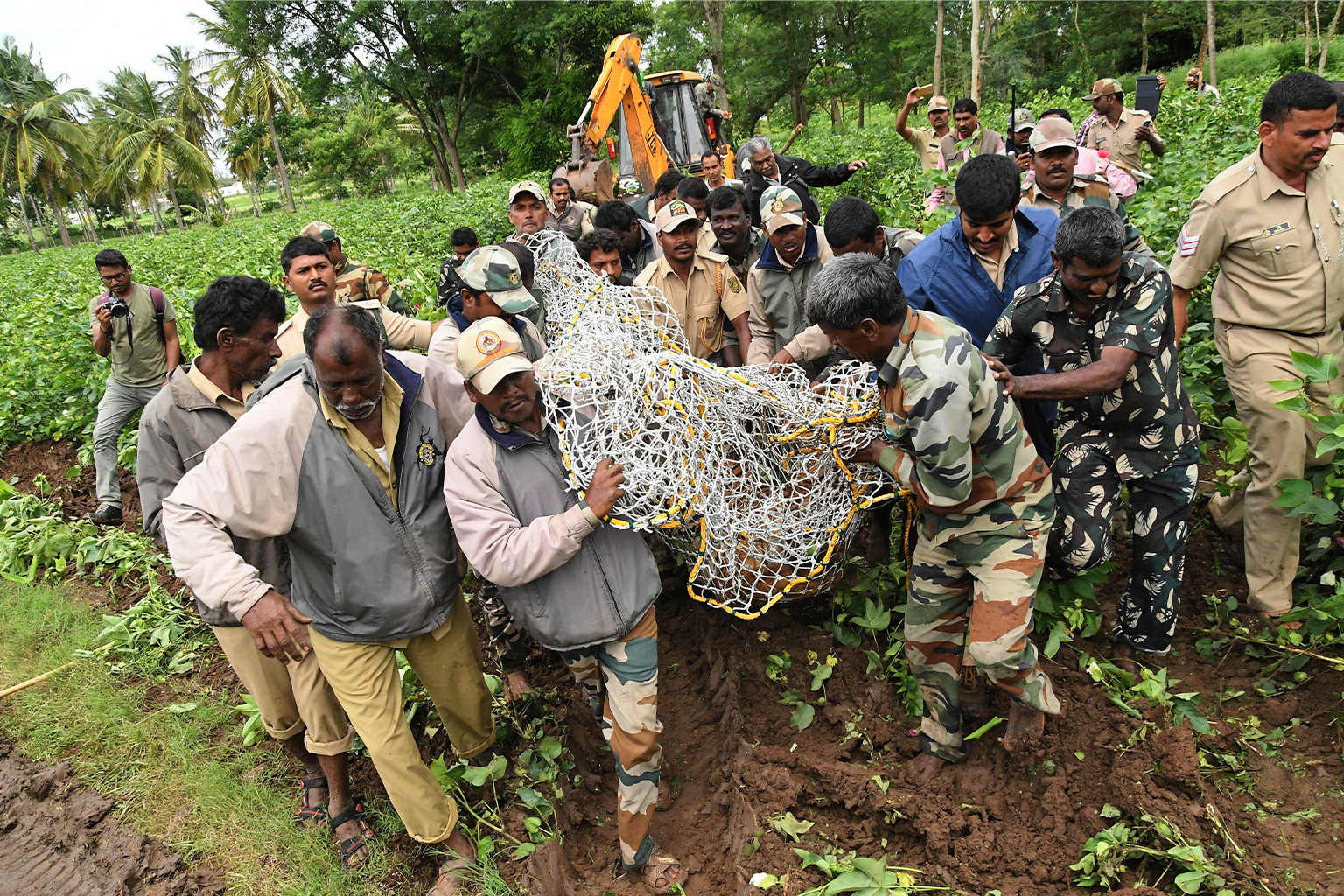
- As tiger populations in India grow and disperse beyond protected areas, encounters with people are increasing, prompting repeated capture and relocation operations by the forest department.
- High density doesn’t necessarily mean India has too many tigers. Experts caution that a region’s carrying capacity is influenced by available habitat and prey, the human population and other factors.
- While some landscapes support large tiger populations, potential habitat is relatively empty in other areas. Distribution and landscape management are top challenges, conservationists say.
- With around 30% of India’s tigers living outside its 58 tiger reserves, a landscape-scale management that maintains and reconnects wildlife corridors is crucial to keep both people and tigers safe, as well as careful monitoring of dispersing tigers, and better management of human-wildlife conflict.
Forty-five-year-old Mahadeva Gowda was tending to his cotton farm in the village of Badagalapura in the southern Indian state of Karnataka when a tiger lunged at him from behind. He was caught unaware: He says he wasn’t aware that the forest department was trying to capture a tiger roaming through the area. Before he realized what was happening, the tiger swiped at his face, severely injuring his eyes and part of his face.
After multiple reconstructive surgeries, Gowda has been left to live the rest of his life blinded, without eyes, his mouth only able to open partially, and his speech slurred.
His wife, Indrani, says survival is extremely difficult for the family: Gowda was the household’s breadwinner, and now, he can’t work. He’s now become fully dependent on his wife for even his most basic needs.
The incident occurred in mid-October 2025. Two weeks later, another farmer, 55-year-old Rajashekarappa, was grazing his cattle in a field when he encountered a tiger: It was fatal.
Badagalapura and other villages that regularly report tiger encounters sit on the edge of the forest, placing them within what the forest department considers a “tiger landscape.”
“Tigers have been present in this landscape for centuries and they constantly move here,” says S. Prabhakaran, who served as conservator of forests and oversaw operations at Karnataka’s Bandipur Tiger Reserve until earlier this year. The 1,456-square-kilometer (562-square-mile) park is home to between 154 and 175 tigers, according to a 2024 estimate by India’s National Tiger Conservation Authority (NTCA).
But the situation is changing, Prabhakaran says. “There is more movement, and so more such encounters with humans during the mating season, which is roughly from October to December.”
Some tiger reserves are overflowing: About 30-35% of India’s estimated 3,682 tigers now live outside protected areas, according to officials. Meanwhile, other reserves are nearly empty: 18 tiger reserves have fewer than 10 of the big cats living inside them, including five reserves with none at all, according to a news report.
In the forest fringes of Karnataka, human-tiger interactions are being increasingly reported, some of them deadly for humans. Under pressure from residents, the Karnataka Forest Department is more frequently capturing tigers that venture near homes, settlements or farms.
Forest department records show 30 tiger captures between September 2025 and May 2026 across the state. All but two of the cats were released back into the wild: One aged and injured tiger was moved to a zoo, while the another, an injured male, was moved to a rehabilitation center.
These incidents aren’t restricted to a few forest patches in Karnataka. Captures are happening near tiger reserves across the country, including Bandhavgarh in Madhya Pradesh state and Tadoba-Andhari in Maharashtra. The incidents point to an increasing number of tigers moving into human-dominated spaces.
But whether relocation is an effective solution for the broader problem remains to be seen.

Tigers on the move
There seem to be two main reasons why tigers move into areas where conflict with humans is more likely, says Kumar Pushkar, Karnataka’s principal chief conservator of forests (wildlife). One is a basic biological imperative: the search for territory. Young cats must disperse to find unoccupied habitat.
The other reason, Pushkar says, is the inability to hunt effectively. Old or injured tigers are more likely to approach human settlements in search of easy prey: livestock. Hunting is tough even for healthy tigers, much less elderly or impaired cats. “On an average, they attempt 20 times to get one prey,” Pushkar says.
He emphasizes that tigers generally don’t seek out humans as prey. Conflict usually comes during sudden encounters.
Tigers that venture near villages or farmland are targeted for capture and then released back into the core area of the forest. The only exceptions are wounded or aged tigers deemed no longer fit to hunt, Prabhakaran says. These individuals, Pushkar says, “are sent to the rehabilitation centers or the zoo.” About 100 tigers are caught and moved to zoos each year across India, according to a media report.

Translocation as emergency response
With the large number of tiger captures, there have been allegations of mistaken identities, where authorities catch and relocate the wrong cat.
Prabhakaran dismisses these allegations, often raised by villagers. He says tigers are captured after careful verification of their identities through camera-trap images. Tigers’ stripes are unique, like a human fingerprint, so a photo can positively identify an individual.
But removing a tiger from its territory isn’t necessarily the end of the story. Sometimes the cat returns to its former territory; other times, its removal disrupts the territorial balance.
“In tiger landscapes such as Bandipur, even if we capture a problem tiger, it is quickly replaced by another dispersing tiger,” Prabhakaran says. That can upset the social structure and spark territorial fights. If a dominant male dies, the male that takes over may kill its rivals’ cubs.
Y.V. Jhala, senior scientist and former dean of the Wildlife Institute of India (WII), says he doesn’t think that tigers involved in deliberate attacks on humans should be released back into the forest. He says there’s a low chance of them establishing themselves or surviving, since there could be other tigers already entrenched there. “They will try to get back home — or disperse. So basically, you’re moving a problem from one area to another.”
Government officials generally defend these efforts as part of the guidelines they’re mandated to follow. Among them is Vaibhav C. Mathur, a senior forestry official with Project Tiger at the Ministry of Environment, Forest and Climate Change. He points to successful translocations where cats have been moved from high-density source populations to areas with fewer tigers.

One example is a tigress named Zeena, who was translocated from Tadoba-Andhari Tiger Reserve to Similipal Tiger Reserve in 2024, some 1,000 km (about 620 mi) away. Though she wandered across three states after her release, sometimes travelling 26 km (16 mi) a day, she was recaptured and returned to Similipal, where she settled and currently lives.
“In carnivores, the period immediately following release often involves an exploratory phase, during which the animal moves extensively while assessing the new landscape,” Mathur tells Mongabay in an email. “This is generally followed by a settling phase and, eventually, a resident phase once the animal establishes a stable home range.”
Zeena eventually found a mate, and in June 2026, she gave birth to four cubs.
Some reserves, such as Bandipur and Nagarhole in the Western Ghats, are reaching their carrying capacity, Mathur says. This wasn’t unexpected. Since India convened the National Tiger Conservation Authority in 2006 to lead management and conservation efforts, officials anticipated that someday, if recovery was successful enough, tigers would start spilling out of the reserves and dispersing into human-dominated landscapes, leading to more interactions with people.
India’s tiger recovery
India’s tiger conservation story dates back half a century, when tigers had declined in alarming numbers. The 1972 tiger census estimated that just 1,827 remained. Even that number may have been inflated, as the cats were tallied using pugmarks — pawprints — a method since abandoned because of inaccuracy: It was easy to count the same animal multiple times.
This shockingly low estimate prompted the launch in 1973 of Project Tiger, by the government of then-Prime Minister Indira Gandhi. It began with nine tiger reserves, today boasts 58 and is the world’s largest tiger conservation program. Still, the illegal trade in tiger skins, bones, claws, and other body parts continued to drive large-scale poaching, threatening tigers across India and the rest of their range.
In India, the wake-up call came when every tiger disappeared from Sariska Tiger Reserve in the northern state of Rajasthan, exposing poor protection and monitoring. The 2006 tiger assessment estimated that just 1,411 tigers were left. This sparked creation of the National Tiger Conservation Authority.
India’s tiger population has rebounded since then. The 2022 census, the latest, estimated 3,682 tigers.
However, with success comes new challenges in the world’s most populous nation, home to nearly 1.5 billion people. As tigers recover, protected areas reach capacity, and more land is cleared to accommodate a growing human population, the cats are dispersing into shared landscapes, with rising rates of human-tiger interactions.
K. Ullas Karanth, one of the world’s foremost tiger experts, says the emerging conflict hotspots need to be viewed against the much larger backdrop of India’s tiger recovery.
“While there are now several places where high tiger densities and human-wildlife conflict are becoming concerns, these remain a very small fraction of the country’s estimated 400,000 square kilometers [about 154,000 square miles] of tiger habitat,” he says.
Experts say that high-density tiger hotspots need to be understood as part of a longer trajectory: The same conservation success that brought tigers back is now creating new management challenges in some landscapes.
“In a very broad perspective, you have to see it as a consequence of some conservation success,” Karanth says.

The new challenges
Rising conflict raises several critical questions about India’s conservation paradigm. Have some forests reached their carrying capacity for tigers — and how should carrying capacity be determined? Are shared landscapes being managed well enough to facilitate coexistence between humans and tigers? And how can the NTCA ensure that future conservation success is measured not only by tiger numbers, but also by better coexistence, healthy prey populations, and secure wildlife corridors that allow tigers to move, as they must?
“Carrying capacity is already a part of India’s legal framework for managing tiger reserves, and several reserves are already operating at or near this level,” Mathur says. He adds that the NTCA issued guidelines about a decade ago for actively managing tiger populations. States were asked to identify suitable habitats that could support additional tigers. The idea was that, where necessary, tigers from areas with very high populations could be moved to these less-populated landscapes.
K. Ramesh, a top human-wildlife conflict expert with the Wildlife Institute of India, cautions against concluding that India’s tiger population has exceeded the carrying capacity of its forests. Carrying capacity, he says, has three dimensions: “numerical carrying capacity, ecological carrying capacity and social carrying capacity.”
Numerical carrying capacity refers to how many tigers can occupy a given space. However, he says this is difficult to apply because forests are not uniform and tigers have home ranges that vary widely, from around 20-200 km² (7.7-77 mi²), depending on the quality of the habitat and amount of available food.
This approach can be problematic, Ramesh notes. “The numerical concept does not hold true for tigers because it is not like a room where every space is equal.”
Karanth says India’s tigers are not well distributed. “Based on the available habitat, India could potentially support 10,000 to 15,000, or even 15,000 to 20,000 tigers,” he says. “The issue is that a large proportion of the potential habitat, perhaps 80%, remains vacant or has very low tiger densities, while the majority of tigers are concentrated in roughly 20% of the habitat.”
The second consideration, ecological carrying capacity, considers the resources needed to sustain a population “comfortably and indefinitely,” Ramesh says.
Ecological carrying capacity includes the availability of prey and water, the quality of habitat or damage to landscapes by development or weather events such as drought and floods, and other factors, experts say.
But this is dynamic, Ramesh says. “If the prey population increases, the tiger population can also increase.”

Ramesh voices another important consideration. “How many people can occupy a landscape without creating conflict with wildlife?” That’s social carrying capacity, which he notes isn’t well understood.
Wildlife can’t be protected without the support of the people who share the landscape with them, so social carrying capacity — how people perceive and respond to wildlife — is a crucial factor.
Therefore, the question isn’t simply whether some of India’s forests have reached carrying capacity, but what the parameters of carrying capacity are. Some experts say more study is needed to understand how many tigers the available habitats can support and, equally importantly, where those tigers are located.
Jhala has a different take. “If we had only about 100 or 200 tigers, then every tiger mattered. But we probably have over 4,000 tigers. We can afford to lose a few tigers for the good of the species’ long-term conservation,” he says.
“It’s important to be mindful about people’s attitude towards tigers,” he says. “If the local community turns hostile, there could be a backlash which could set back decades of tiger revival efforts.”
Communities with a long history of living alongside tigers often have a higher tolerance and more experience managing interactions safely than those who haven’t lived with predators for decades, or in some cases, a century.
Jhala proposes a case-by-case approach. “So if it’s a man-eating tiger, it needs to be dispatched [killed], because life in a zoo is pathetic. ‘Cattle lifters,’ if they are predating on cattle in the forest, they can be ignored.”
But context matters, he says. “If a tiger is coming to human settlements to lift cattle, that needs to be handled differently, as it can escalate into more severe conflict.” But he notes that most states have adequate compensation for livestock predation.”
Jhala says government protocols need to be revised since they were created when tiger populations were much lower. “We need to be more proactive with solutions and less reactive,” he adds.

Landscape management — a long-term solution?
With the world’s largest wildcat increasingly coming near to farms and human settlements, experts note that landscape management is key to tiger conservation. However, some, including Karanth, say the overmanagement of protected areas may have led to overly large populations in certain protected areas, including Bandipur.
He says creating watering holes within reserves and converting forest patches into grasslands to increase the abundance of prey have lowered tiger mortality rates, which, in turn, have increased conflict near overpopulated parks.
Jhala concurs. “We shouldn’t try to increase the tiger numbers beyond a certain limit through intense landscape management. The role of an umbrella species to conserve biodiversity shouldn’t be meddled with,” he says, adding that tigers regulate their own density depending on the quality of habitat and food availability.
However, forest department officials argue that these interventions keep tigers within the forests, and introducing favored prey such as sambar and spotted deer into areas with few tigers is one way they prepare the habitat for tiger translocations.
Mathur, however, agrees that excessive habitat manipulation may artificially increase prey populations and, consequently, predator densities grow beyond the natural carrying capacity of the landscape. “This may lead to greater dispersal of tigers into adjoining human-dominated areas or an increase in intra-specific and territorial conflicts among animals,” he says.
But Mathur adds that habitat interventions are calibrated to the carrying capacity of the landscape. If a tiger reserve has reached its carrying capacity, habitat interventions should generally be limited to what is needed to maintain the existing tiger population, he says.
The rise in human-tiger conflict also needs to be viewed in the context of how people use and occupy land, according to Ramesh. While tiger numbers have increased, India’s human population has grown from around 300 million when the country gained independence in 1947 to nearly 1.5 billion today, with expanding economic and recreational use of landscapes.
“The conflict question revolves around that, not around wildlife. It revolves around people,” Ramesh says.

Tigers outside tiger reserves
Ramesh suggests a broader approach that identifies wildlife-dominated areas, human-dominated areas, and the interface between the two, noting that “at the landscape or regional level, zoning may be the way forward.”
This doesn’t mean redrawing existing protected area boundaries. Instead, areas outside tiger reserves that are used by tigers should also be managed for their ecological function, Ramesh says. Since almost a third of India’s tigers live outside tiger reserves, a landscape approach is increasingly important.
One problem, Ramesh notes, is that India doesn’t have a land-use policy, and a national or regional policies that includes wildlife could help reduce conflict.
Mathur says a new “Management of Tigers Outside Tiger Reserves” initiative provides a road map for the future. The environment ministry has allocated 887 million rupees ($9.33 million) to the project, which will fund monitoring, measures to reduce conflict, staff training, public awareness and efforts to increase prey numbers.
Mathur adds that artificial intelligence and other technical tools are now being extensively used in tiger management. “Drones are being deployed for surveillance in difficult terrain, assisting not only in wildlife monitoring but also in preventing wildlife crime by detecting illegal entry and other unauthorized activities within protected areas.”
He says the government recognizes the importance of maintaining connectivity between important habitats, which means protecting or restoring corridors to prevent isolation and inbreeding.


The National Wildlife Action Plan, the country’s broad policy framework for protecting wildlife and their habitats, advocates a landscape-based approach that considers “the ecological significance of habitat connectivity and the movement ecology of tigers and other wildlife species.”
The NTCA has identified important tiger corridors nationwide, and state governments are incorporating these wild pathways into their plans for conserving tigers under India’s wildlife protection law.
However, while the country is relinking some habitat, rapid development — including road and infrastructure construction — is severing corridors and threatening forests.
Mathur says that under law, the “ecological integrity and connectivity” of corridors must be maintained.
A way forward
The challenge has now shifted to managing where those tigers live and move, whether suitable habitats remain connected, and how people sharing these landscapes can coexist with them.
But for people living along the edges of tiger habitats, the concern, the fear, is real.
For Gowda and families like his, a larger conservation transition offers little comfort unless it also makes living alongside tigers safer.
India’s next phase of tiger conservation, experts say, may depend as much on managing the landscapes between protected areas as protecting the tigers within them.
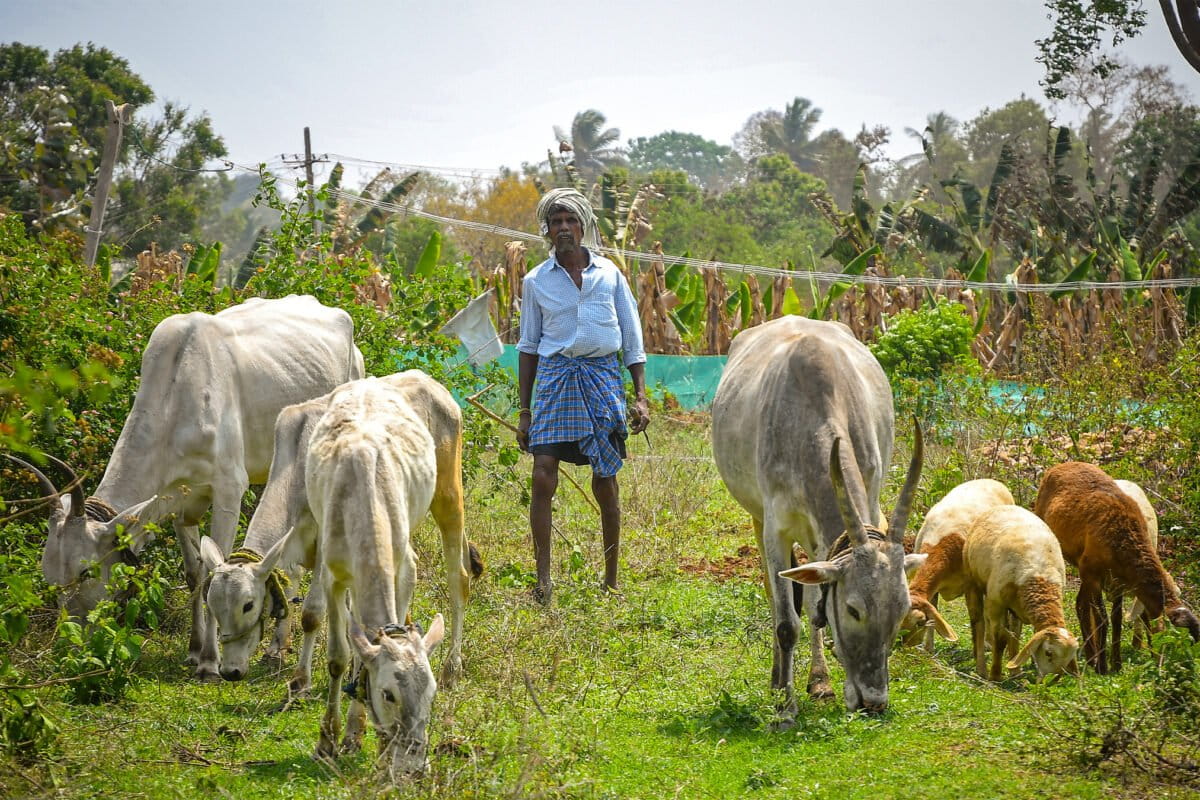
Banner image: Swami Gowda stands with his herd of sheep and cattle taken out for grazing near Badagalpura village, India. Gowda said he used a machete to fend off a tiger after it attempted to attack one of his sheep. Image by Ashishkrishna HP.
India’s tiger numbers are rising. Protecting their pathways is next
By protecting tigers ‘we save so much more,’ says Debbie Banks
FEEDBACK: Use this form to send a message to the author or editor of this post. If you’d like to post a public comment, you can do so at the bottom of the page.

