


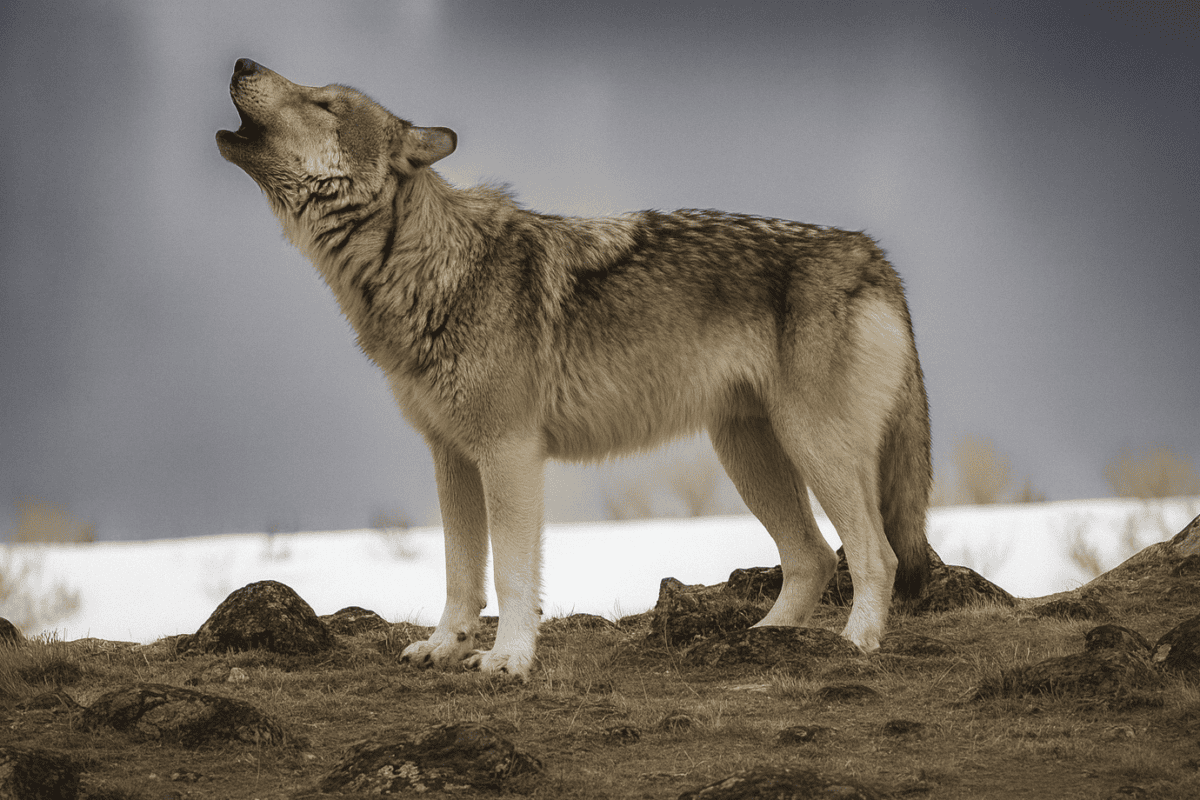
- Wolf howls have mystified listeners for ages, prompting a range of questions. For more than three decades, wildlife biologists, using traditional research methods, have sought answers from the wolf packs of Yellowstone National Park, among the most studied on Earth.
- Jeff Reed, a native Montanan, linguist and computer engineer, has joined the Yellowstone researchers in a quest to decode what he calls “wolfish” by deploying the latest technology. Reed’s bioacoustic listening devices collect massive amounts of ambient sound annually from the vast Yellowstone soundscape.
- Using large-language models and artificial intelligence, Reed has isolated more than 8,000 hours of continuous wolf vocalizations, the largest database of its kind in the world. Through repetitive analysis, Reed has identified a range of distinct wolf calls, possibly signifying specific meanings or emotions.
- Reed’s pioneering technology is already in use to eavesdrop on wolf packs in Italy, and it has potential utility for wildlife research and conservation worldwide. Longtime Mongabay contributor Justin Catanoso field-reported this story from Yellowstone National Park in Wyoming and Emigrant, Montana.
Jeff Reed wasn’t raised to hate wolves. But as a child he bought into the Little Red Riding Hood myth regarding their villainous nature. You see one, you shoot it.
But not on a night on his Montana farm some five years ago, a night that proved life-changing not only for Reed, but perhaps for the study and conservation of wolves.
“I thought it was a large coyote,” Reed recalls. “It was standing broadside in my [pickup truck] headlights, like 10 yards away, this big, beautiful gray wolf. And he’s just looking at me. I open the door, grab my rifle, and he’s standing there … I’m pointing my barrel, looking at it.
“Then all of a sudden — you can call it an Apostle Paul sees Jesus for the first time and goes blind moment — and I just go, ‘What the hell am I doing? Why am I doing this?’ So I shot over its back, like way high. It didn’t bolt. It just trotted right beside me … and kept going.”
Reed heeded that night’s sacred call. It wasn’t long before wolf indifference morphed into obsession, and led to his linking up with the world’s leading long-term wolf research effort. Which may seem like an odd fit, Reed being a Ph.D. linguist who spent much of his career up to that point leading software engineering for Silicon Valley firms.
But all that knowledge has intertwined perfectly: The Cry Wolf Project is grounded in bioacoustics and artificial intelligence and based in Yellowstone National Park, just 30-some miles (about 50 kilometers) south of Reed’s rural Montana home; he helped launch the project in 2023 within the framework of the acclaimed Yellowstone Wolf Project.
A lover of language origins, a computer science savant, a self-trained naturalist, a citizen scientist, Reed is a guy with a bottomless curiosity for animal communication, from the chickadees chirping on his feeder to his own rambunctious pack of canine mutts. His eclectic background is guiding him to study the mysterious language of wolves.
Groundbreaking work in wolf linguistics
Today, some 50 Reed-devised automated recording units, or ARUs, are scattered across the Yellowstone backcountry. These bioacoustic devices accumulate 500,000 hours of soundscape data a year, a compendium of ambient sound. And from that staggering mass of data, Reed has engineered AI programs to pluck out more than 8,000 hours of continuous wolf vocalizations, the largest database of its kind in the world.
“Wolves have over 20 call types,” Reed told listeners in a 2025 mainstage TED talk that has garnered 63,600 views. “Barks, whimpers, whines, woahs, howls, yelps, yips, moans, even teeth clacking. And they are one of the few species that communicate in what’s called a chorus howl,” an entire wolf pack letting loose skyward in unison.
Reed now spends long hours not tracking wolves afoot through the Absaroka Mountains, but staring at the computer screen in his home office on the Yellowstone River. The AI models he’s training enable him to turn separate wolf vocalizations into spectrograms — colorful graphs that chart the jagged rising and falling, mystifying and tantalizing, sound frequencies for Reed to pull apart and analyze.
Over and over, he listens to what he calls “wolfish,” the presumed language of these gorgeous, family-oriented, loved-as-much-as-they-are-hated apex predators.
The questions he poses through the Cry Wolf Project are those asked by wolf lovers for generations: Why do wolves howl? What might they be “saying”? And how can a deeper understanding of wolfish contribute in new ways to a greater appreciation for and conservation of this important species not just in Yellowstone, but around the world?
Welcoming a citizen scientist
Wolves were eradicated from Yellowstone between 1918 and 1926. U.S. National Park Service policy, born out of rancher fears and maybe the Little Red Riding Hood myth, prevailed; the ruthless predator, it was assumed, was killing too many “good” animals — deer, elk, bighorn sheep. But in time, those unchecked herbivore populations grew to overwhelm the park landscape. They overgrazed. They devoured saplings. They interfered with the work of beavers. They pushed nature out of balance.
In 1995, the National Park Service reintroduced wolves to Yellowstone in an attempt to rebalance the ecosystem. Dan Stahler arrived soon after and is now Yellowstone’s chief wildlife biologist. He’s also manager of the Yellowstone Wolf Project, which tracks eight distinct wolf packs totaling 84 wolves at latest count.
“We were still feeding wolves in pens at the tail end of ’97 when I showed up,” Stahler tells Mongabay from his office near Mammoth Hot Springs inside the park. “So it’s been really powerful for me of see those ecological changes, the changes in wolf-population dynamics, their interactions with the different species. The power of our program is how long we’ve been able to monitor this population and the depth and breadth of our questions.”

The research Stahler pursues and manages today is voluminous and comprehensive. When he’s not working with park service wildlife biologists and grad-student interns, he collaborates with leading field researchers from top universities.
Being that busy, there’s little time for him to partner with the citizen scientists and wolf-loving enthusiasts who are legion in Yellowstone and known affectionately as “wolfies.” But he makes an exception for Reed, with his advanced linguistics training, AI skills and work ethic.
Stahler and his scientific team have come to admire Reed as a “visionary” and “a big thinker” who has the financial resources and technological knowhow to push Yellowstone’s “wolf-com” research into new unexplored territory: Advanced bioacoustics. Strategically spaced ARUs, including one located near a wolf-pack den. Large language model data collection. AI muscle that allows for fast, efficient analysis and novel insights.
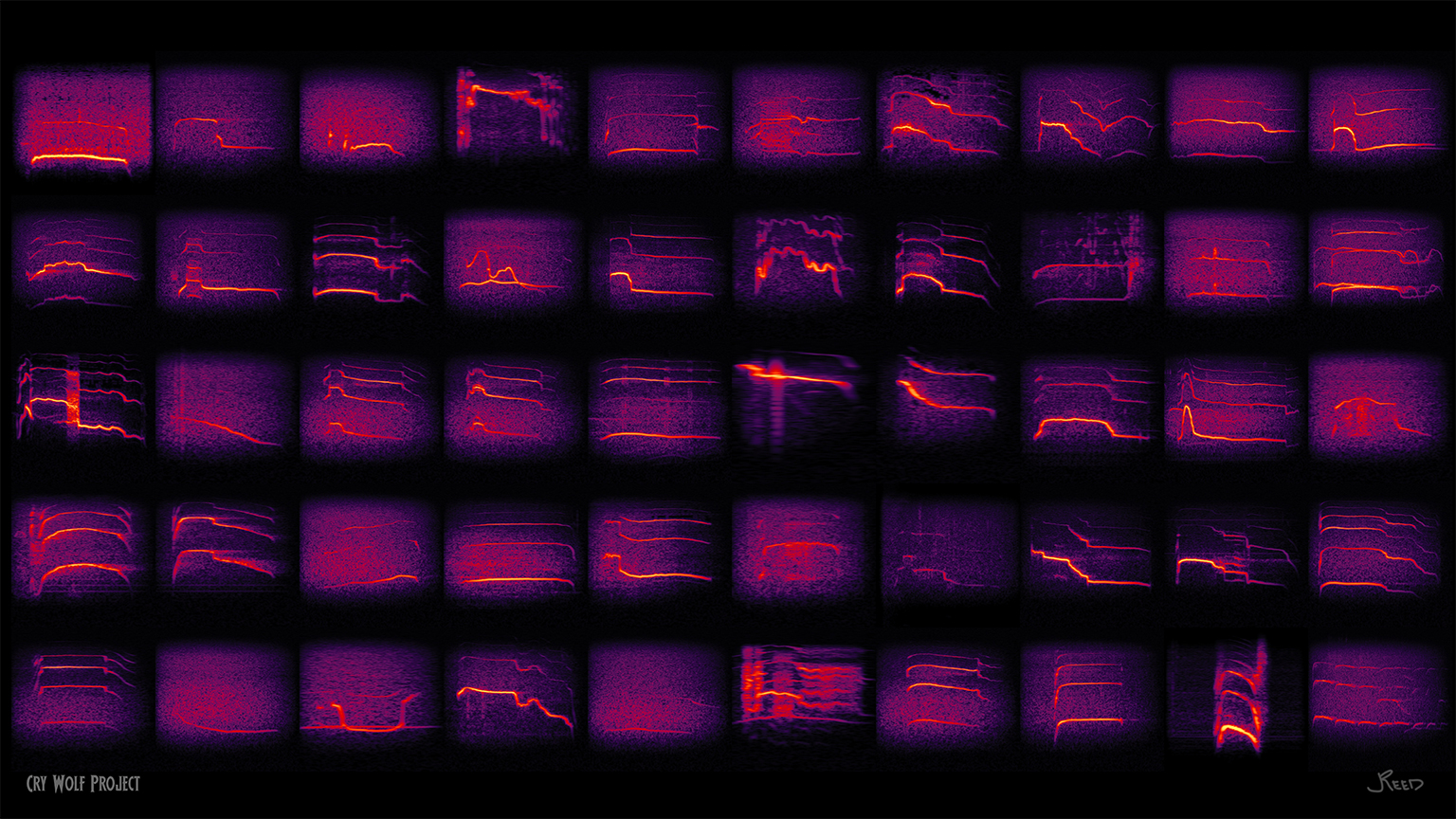
New technology tackles old questions
“Our program relies on collaring wolves, and we do that every year,” Stahler says. “We use helicopters, we dart wolves, we collar them. It’s expensive, it’s risky, but it is invaluable in answering the questions we’re pursuing. As scientists, we’re always trying to do things better, to take advantage of new technology. So, I challenged our team several years ago to think about less invasive ways to monitor our wolf population.”
Which is how Reed entered the exclusive world of Yellowstone wildlife research. His startup, Grizzly Systems, and its ARUs, called GrizCams, contribute to what Stahler calls “a great new prong” of noninvasive wolf studies using AI-driven bioacoustics. The devices methodically record wolf song, along with their location, and thus have become geolocators allowing for remote monitoring of wolf-pack ranges and activity.

“Wolf biologists have been studying wolf howling for decades,” Stahler says. “But now we have new ways to ask questions about wolves because of new technology.”
That technology has not only opened doors to the secret lives of wolves but has the potential to crack wildlife communication codes the world over. Mark Hebblewhite, a conservation ecologist at the University of Montana, uses old-school GPS technology and remote sensing to study mammal behavior in Costa Rica. But now a former student of his is collaborating with Reed in Yellowstone in what Hebblewhite calls “a model public-private partnership.”
“Universities are great at many things, but we’re really slow and a bit stodgy,” Hebblewhite tells Mongabay. “Jeff’s got these crazy ideas, but then he can deliver on hardware and software that, quite frankly, would take us way too long at a university to do in any sort of competitive or productive way.”
Narrating the howl
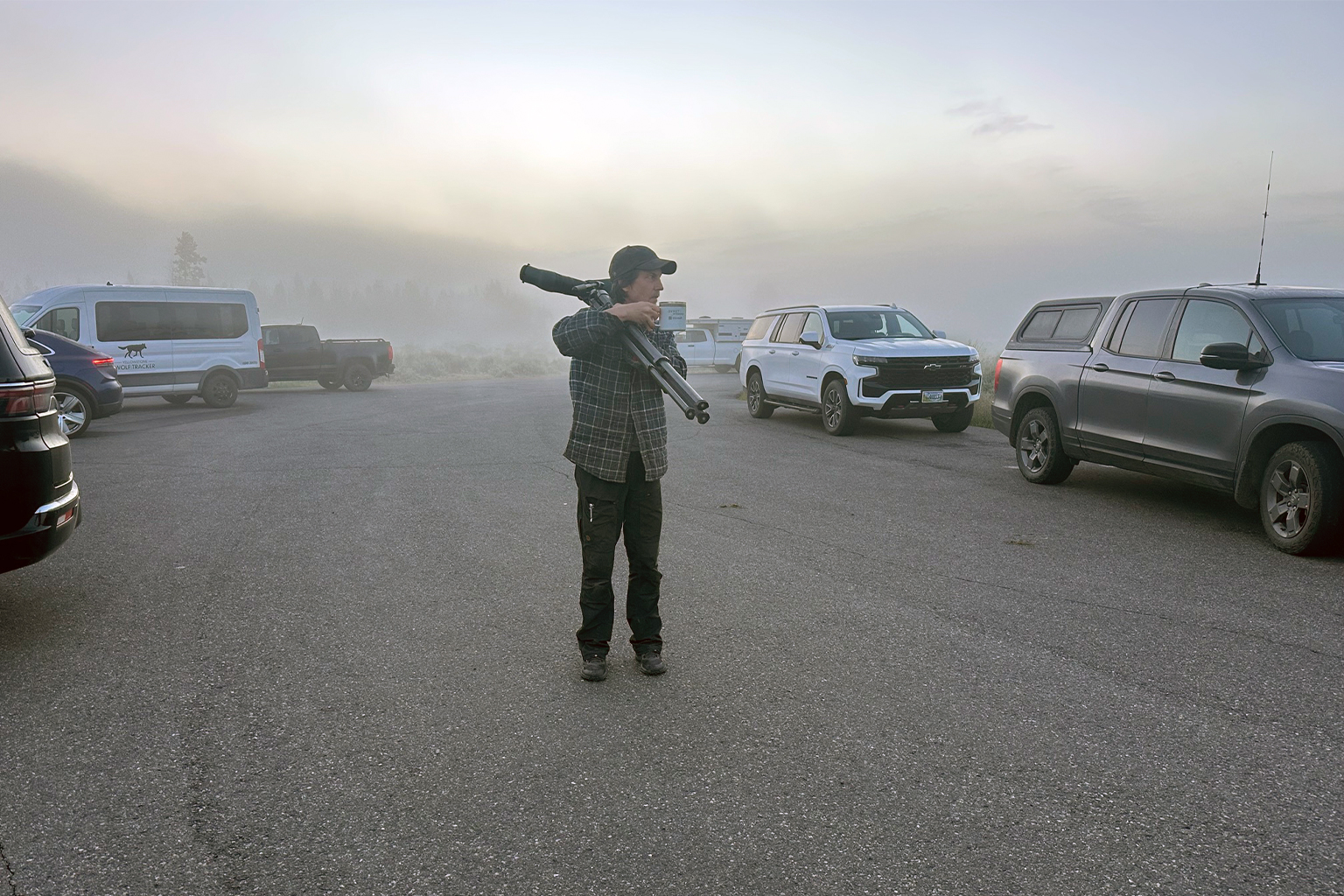
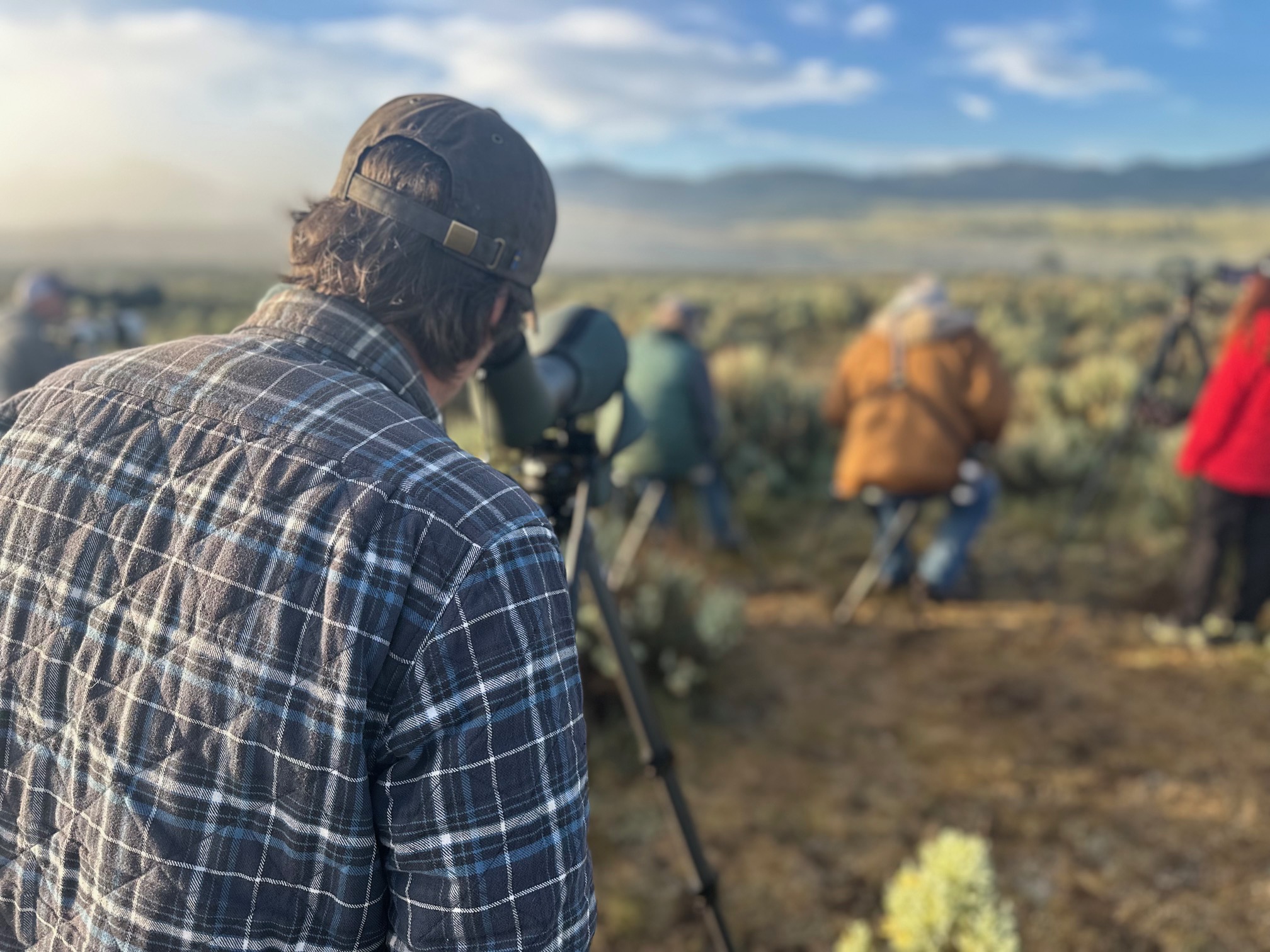
It’s 5:44 a.m. in Yellowstone and a half-dozen wolfies have already set up their scopes, waiting for the mist to lift over Blacktail Deer Plateau. Reed sets up his scope, too. The Rescue Creek Pack with its 23 wolves includes seven pups whom we soon see romping, nipping and rolling all over on each other like, well, puppies.
In this setting, Reed may look like a local rancher with his muddy pants and quilted flannel shirt, but he is at heart a philosopher. As we share time at the scope, his thoughts flow from the origins of ancient languages to the fiction of Cormac McCarthy, from the limited utility of camera traps to the vast potential of bioacoustic eavesdropping.
Words are everything to a linguist, thus Reed rejects the notion that he’s trying to “translate” wolfish into words akin to human language. Rather, he explains, what he’s doing with his ARUs, data sets, AI and spectrograms is “narrating the howl.”
Observing a wolf’s actions at the same time it howls, barks or whimpers, brings one closer to grasping what a wolf is communicating to other wolves or rival packs. “If you want to understand the meaning of the howl,” Reed says, “you have to tell the story, and the story is the individual that uses the howl over time.”
That’s why Reed has learned to recognize an individual not only by sight but by its voice, via repetitive acoustic and spectrogram analysis. Over time, he’s even come to “know” certain Yellowstone wolves by their sounds and numbered names, like 907 or 1513. When he pairs what they’re doing at the moment of a certain vocalization, a story emerges. Like the fearful cries emanating during a risky river crossing or the celebratory calls after a successful hunt.
This digitally enhanced storytelling transcends scientific insight and moves Reed, Stahler and wolfies everywhere toward a parallel goal: better protection of wolves, including those loping onto private ranches, farms and homesteads where they’re unwelcome and likely to get shot. Call it conservation by empathy.
“This pack is just like your family,” Reed says, peering through his scope. “They live together. They hunt together. They take care of their young for long periods of time. When you start to understand that, your entire frame of reference changes. You’re not going to kill them. What is going to drive conservation is telling the story of these animals.”

Conservation beyond Yellowstone
Reed’s technology in the service of wolves isn’t limited to Yellowstone. In northern Italy, a small group of citizen scientists is devoted to protecting Apennine wolves of the Po Valley as the apex predators wander into their community of Fidenza, north of Bologna.
Paolo Mainardi, a retired mechanical engineer there, easily qualifies as a wolfie. He tells Mongabay how he and a half dozen like-minded friends “must be mad,” given the extraordinary number of hours they devote to tracking eight wolf packs using 120 camera traps in an attempt to steer the carnivores away from risk.
Mainardi met Reed during a webinar on bioacoustic monitoring, and acquired a dozen ARUs. The goal of his group — Osservatorio Lupi, or “Wolf Observatory” — is less about decoding wolfish than implementing a kind of early-detection system to scare off wolves that come too close to towns or farms.
“I hope that with this technology, we will find better ways to protect the wolves and the livestock,” Mainardi says.
Reed, who’s finishing a book on wolf communications for a 2027 release by the Hachette Book Group, agrees emphatically. He envisions his ARUs being used by property owners to detect and drive wolves away without guns. The devices are also being eyed by a host of other scientists eager to use Reed’s technology to study bears, ecosystems and wildlife crossings.

What AI can and cannot do
Erin Hecht is an evolutionary neuroscientist at Harvard University who studies how canine brains have evolved. She’s familiar with Reed’s work at Yellowstone and views him as a vital member of a small, trailblazing expert group harnessing new technologies to analyze huge amounts of data in ways not possible just years ago.
“Many people in this field have a sneaking suspicion that animal communication is much more complex than we ever suspected,” Hecht tells Mongabay. “Maybe partly because we just couldn’t analyze it, and probably also because we just don’t know what boxes to put it into.
“But where machine learning can outshine human minds is where it can pick up on patterns that we just don’t see. Our minds are built to process our vocal communication; they’re not built to process wolf vocal communication, or ape vocal communication, or bird vocal communication.”
Reed himself recognizes technology’s limits. Riding with him in his Chevy pickup to his home office on the Yellowstone River, Reed makes clear that for all of AI’s speed and efficiency, a human mind and an enormous amount of human labor are required to sift through 500,000 hours of nature sound to isolate 8,000 continuous hours of wolf vocalizations. Initially, that hands-on approach is the only way to identify and describe the 20-plus unique calls.
“I am 20.2% through annotating every individual howl in those 8,000 hours,” Reed says of a data set that if played nonstop would run 333 days. “This gives you an idea of how hard this is.”
But it’s beautiful, too. Reed plays for me a classic rising-pitch howl of what he believes is an alpha female from the Rescue Creek Pack. Within a few moments, other wolves join in until there is what he calls a chorus howl — a glorious cacophony that after 60 seconds falls suddenly silent.
As if answering that wild chorus, Reed unspools questions he’s determined to answer: What prompted the first howl at 4:02 a.m.? Why did the others join in? Why did they stop? Why is there so much variety in the howl? What’s the point?
It’s tempting to ascribe human emotions to these hypnotizing sounds to hypothesize answers. But ever the linguist, Reed knows wolfish is not English, not human. He’s not tempted at all. It’s as if he’s harking back to that eerie moment when he locked eyes with a large gray wolf not far from his Montana home and embarked on a mission:
Don’t shoot, listen. Don’t kill, conserve.
“This software I’ve written is going to have a global effect because people can download it and use it,” he says. “Paolo [Mainardi) is downloading it in Italy and using it. People in the Netherlands are downloading and using it.
“And if I can get that ball rolling to where they are the storytellers on this communication thing, then the underlying premise becomes: If you can talk with a wolf, you identify with a wolf, you relate to a wolf, and maybe you don’t turn them into Little Red Riding Hood, right? If you get enough of those people [listening], then you have an army of humans who can help with wolves.”
Banner image: The wolf known as 907 howls in Yellowstone National Park. This wolf, unusually long-lived at 11 years, died in late 2024 after being attacked by a rival pack and was one of Jeff Reed’s favorites. Most wolves don’t live more than four years in the wild. Reed’s autonomous recording units (ARUs) captured 907’s last hours alive. Image by Evan Stout, courtesy of Jeff Reed.
Justin Catanoso, a regular contributor to Mongabay, is a professor of journalism at Wake Forest University in North Carolina.
How one woman’s wolf ‘moon shot’ changed Yellowstone forever: Interview with director Tom Winston
Wolves’ continued spread in California brings joy, controversy & conflicts
Choosing coexistence over conflict: How some California ranchers are adapting to wolves
FEEDBACK: Use this form to send a message to the author of this post. If you want to post a public comment, you can do that at the bottom of the page.
Cite this article
Justin Catanoso (2026). ‘Don’t shoot. Listen’: The AI-aided quest to understand Yellowstone’s wolves. Mongabay Conservation news. DOI: https://doi.org/10.66709/news-329875

