


Myanmar’s postcoup civil war has raged for more than five years and left the country in a state that has been compared to the apocalypse. Though the conflict is seldom a leading story in mainstream Western media, the United States’ Christian right is paying close attention.
Between 2002 and 2018, more refugees were resettled in the United States from Myanmar than from any other country. The majority are from the country’s Christian minority and many have now settled in the Midwest, particularly in Indiana and Minnesota. The money they earn in meat-packing factories, Walmart distribution centers, and sushi shops helped fund the uprising against Myanmar’s Junta and meet the country’s humanitarian needs.
Members of the Burmese Chin community in Indianapolis head in to shop at the Chin Brothers restaurant and supermarket in the city’s Southport neighborhood on Feb. 29, 2020. Steve Raymer photo for Indianapolis Monthly
Myanmar’s diaspora is also active in lobbying, using its ties to the broader evangelical and “Make America Great Again” movements. And they remain largely supportive of U.S. President Donald Trump, even though he has stopped humanitarian and democracy aid to Myanmar and cut the country’s refugee program.
But with no new refugees moving to the United States and immigrants already in the country facing pressure, the dynamics that have sustained support for Myanmar’s insurgency may be coming under strain.

Children of Chin refugees take part in a Mass at St. Mark the Evangelist Catholic Church in suburban Indianapolis on Feb. 21, 2020.Steve Raymer photo for Indianapolis Monthly
Esther, who asked that her real name not be used for fear of retaliation, was a university student in Yangon when the nation’s 10-year experiment with democracy ended in a 2021 military coup. After watching her fellow students be murdered in the streets for protesting the takeover, she joined a People’s Defense Force, or PDF, and raised money through social media posts.
On the opposite side of the globe, diaspora members in the United States were hearing thousands of stories like Esther’s and opening their wallets.
“The bulk of the funding increasingly went toward armed struggle because there was this sense that it was only through armed resistance that the other goals of the revolution could be achieved,” said Thomas Kean, a Myanmar researcher at the International Crisis Group.
The initial uprising against the coup took place during the COVID-19 pandemic, when reduced spending on services meant that Americans’ savings were growing, giving the U.S.-based diaspora increased resources to draw on.
“People were also very online,” Kean said. Donations were crowdfunded through social media, incentivizing those on the ground to keep creating content to maintain the funding flows. As society reopened in the United States, in-person fundraisers were held in churches and Buddhist temples around the country.
The fundraisers were a great place to find mohinga and other dishes from Myanmar as well as dances from different ethnic groups. While largely attended by the diaspora, American politicians occasionally joined. For a 2023 Chin National Day event, Republican Sen. Todd Young—then the ranking member on the Near East, South Asia, Central Asia, and Counterterrorism Subcommittee of the Senate’s Foreign Affairs Committee—attended in a jacket made from traditional Chin woven fabric.

A photo posted to social media by U.S. Sen. Todd Young on Feb. 18, 2023, shows him (center) with members of Indiana’s Burmese community to celebrate Chin National Day. Office of Sen. Todd Young on X
From the beginning of the armed struggle, those on the ground worried about the political complications of their dependence on diaspora support.
“If we don’t like Donald Trump, we can’t say that, because the diaspora likes him a lot and we rely on them,” Esther said. This is particularly important for the groups fighting in the majority-Christian Chin state, which has few natural resources and is one of the poorest in the country.
Christians make up around 6 percent of Myanmar’s population, but they have played a significant role in many of the country’s armed rebellions. This started at independence, when the Karen (an ethnic group whose members are both Christian and Buddhist) launched a revolt in 1949. This was followed by revolts among the Kachin in the 1960s, and the Chin, who first rose up in 1988.
While a wide range of ethnic groups in Myanmar have fought against the central government, the ruling junta’s embrace of Buddhist nationalism creates an additional dimension in its conflict with Christians. As a result, the government not only subjects Christian rebels to the same airstrikes, abductions, torture, and rape that are perpetrated against dissidents of all faiths, but it also has specifically targeted churches and other Christian sites during the course of the conflict.
This experience has led many Christians from Myanmar to a version of Christian nationalism that fits well with that of the U.S. right. According to David Thang Moe, a scholar of religion and politics at Yale University, “They see President Trump as a strong leader who protects Christianity and promotes its Christian values. For them, ‘Make America Great Again’ means ‘Making Christianity Great Again.’”

Members of the Karen ethnic group rally on Capitol Hill in Washington in November 2017 to bring attention to human rights violations toward religious and ethnic minorities in Myanmar. Allison Shelley for the Minnesota Star Tribune
Churches in the United States have also embraced the cause of those victimized by Myanmar’s junta government. Jose Abaroa, a pastor at Cypress Creek Church in Wimberley, Texas, told Foreign Policy, “Following Jesus prepares you for the hard times. Our brothers and sisters in Burma know that a lot better.” (Many people in the international community still refer to the country as “Burma” rather than “Myanmar,” often to avoid legitimizing the formal name change made by the ruling junta.)
Hannah Nyreen, who serves with Church on the Rock in Wasilla, Alaska, and helps coordinate support missions to Myanmar, put it more bluntly: “Satan and his demonic forces are using the Burmese government to persecute Christians.”
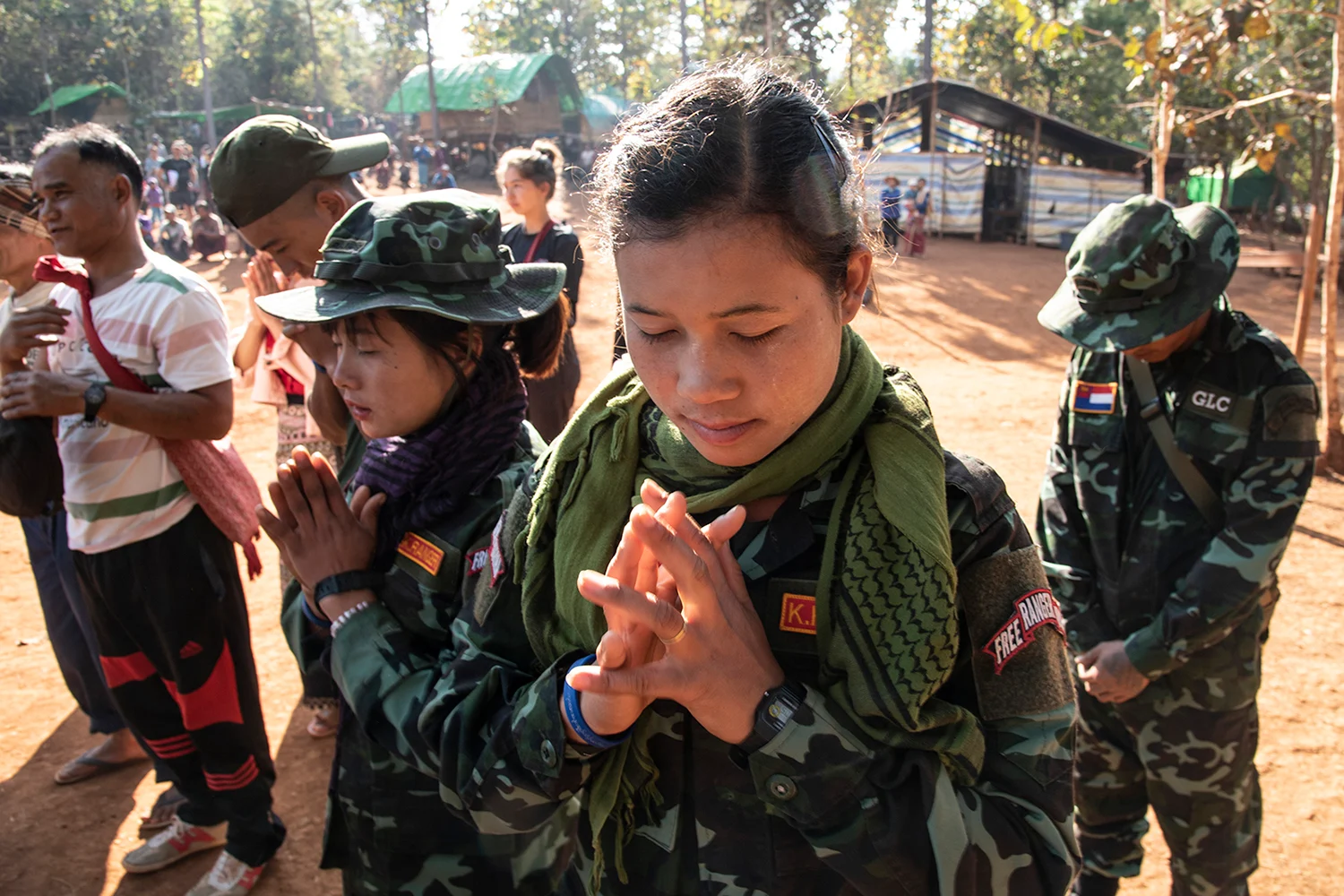
Many U.S.-based churches channel their support to a group called the Free Burma Rangers, which describes itself as a “humanitarian auxiliary” armed with medicine, Bibles, and, if members supply their own, guns for self-defense. Its founder is David Eubank, a former officer in the U.S. Special Forces. Eubank has spent nearly three decades bringing aid to people in conflict areas that are not reached by other humanitarian groups.

A team of Karen guerrillas and Free Burma Rangers, many of whom are Christians, pray before going on a reconnaissance operation in Karen state on Jan. 9, 2008. Thierry Falise/LightRocket via Getty Images
In 2025, the sudden cancellation of most U.S. Agency for International Development (USAID) programs left the Free Burma Rangers, who have 150 relief teams in the country, overwhelmed.
“For a short time, we were one of the biggest donors. That is crazy,” Eubank said. “We are like a volunteer fire department. We can’t sustain large refugee populations.”
The USAID cuts led to a spike in hunger and death among refugees in Myanmar. While describing the suffering caused by the cuts brought tears to Eubank’s eyes, he insisted that there was time for the administration to change its position. “We pray for every administration to follow Jesus,” he said.

David Eubank, the founder and director of the Free Burma Rangers, shows the remnants of a Catholic church that was destroyed by a Myanmar army airstrike in Kayah state on Jan. 26, 2023. Thierry Falise/LightRocket via Getty Images
Others, however, see the cuts of USAID programs as a step toward a world where the church has a more central role in saving people’s lives.
“I would say the church should be the entity that is caring for the Burmese people. The welfare state, hospitals, universities were all Christian institutions. Over time, they have been more of a humanist thing—let’s win it back,” Abaroa said.
Nyreen echoed this sentiment: “Ultimately, the church would be strong enough and have the right people in place so that we don’t have to have a bunch of these government programs.”
On Myanmar’s border with Thailand, Trump’s destruction of the refugee program and visa ban on Myanmar nationals is causing stress. Mung Lung attends a church in Thailand where he fled after heavy fighting in Myanmar’s Kachin state. His hope was to follow a family friend who moved to the United States as a refugee. But the end of the program has left him stranded, his hopes deferred.
Despite this, Lung’s friend in the United States supports Trump because “he is a Christian.”

New U.S. citizens, including Burmese Chin, take the oath of citizenship in Carmel, Indiana, on March 10, 2020.Steve Raymer photo for Indianapolis Monthly
In the United States, Trump’s policies are causing havoc in Myanmar diaspora communities as well. Last month, a judge ended temporary protected status for Myanmar nationals residing in the United States, putting around 4,000 people at risk of deportation. Dozens of people from Myanmar have also been caught up in Immigration and Customs Enforcement (ICE) raids. The death of a blind refugee from Myanmar who was apprehended by Border Patrol, then driven to a remote spot where he was left alone on a freezing winter night in Buffalo, New York, has been ruled by a medical examiner as a homicide.
“I think it was a huge shock when DHS [the U.S. Department of Homeland Security] went after them,” Eubanks said. The diaspora’s thinking, he explained, was that “number one, we are here legally. Number two, if we go home, we get killed. Number three, we voted for you.” As a result, Eubank said, “many are in shock and very disappointed,” but they nonetheless still prefer Trump to the alternative.
The perception that Christian morality is under attack by the Democrats continues to motivate many refugees. “Easter Sunday under [former President Joe] Biden, the White House brings in a trans person and calls it ‘Trans Day.’ That is an insult to their religion. Don’t expect them to support you. It is saying, ‘we don’t agree with your morality,’” Eubank said, referring to Biden declaring March 31 as Transgender Day of Visibility in 2024, when the date coincided with Easter Sunday.
First Presbyterian Church in Midland, Texas, helped early groups of refugees from Myanmar get settled in the area. Recently, its outreach pastor, Walter Thompson, has taken in children whose parents were deported by ICE. “My role is to help put a face to the issue of immigration. As long as it remains faceless, people are able to take positions that are less human,” Thompson said.

Burmese Chin refugee Jones Zaa Thang, an Amazon worker, displays a U.S. flag after taking the oath of citizenship at a naturalization ceremony in Carmel on March 10, 2020.
Though support for the president has dulled among the diaspora, it has hardly gone away.
“There are definitely more posts of ‘we are not going to vote for him again,’” said Don Gel Nuam, a diaspora member from Tulsa, Oklahoma, who recently received a master’s degree in clinical psychology. But, she added, “I have also seen a lot of his huge supporters still supporting.”
