


- After a cycle of left-wing administrations, four out of nine Amazonian nations are currently under right-wing leadership that favors exploitation of natural resources over conservation.
- Brazil could be next after October’s elections, which could put up to 95% of the Amazon under mining- and agribusiness-friendly administrations.
- According to experts, the Amazon Rainforest’s already challenging environmental situation could reach a dangerous tipping point if regional leaders abandon environmental cooperation.
In January 2027, five of the nine Amazonian countries could be run by right-wing or far-right parties, posing new risks to the world’s greatest rainforest, experts warn. Peru, Colombia, Bolivia, and Ecuador have already elected presidents who explicitly favor agribusiness and mining over environmental conservation.
Brazil, home to more than 60% of the Amazon, could be next. According to polls, the left-wing incumbent, Luiz Inácio Lula da Silva, is neck and neck ahead of October’s ballot against Flávio Bolsonaro, the eldest son of Jair Bolsonaro, the far-right president he defeated in the last election four years ago. The elder Bolsonaro has since been convicted for an attempted coup d’état, imprisoned, and barred from running for office.
Venezuela, run by a nominally socialist regime but now under economic intervention from the U.S., is facing mounting pressure from President Donald Trump to boost oil production and sign new mining deals, raising environmental concerns in the country.
Together, these six nations cover up to 95% of the Amazon.
Experts say Brazil’s election will have high stakes for the Amazon and other biomes, especially as the younger Bolsonaro looks set to revive his father’s policies.
“Even under a government that is somewhat committed to combating deforestation, the task is already very difficult,” Márcio Astrini, executive secretary of the Climate Observatory, a Brazilian network of nonprofits advocating for climate action, told Mongabay. “And when there are governors who are on the opposite side of it, believing that a ‘chainsaw’ is right and that conservation laws are wrong, the situation becomes nearly impossible.”
In Bolivia, Peru, and Colombia — which host a combined 28% of the Amazon — voters have since October 2025 ushered in leaders who have campaigned against environmental safeguards and in favor of militarization, mining, and agribusiness. In Ecuador, the law-and-order hard-liner Daniel Noboa, reelected in April 2025, is reopening the country’s doors to mining while downgrading environmental agencies.
Experts also warn Brazil’s October election could either give rise to a “conservative alliance” in the Amazon or force Lula to govern in diplomatic isolation.
Political changes can also reshape cooperation between countries with shared borders, replacing discussions around a joint approach to protect the rainforest and its populations with a hard-line security agenda to tackle organized crime — especially in crime-hit border areas.
The future is also uncertain for intergovernmental entities dedicated to sustainable development and Indigenous rights, such as the Amazon Cooperation Treaty Organization (ACTO), if conservation efforts are no longer a priority regionally. And as business-oriented governments take hold, trans-Amazonian infrastructure projects, already facing criticism for potential environmental damage, may also be fast-tracked. 
“The challenge [for the Amazon] will remain enormous,” Astrini said. “The scope of influence of a Brazilian government that prioritizes the environment is already limited. In other words, you can count on complementary actions from [neighboring] countries — provided those countries are willing. But once a new government that denies climate change comes, or actively works against efforts to address it, the ability of any government to exert influence [in terms of conservation] is very limited.”
According to analyses by the Monitoring of the Andes Amazon Program (MAAP), a U.S.-based nonprofit, Pan-Amazonian deforestation has experienced recent fluctuations: while 2024 was marked by a record high in fire impacts (affecting around 2.8 million hectares, or 6.9 million acres, due to extreme droughts associated with El Niño) and a 34% increase in overall deforestation, 2025 saw a partial recovery with a reduction in the area affected by fire and the lowest level of forest loss from deforestation in the last 10 years. Approximately 13% of the biome, according to MAAP, have been deforested so far.
Amid the right-wing shift across much of the Amazon, Guyana, under recently re-elected left-leaning President Irfaan Ali, has been betting big on its fossil fuel agenda, driven by U.S. ExxonMobil’s oil discovery offshore Guyanese territory. Suriname, meanwhile, is led by Jennifer Geerlings-Simons in a coalition with left and center-to-right parties. Meanwhile, French Guiana operates as an overseas department of France, governed regionally by a left-leaning and socialist leadership.
Winds from the right
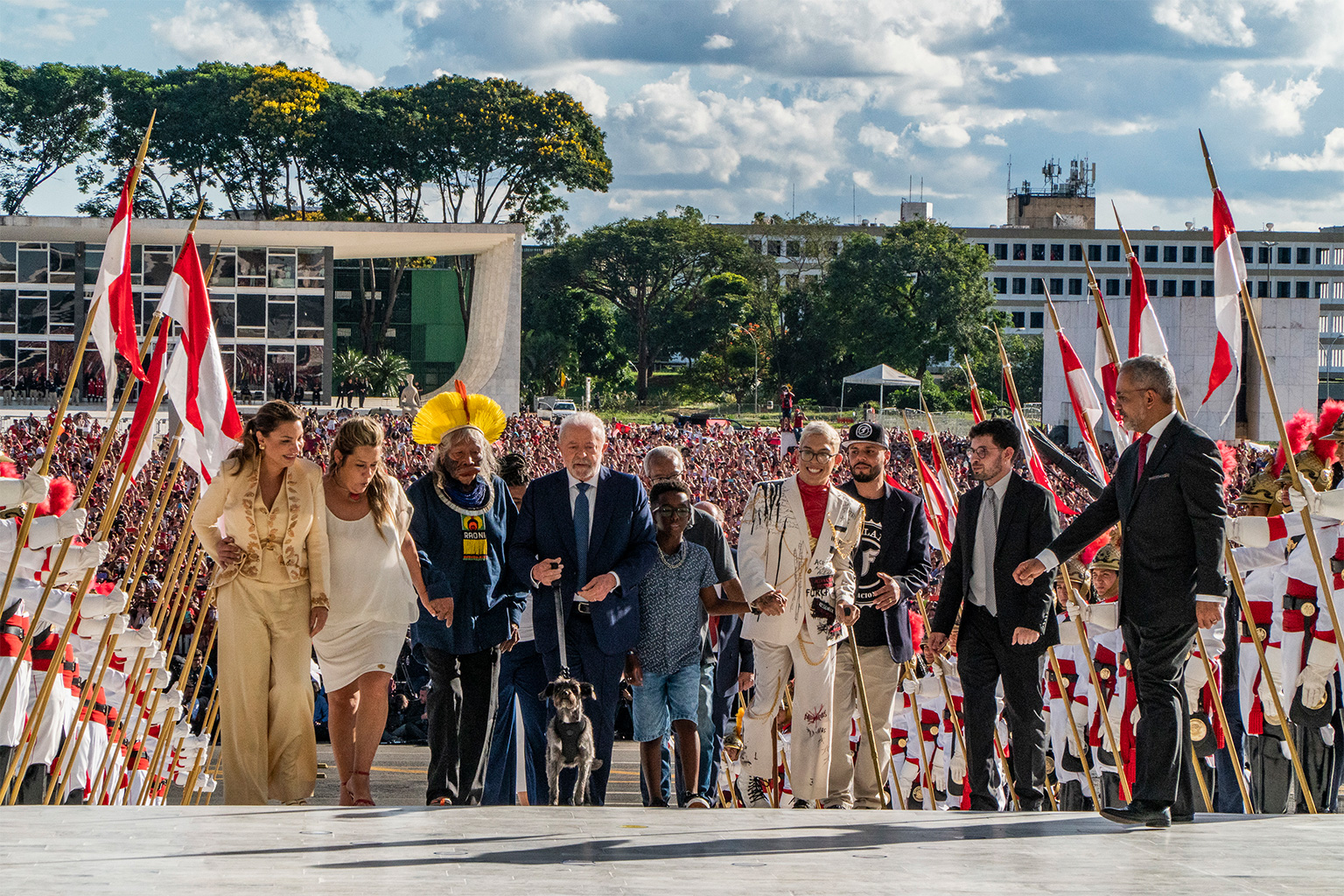
In January 2023, Lula entered the presidential palace to start his third term escorted by figures representing civil society, including Indigenous Kayapó leader Raoni Metuktire. It was also a direct response to Jair Bolsonaro, who had rolled back environmental policies, official oversight, and Indigenous rights, leading to rising Amazon deforestation and record levels of invasions of Indigenous territories.
Nearly four years later, under Lula, Amazon deforestation has hit a 10-year low as environmental policies were reinstated.
In Bolivia, the victory of President Rodrigo Paz Pereira and his “capitalism for all” in 2025 marked the end of nearly 20 years of left-wing administration under the once-dominant Movement Toward Socialism (MAS) party. It also brought significant environmental shifts.
While observers note that the practical results of the MAS administration regarding deforestation, oil drilling, and mining in the Amazon were mixed and highly debated, Paz Pereira’s present administration has made clear from the outset that addressing these issues is not one of its priorities, as it was under the left-wing party’s two-decade rule.
Adhering to a plan centered on economic and fiscal issues and citing broader “state-downsizing” efforts and “reducing bureaucracy,” Paz Pereira eliminated Bolivia’s Ministry of Environment in August 2026, relegating the portfolio to a vice-ministry now attached to the Ministry of Productive Development, Rural Affairs, and Water.
Also, through his Decree 5503, Paz Pereira fast-tracked a series of rollbacks of environmental regulations, relaxing controls to attract foreign direct investment and private capital into the country’s energy and mineral sectors. His initial decisions were followed by protests called by Amazonian Indigenous groups who feared a “mining boom” under the new administration.
Valentina Figuera Martínez, a gender justice and forests campaign coordinator at the Global Forest Coalition, an international alliance for rights-based conservation, Indigenous rights, and social justice, raised concerns about the legal changes, especially as seen within a broader regional context.
“In Bolivia, the Mining Law requires free, prior, and informed consultation, environmental studies, and approval by the Plurinational Legislative Assembly,” Martínez told Mongabay. “However, administrative loopholes were created to allow mining projects to operate without legislative approval and in violation of territorial rights.”
She said parallels exist across Amazonian countries, citing Brazil as an example.
Martínez pointed out that the Brazilian Congress weakened environmental oversight and legislation, while Venezuela accelerated opaque oil deals with the U.S. She added that global responses continue to prioritize fossil fuel exploitation over a just climate transition. “It is the greatest erosion of rights and sovereignty in recent years,” she said.

In Ecuador, environmental shifts have also taken place under Noboa, a conservative politician in office since 2023, whose administration has drawn backlash from Indigenous groups and experts for pushing mining and fossil fuel projects in the Amazon. Meanwhile, reports by collaborative media alliance Amazon Underworld suggest that Noboa’s tough-on-crime approach — one of his main platforms — has been fueling violence driven by illegal gold mining and drug trafficking.
Quito is also sparking controversy by folding the Ministry of Environment into the Ministry of Energy and Mines; issuing new laws that strengthen the mining sector by eliminating environmental licensing requirements; and pushing oil and gas expansion plans worth more than $45 billion, which have been condemned by Indigenous groups.
“They [the right-wing administrations] are contributing to the accelerated extinction of life on the planet through climate denial, the violation of rights, and the dismantling of environmental regulations,” Martínez said. “Existing regulations are being violated, or mechanisms are being sought to delay implementation or roll back hard-won rights.”

Militarization looms over the Andes
In 2026, two ultra-conservative platforms prevailed with razor-thin victories in the Amazon region. In July, Keiko Fujimori, daughter of late former president Alberto Fujimori (1990-2000), took office as president of Peru. The following month, in Colombia, far-right pro-Trump lawyer Abelardo de la Espriella also received the presidential sash.
Fujimori, who had lost the last three elections, largely avoided mentioning the Peruvian Amazon’s most sensitive issues in her inauguration speech, including deforestation and the rampant violence faced by environmental defenders. She did, however, note Peru’s growing illegal mining crisis — whose effects include Indigenous health impacts and river contamination by heavy metals such as mercury — as something she plans to confront with military power.
Astrini said he fears a repetition of the model adopted by Brazil under Bolsonaro, when one of the government’s strategies was to remove biodiversity experts and heads of conservation units on a large scale, while militarizing decision-making and leadership positions. For Astrini, a greater military presence in the Amazon, in and of itself, “is no guarantee that things will improve or that there will be security.” He also said cross-border criminal activities, such as illegal timber trade, could even be facilitated under such a scenario.
Fujimori’s lack of environmental policies has raised concerns among environmentalists and Indigenous groups from day one, given her intention to promote private investment and expedite environmental permits for fossil fuel and mining concessions, while also opposing the ratification of the Escazú Agreement, a regional treaty aimed at guaranteeing access to information, public participation, and justice in environmental matters, as well as protecting environmental defenders.

Also, conservationists have warned about the legacy of her late father, who dismantled legal safeguards protecting Indigenous communal lands, leaving communities vulnerable to asymmetric negotiations with extractive corporations. Under the elder Fujimori, Indigenous women were also subjected to forced sterilization, which Amnesty International called “crimes against humanity for which there is no statute of limitations.” In 2021, Keiko Fujimori denied that state-led violations had occurred under her father’s presidency, calling them “family planning programs.”
In Colombia, De la Espriella is inheriting from his predecessor, Gustavo Petro, Colombia’s first-ever left-wing president, a reduction in Amazon deforestation rates — but challenges remain amid the advance of illegal groups, as Mongabay has reported.
Like many of the other leaders in the region, De la Espriella is betting on increased militarization to tackle violence. His government program doesn’t mention the words “Amazon” or “deforestation,” attributing forest loss entirely to illegal economies and advocating for a militarized territorial control strategy to restore the state’s authority.
This approach could replicate contested military campaigns of the past, such as Operation Artemis, which targeted vulnerable peasant farmers rather than the wealthy financiers of deforestation, and which ultimately failed, according to a report by Brazilian news outlet InfoAmazonia.
Martínez said she fears seeing major social setbacks in Colombia, which she warned have historically been disproportionately harsh on women, Indigenous peoples, and land defenders. She noted that Colombia was once again named the world’s most dangerous country for land and environmental defenders in 2024, with 48 killings recorded out of 146 deaths globally, according to a 2025 Global Witness report.
“If Colombia topped the list of reported murders of environmental activists under Gustavo Petro’s administration, what can we expect from the current far-right government?” Martínez said.
Experts say the trend is toward “increased resistance and lethality,” which could spill over and spread violence across the borders between Amazonian nations, especially in the tri-border region of Brazil, Peru, and Colombia, where cartels have established roots with drug and illegal gold trafficking.
De la Espriella has promised to expand fossil fuel production and mining (specifically copper, gold, and silver), while recently slashing Colombia’s environmental investment budget by 50%. “Colombia cannot continue to approach the mining and energy sector with ideological biases,” his government plan reads.
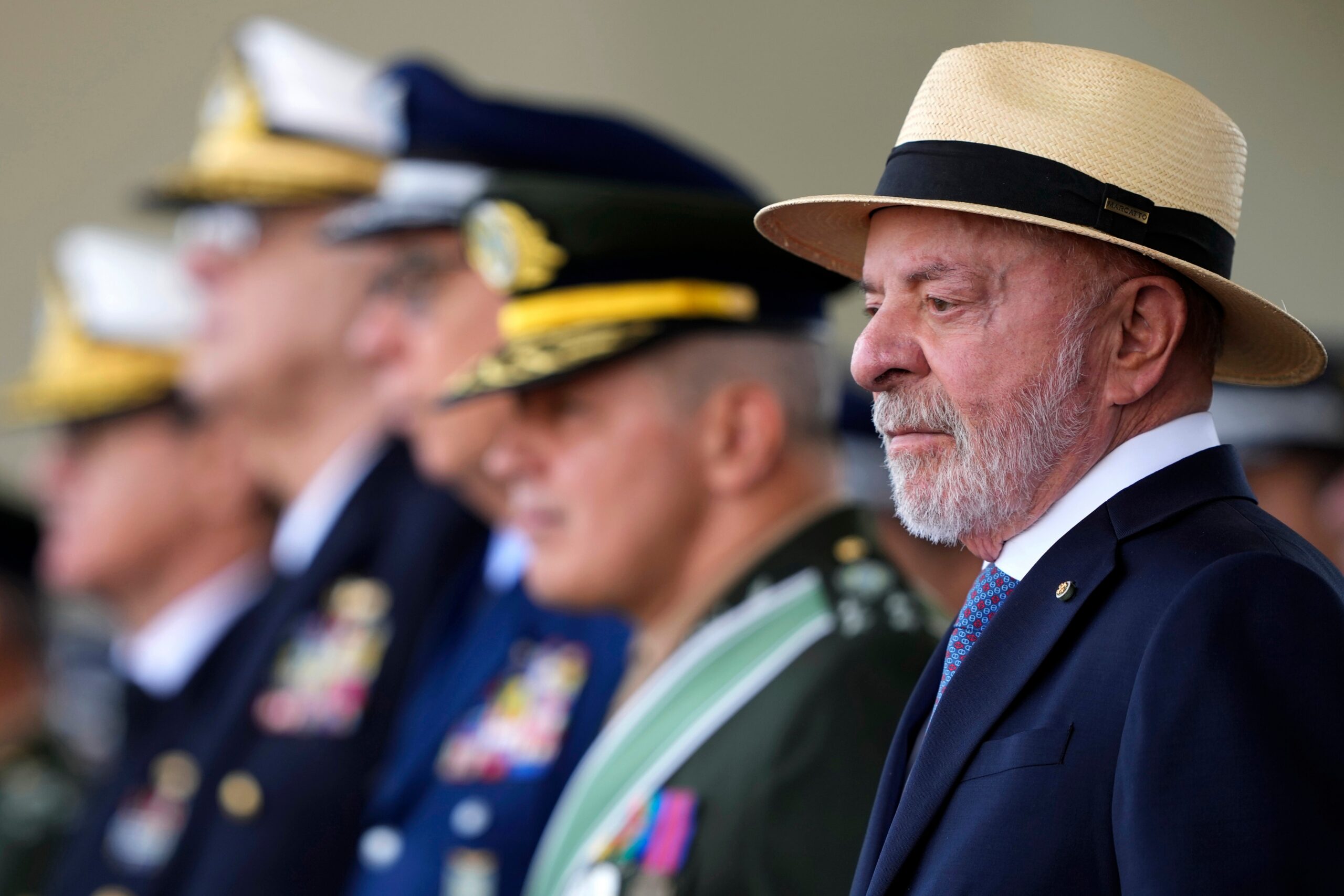
Banner image: Brazilian President Luiz Inácio Lula da Silva, right, stands alongside commanders of the armed forces during the playing of Brazil’s national anthem at a Soldier’s Day ceremony at Army headquarters in Brasilia, Brazil, Tuesday, Aug. 25, 2026. Image by AP Photo/Eraldo Peres.
Indigenous Parakanã fear election U-turn may spark new invasions in Brazil
FEEDBACK: Use this form to send a message to the author of this post. If you want to post a public comment, you can do that at the bottom of the page.
