


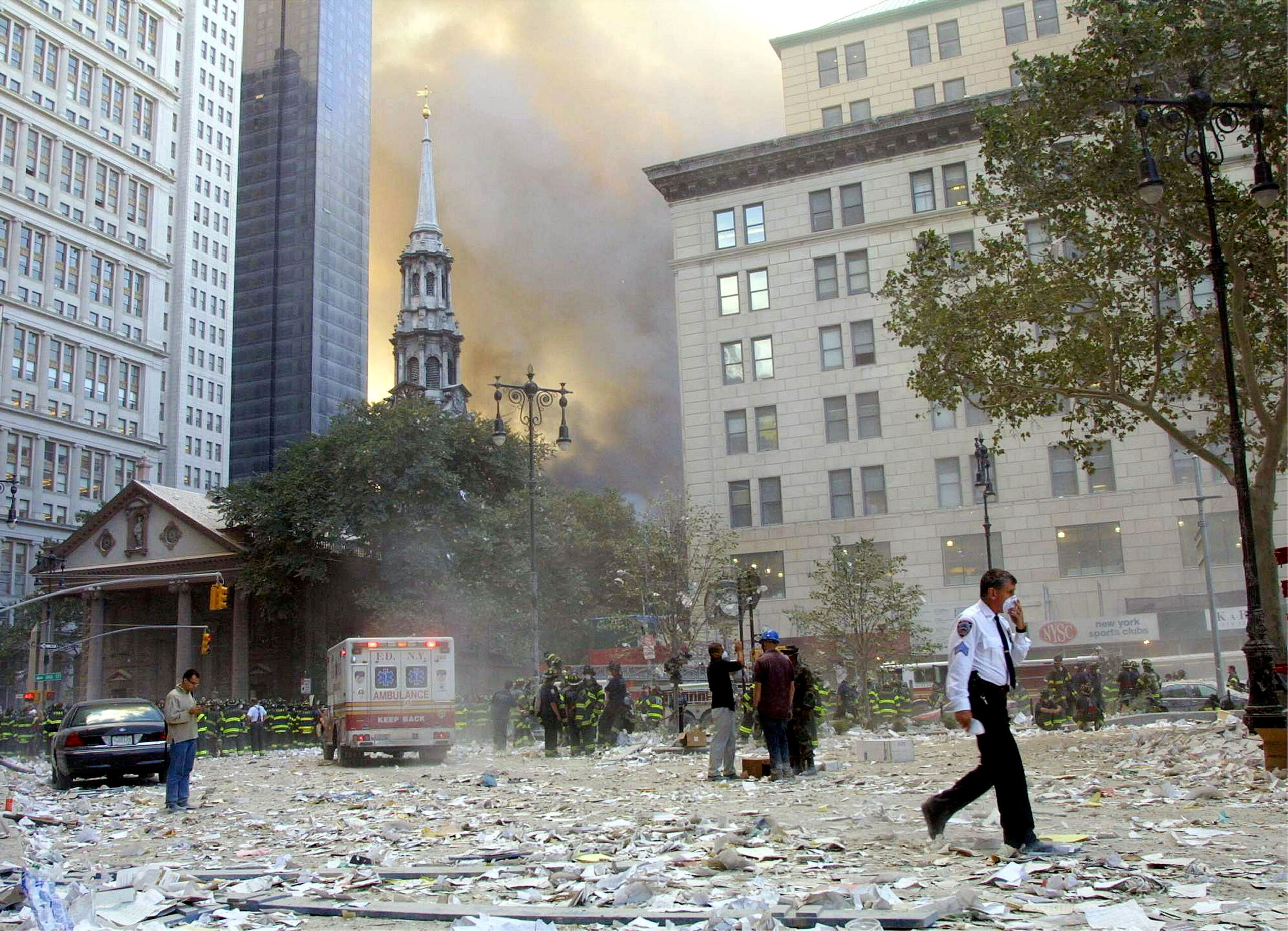
Philip Landrigan learned about the attacks on 9/11 the way much of the world did when he was chair of the Department of Preventive Medicine at Mount Sinai School of Medicine in New York: by watching television.
“We were distressed that it was a terrorist attack,” he said in an interview on Friday, the 25th anniversary, “but our primary response was to be doctors.”
Mount Sinai, several miles uptown from the World Trade Center, did not immediately receive injured people, most of whom were taken to hospitals in lower Manhattan. Still, the hospital prepared. Surgeons finished the operations already underway but did not begin new ones, leaving operating rooms empty and ready for casualties.
Usually, when a disaster like this happens, there is a small number of deaths and a large number of injured people, Landrigan said. “But after the World Trade Center, it was the other way around.”
Landrigan and a group of doctors trained in occupational medicine began preparing for a different kind of patient. They quickly drafted a plan for evaluating workers who had been exposed to the cloud of dust that engulfed lower Manhattan after the towers collapsed, putting out the word through the media and major labor unions.
“We knew how to evaluate workers who had sustained hazardous exposure,” Landrigan said.
In the years that followed, the health consequences of 9/11 exposures would become increasingly clear.
Now, 25 years after the attacks, a trove of newly released city records and a new medical paper are shedding further light on what officials knew about the hazards in the aftermath of 9/11 and what researchers have since learned about their long-term health effects.
Last Wednesday, New York City Mayor Zohran Mamdani released 170,000 pages of records detailing health concerns, air-quality monitoring and correspondence among city officials during and after the attacks.
The documents, which had been stored in 68 boxes in a city office, offer a window into how officials grappled with the potential dangers as New Yorkers returned to lower Manhattan. At the time, city officials sought to reassure New Yorkers, assurances Landrigan said were overstated.
The day after Mamdani released the records, a paper published in the Journal of the American Medical Association, “Twenty-Five Years After 9/11—Lessons From the World Trade Center Health Program,” examined the long-term and evolving health effects linked to 9/11, some of which can emerge decades after exposure.
The authors drew on substantial research and data from the World Trade Center Health Program, the federal initiative that provides monitoring and treatment to eligible responders and survivors.
“This paper confirms and extends what we already knew about the hazards of the dust, and it shows that the political leaders at the time were not being honest when they told people that the air was safe,” said Landrigan, now director of the Global Observatory on Planetary Health at Boston College and not involved in the research.
“They were just trying to rally the population to tell people to be courageous, and I can sympathize with that,” he said. “The other motive, I think, was not so noble—they wanted to keep Wall Street going.”
The paper, by Alejandro Azofeifa and other scientists from the World Trade Center Health Program, found that those long-term consequences associated with the 9/11 attacks would take years to emerge. “Disaster-related health effects are often chronic, dynamic and involve multiple organs in the body,” Azofeifa said in an interview.
The first signs of harm, however, appeared much sooner.
Landrigan said he remembers the first workers who came in, a few days after the attacks, with what experts called the World Trade Center cough. “We made the link almost immediately.”
“I think the single most irritating component of the dust that was responsible for the cough was the pulverized cement,” he said.
To treat those patients, doctors initially focused on their symptoms, prescribing medications to relieve persistent coughs and other respiratory problems.
For a handful of patients, doctors performed bronchoscopies, passing a tube into the lungs.
Other illnesses materialized later. The new paper describes how cancer, respiratory disease and mental health conditions are among those with the strongest and longest-standing evidence linking them to 9/11 exposures.
For example, cancers associated with high levels of asbestos exposure can take decades to develop, with incidence typically rising 20 to 25 years after exposure, according to Landrigan. That long latency period means some cases linked to 9/11 exposures may only now be emerging.
Landrigan said lymphoma was among the first cancers to appear. One component of the dust that may have contributed to lymphoma was the carcinogen benzene, released from the jet fuel of the planes that crashed into the towers, he said.
For many, those health effects from the aftermath of the attacks do not occur in isolation. As the exposed population ages, researchers are increasingly seeing people living with multiple chronic conditions at once, which can lead to greater disability and make their medical care more complex.
This story is funded by readers like you.
Our nonprofit newsroom provides award-winning climate coverage free of charge and advertising. We rely on donations from readers like you to keep going. Please donate now to support our work.
Mental health effects have also persisted decades after the attacks. Research has linked 9/11 exposures to post-traumatic stress disorder, major depression, anxiety and substance use disorder, according to the new paper.
Researchers are also looking for health effects that may take even longer to emerge. One current focus of the World Trade Center Health Program is a new initiative studying people who were 21 or younger on 9/11 and in its aftermath, “since exposure at a young age may produce health effects that differ from, or take longer to appear than, those seen in adult responders and survivors,” said Azofeifa, the lead author of the paper.
For Landrigan, however, the lessons of 9/11 are not only about what went wrong. The attacks showed him how important it is for cities to have doctors trained to respond to environmental and occupational disasters before they happen.
“We were able to respond as well as we did,” he said. “It wasn’t perfect, of course, but we were able to put together a response—a rapid, effective, targeted response because we had trained people and we had facilities, and we were right there.”
About This Story
Perhaps you noticed: This story, like all the news we publish, is free to read. That’s because Inside Climate News is a 501c3 nonprofit organization. We do not charge a subscription fee, lock our news behind a paywall, or clutter our website with ads. We make our news on climate and the environment freely available to you and anyone who wants it.
That’s not all. We also share our news for free with scores of other media organizations around the country. Many of them can’t afford to do environmental journalism of their own. We’ve built bureaus from coast to coast to report local stories, collaborate with local newsrooms and co-publish articles so that this vital work is shared as widely as possible.
Two of us launched ICN in 2007. Six years later we earned a Pulitzer Prize for National Reporting, and now we run the oldest and largest dedicated climate newsroom in the nation. We tell the story in all its complexity. We hold polluters accountable. We expose environmental injustice. We debunk misinformation. We scrutinize solutions and inspire action.
Donations from readers like you fund every aspect of what we do. If you don’t already, will you support our ongoing work, our reporting on the biggest crisis facing our planet, and help us reach even more readers in more places?
Please take a moment to make a tax-deductible donation. Every one of them makes a difference.
Thank you,
Fellow
Alissa de Chassey is a French journalist and a fellow at Inside Climate News. Previously, she covered science and health for Le Figaro in Paris. She is currently pursuing a master’s degree in Science, Health, and Environmental Reporting at New York University. Her work has also appeared in Nature, The Guardian, and The Transmitter.
