


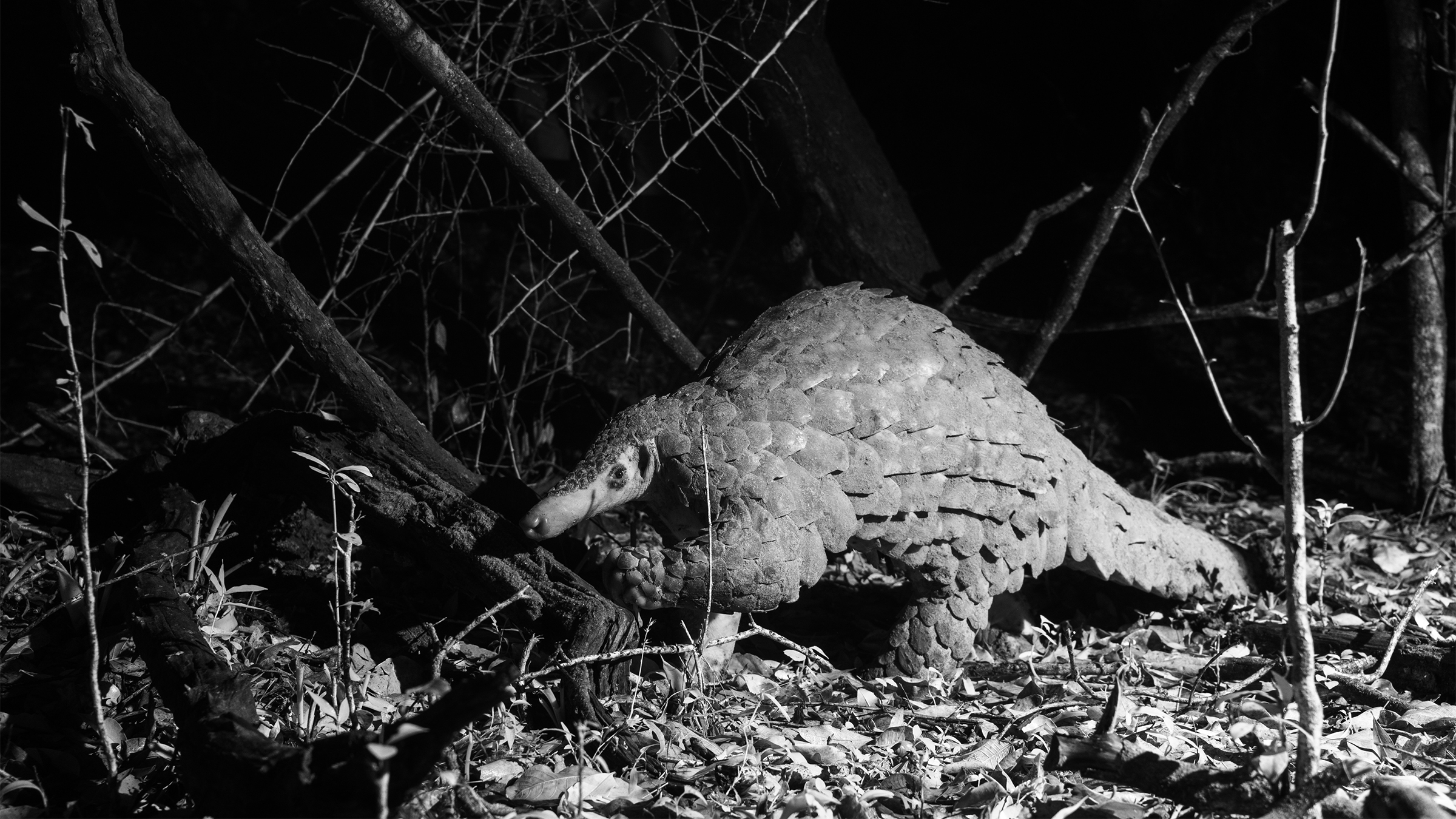
- Electric fences were responsible for 14 of the 15 giant ground pangolins found dead near Kenya’s Nyekweri Forest since 2022.
- With fewer than 30 giant ground pangolins believed to remain in the country, all in this one area, landowners are switching off the lowest strands of their electrified fences to create safe passage for these endangered animals.
- This community-led effort has made about 134 kilometers (83 miles) of fencing safer, but habitat loss and continued land subdivision threaten to undermine those gains.
Naserian, a giant ground pangolin, lived for about two years in Kenya’s last remaining stronghold for this animal, Nyekweri Forest.
When researchers from The Pangolin Project began tracking her in 2025, they observed her threading her way through a landscape where forests, farms and fences increasingly intersected. Each night, she emerged from the darkness of Nyekweri Forest and moved through a shifting mosaic of woodland, farms and grazing lands on the western fringes of Kenya’s Maasai Mara National Reserve.
Researchers watched on computer screens from their outpost near the reserve, tracking Naserian’s GPS signal as she followed familiar paths across a patchwork of privately owned parcels of land.
Then one night, the signal stopped.
A team from the Kenya-based pangolin research organization headed to the site. Naserian lay dead beneath an electrified fence. After years navigating a changing landscape, a single charged wire had ended her life.
A landscape closing in
Giant ground pangolins (Smutsia gigantea) are endangered across their fragmented Western and Central African range, with their numbers decreasing.
Kenya’s only known population resides in Nyekweri, but it isn’t the safest place for them. Since 2022, researchers have recorded 15 deaths in the area, including 14 by electrocution on electric fences. With fewer than 30 believed to remain in Kenya, every death carries outsized consequences.
The giant ground pangolin — the largest of the eight species, all of which live in Africa and Asia — occurs naturally at low densities. They normally give birth to just one offspring at a time, making losses difficult to replace.
All eight pangolin species are endangered, and for decades they’ve been the world’s most trafficked mammal, according to the International Fund for Animal Welfare (IFAW).
However, in the ecosystem surrounding the Maasai Mara, the greatest immediate threat to the species has changed: It may no longer be poaching for the keratin scales that armor their bodies — which are worth a fortune in China and Southeast Asia — but rather it’s the slow, cumulative transformation of the landscape itself.
“People often assume poaching is the greatest danger facing pangolins, but in Nyekweri the reality is far more alarming,” Michael Koskei, The Pangolin Project’s conservation monitoring and data manager, told Mongabay.
“Right now, these fences are killing pangolins faster than traffickers are taking them. We are watching a species edge toward local extinction, not because it is being hunted, but because it can no longer move safely through its own habitat.”
Electric fences across the landscape
Electric fences are relatively new here. Nyekweri Forest was once part of a vast, interconnected landscape where wildlife moved freely across communal Maasai land, but the forests in the area are rapidly disappearing.
“A woodland block that seemed secure just a few months earlier can disappear within a week,” Koskei said, adding that he has watched these changes unfold from his office overlooking the rolling Maasai rangelands.
Ancestral lands have been subdivided into privately owned parcels and forests cleared for farming and settlements. “Trees are cut, charcoal is burned, land is subdivided among heirs, and fencing follows almost immediately,” Koskei said.
Peter Ole Tompoy, a resident who serves as chairperson at a local NGO, the Nyekweri-Kimintet Community Forest Conservation Trust, has also witnessed the changes. When he was younger, wildlife “could move from one place to another without obstruction,” he said. He’s 73 and has lived in Nyekweri all his life.
But after land subdivision in recent years, landowners erected fences that carved the landscape into isolated fragments, breaking up the wildlife corridors and migratory routes that wildlife have depended on for generations..
The Pangolin Project’s tracking data has brought that reality into sharp focus. Night after night, tagged pangolins are seen crossing multiple privately owned properties, navigating a landscape crisscrossed by roughly 268 kilometers (167 miles) of electrified fencing.
Finding a way to coexist
Fences are part of a larger problem. The landscape is rapidly changing: More than 80% of Nyekweri Forest, which is adjacent to Maasai Mara Reserve, has been cleared in the last 20 years for crops and livestock grazing, according to Legado, an international nonprofit that promotes community-led change.
This forest, managed by the Maasai Mara and other Indigenous people, hosts a vast array of African wildlife, including giant ground pangolins.
The threat posed by fences has sparked an unusual conservation response. Rather than removing fences altogether, conservationists and local landowners came up with a simpler solution.
Across Nyekweri, Maasai landowners are voluntarily de-electrifying the lowest strands of their electric fences, creating narrow gaps that allow pangolins to walk beneath them safely, while keeping livestock protected and larger wildlife at bay.

Driven almost entirely by community participation, The Pangolin Project says it has become one of its most effective conservation measures.
“We agreed not to put electricity on the bottom two wires of the fence to allow the safe passage of pangolins,” Tompoy said. “Sadly, the only giant pangolin I have ever seen was dead. It had been electrocuted by an electric fence. Seeing that made me realize what these fences were doing to pangolins.”
The experience left him with little doubt that communities must find new ways to coexist with wildlife, he said, and he’s been part of the solution.
Mitigating deadly fences
Unlike many larger mammals, pangolins cannot leap over fences. When threatened, they curl into a tight ball, a defense that offers no protection against electricity.
Many of the people living here consider the fences a necessity. Naisenya Rakita is among them. Her 56-hectare (140-acre) property lies alongside the Maasai Mara National Reserve, and wildlife is part of everyday life.
Wild animals frequently wander onto her land, she said, and predators are never far behind. To protect crops from elephants and livestock from lions and other carnivores, she, like many residents, erected electric fences around her property.
“Lions often follow wild prey into the area and, in the process, end up preying on our livestock,” she said.
For families who depend on cattle, sheep and goats, a single attack can be a devastating financial loss. In that context, fences are not symbols of exclusion, but tools of survival.
“We’ve had neighbors lose dozens of livestock in a single night to predators,” Rakita said. “Compensation is provided for under the law, but it isn’t always available when people need it. That’s why many of us feel we have no choice but to put up fences.”
The answer, conservationists have realized, is not to remove fences, but to make them safer for the pangolins.
Learning that giant ground pangolins still lived nearby changed how resident Ben Sulel viewed his land. After discussions with community conservationists, he said he agreed to de-electrify the lower strands of his fence and has since encouraged his neighbors to do the same.
“When I understood what pangolins need to survive, I realized my land is part of something much bigger,” he said.
A similar shift took place for farmer Ole Manguyo. Although he’d known about pangolins since childhood, he said he only recently came to appreciate their ecological importance and the role they play in controlling ant and termite populations.
They use their long, sticky tongues to harvest these insects, which are their primary food, and a single pangolin can eat 70 million in a year, giving them a huge role in regulating insect populations.

“Before, I thought pangolins might become a problem for my farm,” he said. “It wasn’t until I learned more about them through the project that I realized they don’t damage crops.”
He had planned to fence his entire property but instead focused only on areas used for farming and grazing, leaving large areas of natural habitat open.
“Even where I have fenced, I’ve left the lower wires unpowered so pangolins can pass underneath safely,” he said.
Ole Tompoy, Rakita, Sulel and Manguyo are among a growing number of landowners living alongside protected areas who demonstrate that agriculturally productive land and thriving wildlife need not be mutually exclusive.
In total, landowners that hold properties near the Maasai Mara have left the bottom two or three fence wires unpowered along approximately 134 km (83 mi) of fencing, half of all the mapped electric fencing across Nyekweri, according to The Pangolin Project.
Tracking and saving pangolins
Using EarthRanger, a real-time wildlife monitoring platform, researchers combine GPS tracking data with digital fence maps to monitor tagged pangolins as they navigate this increasingly fractured habitat. The system allows them to identify potential collision points long before an animal reaches a fence.
By creating virtual “geofences” that mirror the location of electrified fences, the system automatically alerts rangers whenever a tagged pangolin approaches a high-risk area, enabling teams in the field to respond quickly.
But only seven giant ground pangolins are currently fitted with GPS tags, which are attached to the scales near their tails. The rest move through the landscape untracked, according to the researchers.
Even so, the movement data has provided compelling evidence that has helped persuade landowners to adapt their fences.
The effort remains incremental and there is no certainty it will keep pace with the rapid transformation unfolding across the area. But Wilson Parkesui, a habitat protection officer with The Pangolin Project who works closely with local landowners, says he believes attitudes are steadily changing.
“Not everyone is on board yet,” he said. “Some people still refuse to de-electrify their fences. But little by little, more landowners are beginning to understand that making space for pangolins doesn’t mean giving up their livelihoods.”

Protecting more than pangolins
For some landowners, switching off a few strands of wire is only the beginning.
Beyond safer fencing, voluntary conservation agreements encourage landowners to protect and restore forests to keep wildlife corridors open. Under one-year stewardship agreements, families are paid to conserve existing forest, while 15-year leases allow up to 90% of land to be restored, retaining only homes and kitchen gardens. Payments are linked to the ecological condition of the land, The Pangolin Project told Mongabay.
So far, more than 6,000 hectares (14,800 acres) of privately owned land have been placed under conservation easements.
“The objective is to reconnect enough habitat to support a viable population of giant ground pangolins,” said Beryl Makori, chief program officer at the Pangolin Project. “Switching off the lower fence wires removes one immediate threat, but it is only part of the solution. Without protecting what remains of the forest, there will be nowhere left for pangolins to feed, shelter and breed.”
For Makori, the effort extends far beyond saving a single endangered species.
“If we lose the remaining forest, we lose much more than pangolins,” she said. “We lose an entire ecosystem that stores carbon, protects water sources, supports countless other species and sustains local livelihoods. Protecting pangolins means protecting the forest itself.”
Banner image: Saruni, a male giant ground pangolin, was tracked by conservationists in the Nyekweri Forest ecosystem to try to keep him away from electric fences. After losing his tracking tag, Saruni disappeared from the monitoring system, and as of August 31, 2026, it was unknown whether he was still alive. Image courtesy of The Pangolin Project.
To save pangolins, we need to change the narrative (commentary)
A universal tagging system for pangolins, world’s most trafficked mammal
Citation:
Wang, X., Janssens, G. P., Xie, C., Xie, B., Xie, Z., He, H., … Xu, J. (2022). To save pangolins: A nutritional perspective. Animals, 12(22), 3137. doi:10.3390/ani12223137
FEEDBACK: Use this form to send a message to the author or editor of this post. If you’d like to post a public comment, you can do so at the bottom of the page.
Cite this article
Pauline Kairu (2026). Electric fences that kill and the Maasai trying to save Kenya’s last giant pangolins. Mongabay Conservation news. DOI: https://doi.org/10.66709/news-329650

