


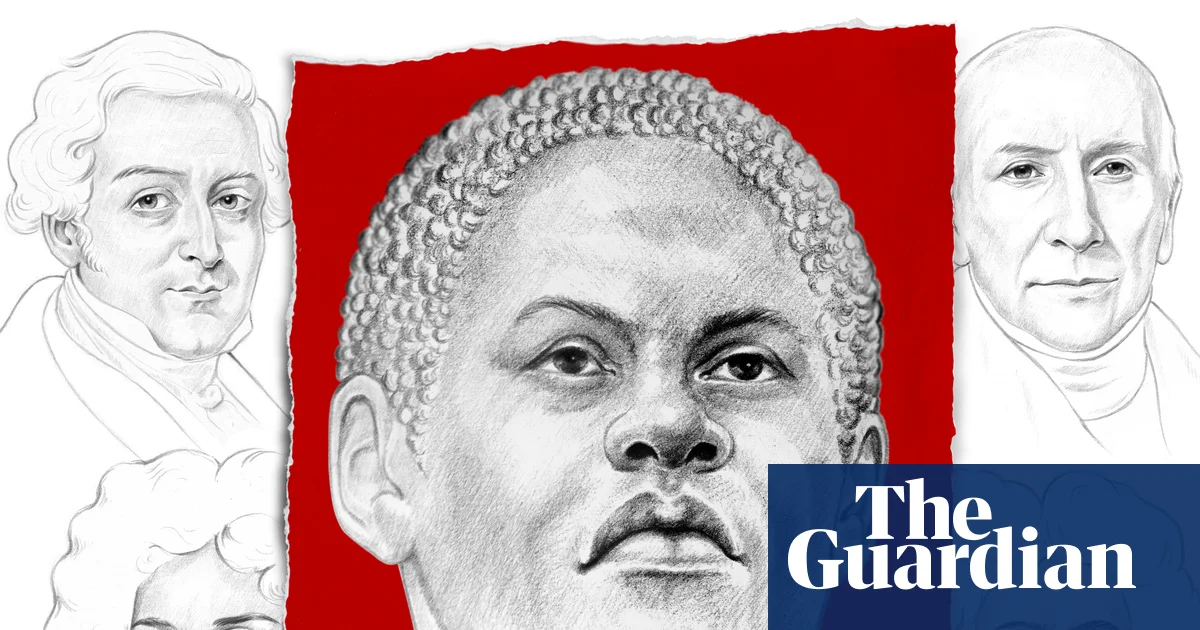
There is a British culture of celebrating the abolition of slavery without acknowledging that the country enslaved and trafficked millions of African people for centuries.
The newly published Register of British Slave Traders, which documents the thousands of investors in Britain’s near 250-year trafficking of more than 3 million enslaved African people, shows that it was a state-backed operation, fully supported by both major political parties at the time, the Tories and Whigs – the forerunners of today’s Conservatives and Liberal Democrats respectively.
Many Tory and Whig MPs were investors in the slave trade, the register shows, and many also owned plantations. But when the movement to abolish the slave trade and enslavement grew in the late 18th century, the Whigs generally moved towards supporting abolition, while Tory governments opposed and delayed it for decades.
The Lib Dem leader, Ed Davey, said in response to the Guardian’s reporting of this history that he supported “full transparency” and it was “vital that we face up to the full truth of Britain’s history”.
The Conservative party referred the Guardian to a post on X by its leader, Kemi Badenoch, in March, in response to a UN declaration that the historic enslavement and trafficking of African people was “the gravest crime against humanity” and reparations should be discussed.
“Britain led the fight to end slavery,” Badenoch posted. “We shouldn’t be paying for a crime we helped eradicate and still fight today.”
More than 50 Tory MPs and about 50 Whig MPs are identified in the register as historic slave traders. Most invested in Britain’s state-backed Royal African Company (RAC) and its predecessors, and some were involved in the South Sea Company.
The involvement of Tories in the RAC was rooted in the foundation of the party. The original Tory faction formed during the 1679 exclusion crisis, in support of the then Duke of York being crowned King James II. Their opponents, the Whigs, sought to prevent James’s succession.
James became king and led the RAC, which trafficked more enslaved people – at least 150,000 African men, women and children – than any other organisation in the history of the transatlantic slave trade.
Many Tories who supported James also invested in the RAC.
Prof William Pettigrew, the lead historian of the register, said: “This platform of support for the Duke of York became the Tory party. Support for the duke’s slave-trading project, the Royal African Company, provided a further rallying point for these early Tories, while early Whigs were opposed to it. Disagreements about the best way to expand the nation’s slave trade were present at the birth of our political parties.”
The Whigs’ opposition was not to enslaving African people, but to the RAC’s royal monopoly. Many Whigs lobbied to expand the slave trade by opening the trafficking to independent “separate traders”.
Sir Benjamin Bathurst, one of many prominent Tories in the register, illustrates the elite status of the RAC investors. He was a friend of King James and Queen Anne, and the Tory MP for New Romney, Kent.
Bathurst was an assistant and leader of the RAC at various points between 1677 and 1700, when the company made 222 transatlantic voyages, transporting tens of thousands of African people to the colonies.
Sir Robert Clayton, a 17th-century banker who was a managing director of the RAC, was a Whig MP for London. Clayton donated money to St Thomas’ hospital – now part of Guy’s and St Thomas’ NHS foundation trust – where a statue commemorates him.
Edward Colston, a dedicated RAC shareholder and assistant whose statue was toppled by campaigners in 2020, was the Tory MP for Bristol in 1710-13.
The register shows more Tory and Whig politicians invested in the RAC after the South Sea Company was formed in 1711. The company was developed by Robert Harley, the chancellor of the exchequer who became leader of the Tory party, and moved into trafficking enslaved people.
In 1713, Queen Anne secured from Spain’s King Philip V an asiento – an agreement to deliver a stipulated 4,800 enslaved African men to Spain’s American colonies every year. Anne gave the asiento to the South Sea Company, which contracted the RAC to fulfil it.
Several Tory and Whig MPs became directors of the South Sea Company, including Sir Richard Hoare, the Tory MP for London and a lord mayor. He founded the private bank Hoares, which is still owned by the family today.
The Whigs, in government for decades in the mid-18th century, supported Britain’s development into the world’s foremost enslaving nation as independent traffickers in Bristol, then Liverpool, industrialised slave trading operations.
When moral opposition finally came, it was an outcry led by enslaved and freed people, Quakers, and in parliament by the independent MP William Wilberforce. Some freed enslaved people, most famously Olaudah Equiano, wrote shocking accounts of their experiences.
The Tories, who were in government almost continuously from 1783-1833, continually delayed abolition, while the Whigs generally moved towards the abolitionists’ view. After the Quakers’ first parliamentary petition in 1783, enslavement remained enforced for 50 years before a new Whig government passed the abolition law in 1833. Party affiliations were not as clear as they are now, and there were exceptions on both sides.
Wilberforce’s motions in parliament to abolish the slave trade, beginning in 1791, were defeated.
The Tory home secretary, Henry Dundas intervened to add the word “gradually” to Wilberforce’s 1792 abolition bill, which was then blocked in the Lords.
Prof David Richardson, the founding director of the Wilberforce Institute at the University of Hull, wrote in his 2022 book that Dundas “played a leading role in killing the abolition bill”. Richardson identified several other Tory ministers, including the “deeply conservative, even reactionary” lord chancellor Edward Thurlow, whom he said were “powerful Tory opponents … to slave trade abolition”. A group of “Whig grandees” was also opposed to abolition, Richardson wrote.
It took until a Whig-led “ministry of all the talents” coalition government briefly replaced the Tories for the law abolishing the slave trade to be passed in 1807. During the 16 years of delay since 1791, the British slave trade was at its peak and trafficked 648,000 more African men, women and children across the Atlantic into enslavement.
When the next campaign was mounted in 1823 to abolish enslavement itself, the Tory government’s response was to delay it indefinitely, claiming enslaved people were not ready for freedom. The foreign secretary George Canning, later a Tory prime minister, had resolutions passed requiring “a progressive improvement in the character of the slave population” before they could be emancipated.
Tories were also at the forefront of claiming that if enslaved people were freed, compensation must be paid to the enslavers. Ultimately, the enslavers were paid £20m public money – the equivalent of £2.7bn today according to the lowest method of calculation. The 800,000 enslaved people in Britain’s colonies were paid nothing and consigned to “apprenticeships” – further years of forced unpaid labour.
In an 1824 Commons debate, Canning made “arguably the most racist speech in the history of the British parliament”, according to the historian Michael Taylor. Canning said: “In dealing with the negro, sir, we must remember that we are dealing with a being possessing the form and strength of a man, but the intellect only of a child.”
Sir Robert Peel, a founding father of the Conservative party, said he had “never objected to the extinction of slavery”, but he spoke in the Commons against immediate emancipation as late as 1833. He urged the house “to recollect the eloquent language of Mr Canning” and repeated Canning’s remarks. Peel claimed emancipation would mean “two distinct and separate races” had to be amalgamated, and the “distinction of colour” was an obstruction.
In 1834, the year after the abolition law finally passed under a Whig government, Peel issued his Tamworth manifesto which is seen as a foundational document of the Conservative party. He became the first Conservative prime minister.
Peel later celebrated emancipation and became associated with stopping the slave trade. As prime minister in 1845, he signed a convention with France that both countries would deploy expanded squadrons of ships to enforce the ban on transatlantic trafficking.
The Legacies of British Slavery archive at University College London, which is based on records of “compensation” paid after 1833, found there were about 80 Tory and Conservative MPs involved in the ownership of enslaved people in the decades before abolition, and in compensation claims. There were also more than 60 Whig and Liberal MPs. The largest total payment to any individual was almost £110,000, the equivalent of £14.6m today, to John Gladstone, the Tory MP who claimed for 2,508 men, women and children enslaved on his plantations in Guiana and Jamaica.
The largest single payment was to the Tory MP James Blair, who owned huge sugar plantations, collectively named Blairmont, in Guiana.
One of Blair’s only two speeches in parliament, in 1824, followed the landmark 1823 uprising of enslaved people in Demerara, Guyana. It was led by an enslaved man on Gladstone’s Success plantation, named Jack, who with his father, Quamina, had the surname Gladstone imposed on them. Quamina had been enslaved and trafficked as a child with his mother from modern-day Ghana and suffered terrible whippings. He was the head carpenter on the plantation and became a deacon at a chapel established by missionaries, where he learned to read and write. According to accounts of the uprising, Quamina was determined that enslaved people should be free, but urged Jack to be cautious.
The British colonial authorities suppressed the Demerara rebellion with their customary extreme violence, killing scores of participants and subjecting others to merciless floggings. More than 50 people were executed, and some were then decapitated, their heads stuck on poles as a warning. Quamina was tracked down and shot and his body put up to rot.
He is now a national hero in Guyana.
A rebellion on Blairmont had been suppressed with similar ruthlessness in 1814, a year before Blair inherited it: the heads of six men were put on poles.
In his 1824 speech, Blair told parliament enslaved people were “mildly and … humanely managed” and argued for a limit to amelioration.
“I conceive that unless a line be drawn and unless we are told where concession is to stop…” he said, “the negroes will never enjoy quiet, nor the planters that undisturbed possession of their property, to which they are by law entitled.”
When abolition finally came, Blair was paid £83,530, equivalent to £11m today, for the loss of his “property” – 1,598 enslaved men, women and children.
In response to the research, a Conservative party spokesperson said: “The Conservatives are proud of our country’s history, leading the world in abolishing slavery. Kemi Badenoch has been clear that in the modern age we must build a meritocracy that does not discriminate on ethnic grounds.”
Davey, the Lib Dem leader, said: “The transatlantic slave trade was an abominable crime against humanity and it is vital that we face up to the full truth of Britain’s history. The Liberal Democrats support full transparency, teaching the complete context of our colonial past in schools, and engaging in open, constructive dialogue with international partners.”
Eric Phillips, the Guyanese vice-chair of the Caribbean Community (Caricom) Reparations Commission, said: “The British Conservative party should examine its history and acknowledge it, not be caught up in this denial of only talking about abolition. The history happened, you can’t change it. Let’s accept it and discuss it, and move towards healing, ways to work together, and mutually beneficial solutions.”
