


- Wildfires across Borneo and Sumatra are raising health risks for local populations, with some health offices reporting rising rates of respiratory disease.
- Mothers in Indonesia’s South Kalimantan province report extensive stress from caregiving and domestic responsibilities as family members fall ill amid harmful air quality caused by hinterland fires.
- A strong El Niño is expected to prolong Indonesia’s main dry season, possibly beyond October, elevating risks to people and wildlife from wildfires.
- Southeasterly trade winds have spread wildfire pollution beyond Indonesia to neighboring Malaysia and Singapore, whose governments have issued health advisories for their citizens.
BANJARMASIN, Indonesia — Siti Sarah slept in fits and starts through August as the fires broke out around her village and surrounding peatlands. One fire on Aug. 18 at first seemed a safe distance away, but in a heartbeat the flames were within 100 meters (330 feet) of her home in Pengayuan, a village in Indonesia’s South Kalimantan province.
“The fire seemed to leap up,” Siti told Mongabay Indonesia. “All of a sudden it was right there — it grew so fast.”
Cries for help echoed around the village as Siti joined the community’s firefighting press. “I also helped put out a fire,” she said. “By whacking it with a piece of wood.”
Two days later, firefighters scrambled to extinguish yet another blaze in the village grounds, dousing the flames before they could reach any homes.
Across Indonesia, community and government firefighters have been battling fires like this since the main dry season began in July, many of them burning across carbon-rich peatlands in the low-lying deltas and plains of Borneo and Sumatra.
In recent decades, Borneo’s peatlands have been drained for oil palm plantations to meet rising global consumer demand for palm oil. Fire is often used as a cheap way to clear land, but the flames can quickly run out of control across drained peatlands, which become a tinderbox when desiccated by El Niño-fueled drought.
In western Borneo, animal rescuers are scrambling to save orangutans stranded by the fires, while smoke blankets towns and villages across the island, sickening residents and upending daily life.
Southeasterly winds have carried smoke from Indonesia’s wildfires across borders into Malaysia and Singapore, prompting health advisories in both countries.
During the Southeast Asian wildfire catastrophe of 2015, also fueled by a strong El Niño and positive Indian Ocean Dipole, Indonesia’s total carbon dioxide emissions from fires overtook those of the entire U.S. economy on several days, and were estimated to have caused more than 100,000 premature deaths across Indonesia, Malaysia, and Singapore.
The fires this year have left Siti on edge. She said she’s reluctant to leave her home, while nightfall brings little relief: even the prospect of falling asleep makes her anxious.
“I’m worried that a fire will suddenly start,” Siti said.
The smoke slips under doors and seeps through windows, leaving Siti dizzy and struggling to breathe. Fine airborne particles aggravate the asthma she was diagnosed with as a child.
“These particles are extremely fine,” said Syamsul Arifin, the dean of Lambung Mangkurat University’s medical faculty. “They can’t be trapped by nasal hairs, so they’re inhaled down to the alveoli [in the lungs] and into the bloodstream.”

Siti recalled similar fires breaking out around the village as far back as her teenage years.
“Often I can’t even lie down,” she told Mongabay Indonesia. “I can just sit up because I’m that out of breath — particularly when the nights are really cold.”
She said she felt the strain accumulate as her husband, three children, and her father all fell ill. Coughing reverberated through the house as health workers arrived to treat the family.
“How can we prevent this from happening again?” Siti said. “The government should be more serious about handling this.”
For families like Siti’s, the smoke can be a threat to life. Pneumonia is the leading cause of death from infectious diseases among children under the age of 5 worldwide, killing more than 700,000 infants each year.
Air pollution is a principal risk factor for respiratory disease in children, with UNICEF, the United Nations children’s agency, specifically identifying wildfire smoke among the sources of pollution that can threaten health.
“It causes systemic inflammation and disorders of various organs,” said Syamsul, the medical school dean. “[Acute respiratory infection] is the most frequently reported morbidity during forest and land fires.”
The danger is particularly stark in Borneo and Sumatra, where wildfire smoke can envelop homes and communities for weeks at a time, exacerbated by the effect of El Niño.

Pneumonia risks
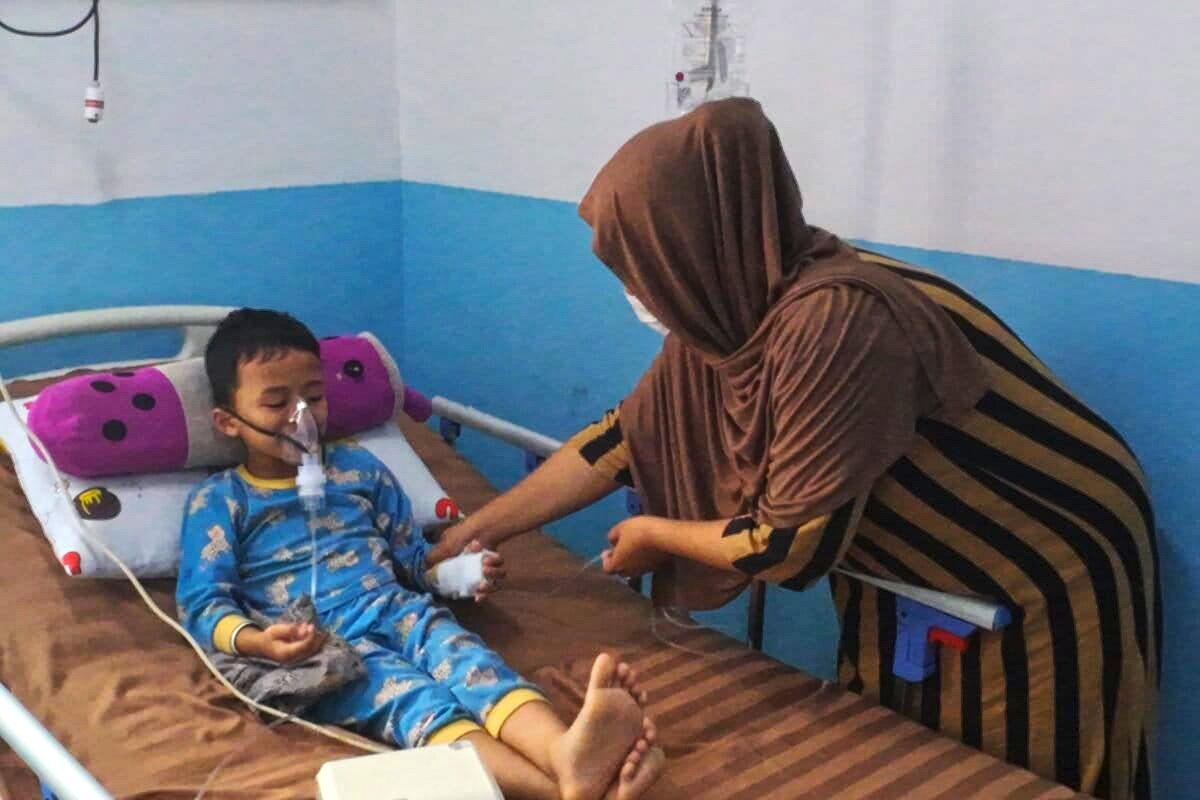
Raina, who lives in Pemurus Dalam village, also in South Kalimantan province, began to worry not long after her only child, Muhammad Raihan, developed a cough in July.
The 29-year-old mother suspected her son had simply contracted a typical bug from another child, but the situation soon became urgent as fires spread across southern Borneo.
“Because the weather was so hot, and it was his first time at school, perhaps due to exhaustion, his illness worsened,” Raina told Mongabay Indonesia on Sept. 3. “He didn’t get better for three weeks, and even went on to develop a fever.”
Raina took the 5-year-old to the community health clinic, where he received medication for his fever. But Raihan’s condition worsened, and on the last Sunday in August he spent all night throwing up.
Raina cared for Raihan at home for three days, but on Sept. 2 they rushed him to a hospital in the provincial capital.
The doctors there caught Raihan’s pneumonia in time, but across Indonesia every year thousands of other children under the age of 5 will not survive. UNICEF estimated in 2018 that around 19,000 children die annually because of preventable pneumonia.

Data from the South Kalimantan provincial health department showed health workers diagnosed 36,196 cases of acute respiratory infection from July 12 through Aug. 15 in the province of around 4.4 million people.
“Vulnerable groups, such as children, the elderly, pregnant women, and people with lung and coronary disease need to be given greater attention,” said Diauddin, the health department head, adding that the link between respiratory tract infections and fires could not yet be established.
“I’m traumatized by this smoke,” Raina said, adding that she had spent millions of rupiah, perhaps hundreds of dollars, on out-of-pocket health care costs to save her son.
This fire season is already shaping up to be one of Indonesia’s worst in years. FireWatch, a satellite-monitoring platform developed by the nonprofit Nusantara Atlas, recorded more fire hotspots through Sept. 8 than during the same period in 2019, one of Indonesia’s most severe wildfire years.
“The government must find a way to prevent fires like this from recurring every year,” Raina said.
Banner image: Raina accompanies her only son, Muhammad Raihan (5), who is undergoing treatment at the Banjarmasin Islamic Hospital after experiencing respiratory complaints amid the haze from forest and land fires earlier this month. Image by Riyad Dafhi Rizki/Mongabay Indonesia.
This story was first published here in Indonesian on Sept. 8, 2026.
Six things to know about Asia’s heatwave and the health impacts
Rescuers scramble to save orangutans as El Niño-boosted fires spread across Borneo

