


Welcome to Foreign Policy’s South Asia Brief.
The highlights this week: India gears up for the BRICS leaders’ summit this weekend, Nepal’s youth movement marks its protest anniversary as the country reels from deadly floods, and Bangladesh’s energy crunch puts pressure on the government.
New Delhi Preps for BRICS Summit
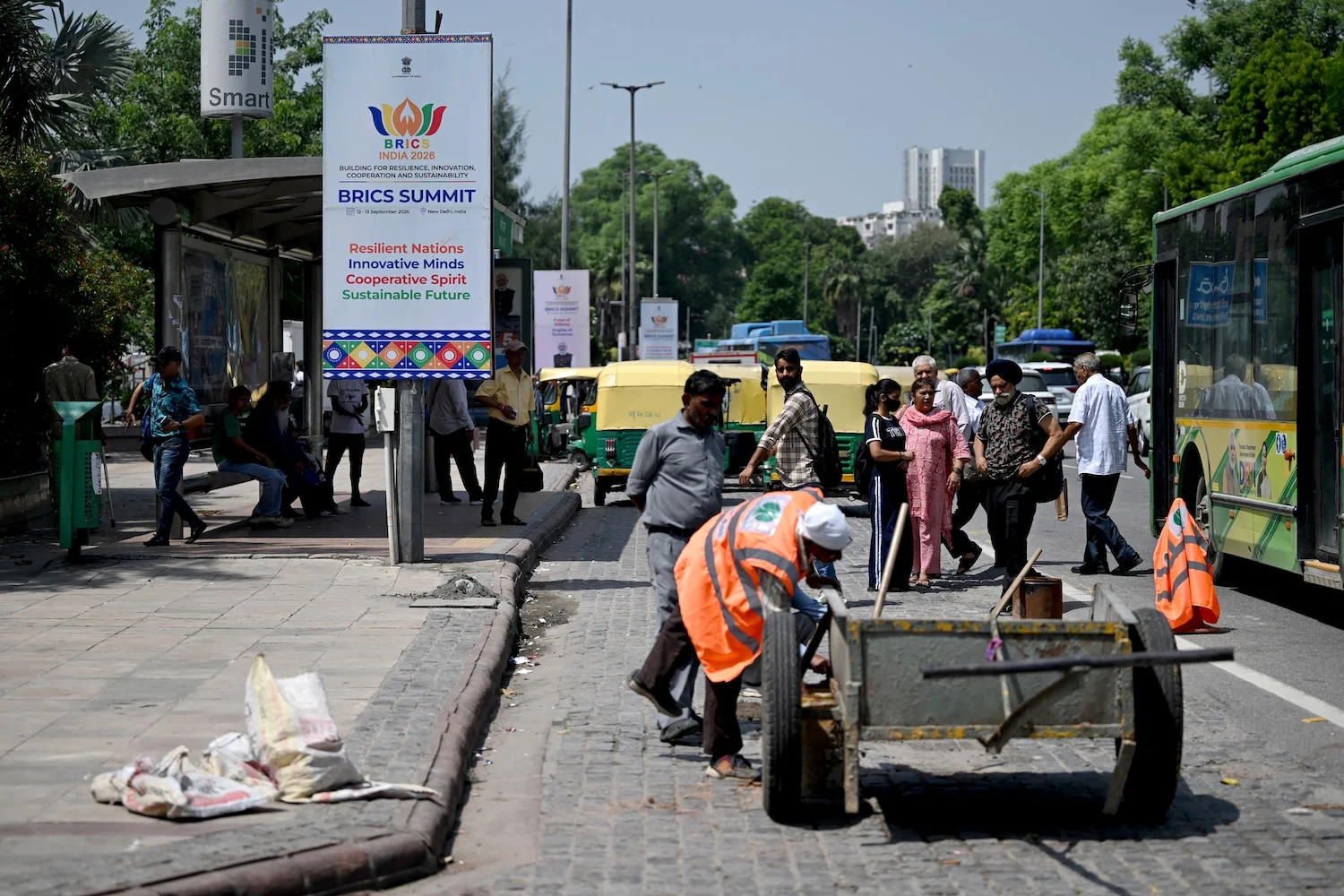
India’s government is pulling out all the stops ahead of the BRICS leaders’ summit hosted in New Delhi on Sept. 12 and 13. Commandos are staging security protocol drills; police are carrying motorcade rehearsals; and city officials are executing a makeover that includes fixing roads, planting flower beds, and deploying BRICS branding.
BRICS—named after its original members of Brazil, Russia, India, China, and South Africa—has long been a critical institution for India. New Delhi balances its membership in the grouping, meant to provide alternatives to Western economic institutions, with its close ties with the West; in doing so, it bolsters its strategic autonomy.
The core goals and priorities of BRICS align with Indian ones: engagement with the global south, advocating for United Nations reform, embracing multilateralism. Most BRICS members are also top Indian partners, and India’s ongoing albeit modest rapprochement with China certainly helps.
The grouping expanded in 2024, and aside from Iran, every new member is a close Indian friend. They include Egypt, Ethiopia, Indonesia, and the United Arab Emirates.
This year’s leaders’ summit, which follows a BRICS foreign ministers’ forum in New Delhi in May, is especially significant for India, though. The high-level summit offers the world’s fastest-growing major economy an opportunity to showcase its convening power and reassert its global leadership.
India hasn’t regressed in this realm per se, but in recent months it has been somewhat upstaged in international diplomacy by its rival Pakistan, thanks to Islamabad’s lead mediation role in the Iran war and its increasing influence in the Middle East—from growing arms sales to participation in new bilateral and multilateral defense pacts with regional allies.
Further, the BRICS summit provides India with an important space for deeper engagement with the global south amid rising discontent with the Western-led global economic order. New Delhi takes very seriously its goal of becoming a leader of the global south—an objective tied to both its great-power aspirations and historical leadership of the Non-Aligned Movement decades ago.
But this effort faces obstacles, especially given India’s limited inroads in Latin America and Africa. Notably, China has a major investment presence in both regions and also seeks to assert itself as a global south leader. The upcoming summit gives Indian Prime Minister Narendra Modi a chance to engage bilaterally with the leaders of Brazil and new member Ethiopia.
Finally, this weekend’s summit provides India with a platform to make a strong pitch for freer markets and trade and more multilateralism amid U.S. President Donald Trump’s second-term policies, especially high tariffs. These policies probably inspired one of the themes of the summit, economic resilience.
This theme is sure to resonate among all BRICS members, and India’s approach aims to ensure consensus for a strong joint statement—an outcome that New Delhi considers essential for a successful summit.
The lead-up to BRICS leaders’ summits tends to produce contrasting commentary. One position dismisses the grouping as irrelevant, a talk shop incapable of producing anything of substance. The other celebrates it as a counter to the Western-led global order.
Both arguments are flawed: BRICS has produced new initiatives, including its own development bank. At the same time, poor relations among some of the new members, heavy reliance on the U.S. dollar, and a lack of clarity around the group’s ultimate objectives constrain its ability to fully take on the West.
Ultimately, BRICS is a significant grouping with considerable limitations. But for India, the calculus is simple: BRICS, warts and all, is a critical vehicle to advance its core foreign-policy interests.
What We’re Following
Nepal’s youth movement marks anniversary. A year ago this week, young people in Nepal took to the streets to denounce corruption and nepotism. The protests ousted the government in less than 48 hours, ushering in a caretaker government. Elections in March propelled to power the anti-corruption Rastriya Swatantra Party (RSP), which had never held power before.
The RSP-led government helmed by Prime Minister Balendra Shah, the popular 35-year-old former mayor of Kathmandu, didn’t take long to position itself as a very different kind of political player. It released a 100-point governance reform agenda and took unconventional positions; Shah initially refused to meet with foreign officials not of equal or similar rank before changing course.
Six months after taking office, the government has been put to the test by the massive floods two weeks ago that killed an estimated 1,400 people in Nepal, with nearly 6,000 still missing. Even amid catastrophe, the government has acted like a maverick, initially declining foreign search-and-rescue teams, and now requesting $20 billion in climate change compensation.
Nepal initially called on neighbors China and India to provide aid, but it has asked for support via the U.N. loss and damage fund. Unfortunately for Kathmandu, 119 countries have made similar requests totaling $2.8 billion; only $400 million has been provided.
Bangladesh faces pressure on energy crunch. Bangladesh is grappling with a long-running energy crisis, and its new government is feeling pressure to address it. The opposition launched a long march in Dhaka over the weekend, with plans to reach Chittagong. On Monday, opposition leader Shafiqur Rahman, who heads the Jamaat-e-Islami party, said in parliament that Dhaka should establish a task force to tackle the crisis.
The Bangladesh Nationalist Party government led by Prime Minister Tarique Rahman surely knew that energy would be one of its biggest initial policy challenges when it took office in February. Bangladesh has suffered serious shortages in recent years due to diminishing supplies of domestic fuel. The wars in Iran and Ukraine have worsened the crisis; Bangladesh relies heavily on foreign hydrocarbon imports.
Recent industrial accidents, including fires at gas facilities, have made matters worse. Bangladesh has been less successful than many of its South Asian neighbors in embracing renewables to cushion the blow of oil and gas supply shocks. Dhaka recently vowed to expand domestic gas production and tap into clean fuels.
But this hasn’t appeased the opposition or a restless public, and Rahman now faces the first major protest movement targeting his government.
More violence on Afghanistan-Pakistan border. Last Thursday, Pakistan’s military said it had killed 15 militants attempting to enter the country from Afghanistan. Its statement identified them as members of Tehrik-i-Taliban Pakistan (TTP), which carries out attacks in Pakistan and which Islamabad accuses the Taliban regime in Afghanistan of sheltering.
The links between the TTP and the Taliban—and Pakistan’s contention that Afghanistan provides sanctuary to the militants—have sparked serious tensions between the two countries since the Taliban returned to power in 2021.
The Taliban have not responded publicly to the Pakistani military’s recent statement. This silence is striking, given that the Taliban have repeatedly rejected claims that they shelter militants. The lack of response might indicate ongoing third-party efforts to ease tensions: Last week, the Chinese and Pakistani special envoys for Afghanistan reportedly met in Islamabad.
However, previous external mediation efforts have failed to end the crisis. Islamabad continues to insist that the Taliban regime provide verifiable and written assurances that bases on Afghan soil won’t be used for terrorism against Pakistan.
Under the Radar
Last Wednesday, Sri Lanka announced that U.S. and Sri Lankan officials had busted a large drug smuggling operation that was attempting to use the country as a stop on the way to international markets. Sri Lankan police said anti-narcotics authorities from both countries seized about half a ton of crystal methamphetamine that arrived in a shipping container the previous weekend.
Two Pakistani citizens were reportedly arrested in the sting. The U.S. Embassy in Colombo made a similar announcement, noting that $2 million worth of drugs were found hidden in bath towels in the shipping container.
But this story has a curious twist. On Friday, Pakistan’s anti-narcotics agency issued its own statement announcing that Islamabad had worked with partners in the United States and Sri Lanka to bust a narcotics trafficking network. Pakistani officials said the raid in Sri Lanka was preceded by a Pakistani operation in Karachi in July.
Additionally, while the U.S. and Sri Lankan statements described the drug ring as Pakistan-based, the Pakistani statement said it originated in Afghanistan. The reason for this discrepancy is unclear, though Pakistan would have an incentive to downplay drug trafficking on its own soil and emphasize the culpability of Afghanistan.
Either way, trilateral cooperation between the United States and partners in South Asia is unusual. But in this case, it would make sense: Washington currently has warm ties with both Colombo and Islamabad, and Sri Lanka is one of Pakistan’s few close friends in the region.
FP’s Most Read This Week
Regional Voices
In the Indian Express, journalist Aakash Joshi laments the killing of Chongtham Vikram Singh, a musician and member of an ethnic minority from India’s Manipur state. “Between the many whys and the single how of a murder in Delhi, there’s all the anger, inequality, bigotry and dehumanization that we accept every day,” he writes.
A scathing Kathmandu Post editorial accuses Nepal’s government of reneging on its reform pledges a year after the Gen Z protests: “The most profound failure of accountability is the treatment of those who bled for this political change. A year later, wounded protesters are trapped in state neglect while new leaders thrive.”
In the Daily Star, scholar Manzoor Ahmed argues that Bangladesh must adapt new strategies for combating illiteracy, which remains a persistent challenge. “Technology could help reshape how foundational skills are taught, moving away from rigid, under-resourced classrooms towards flexible learning environments,” he writes
