


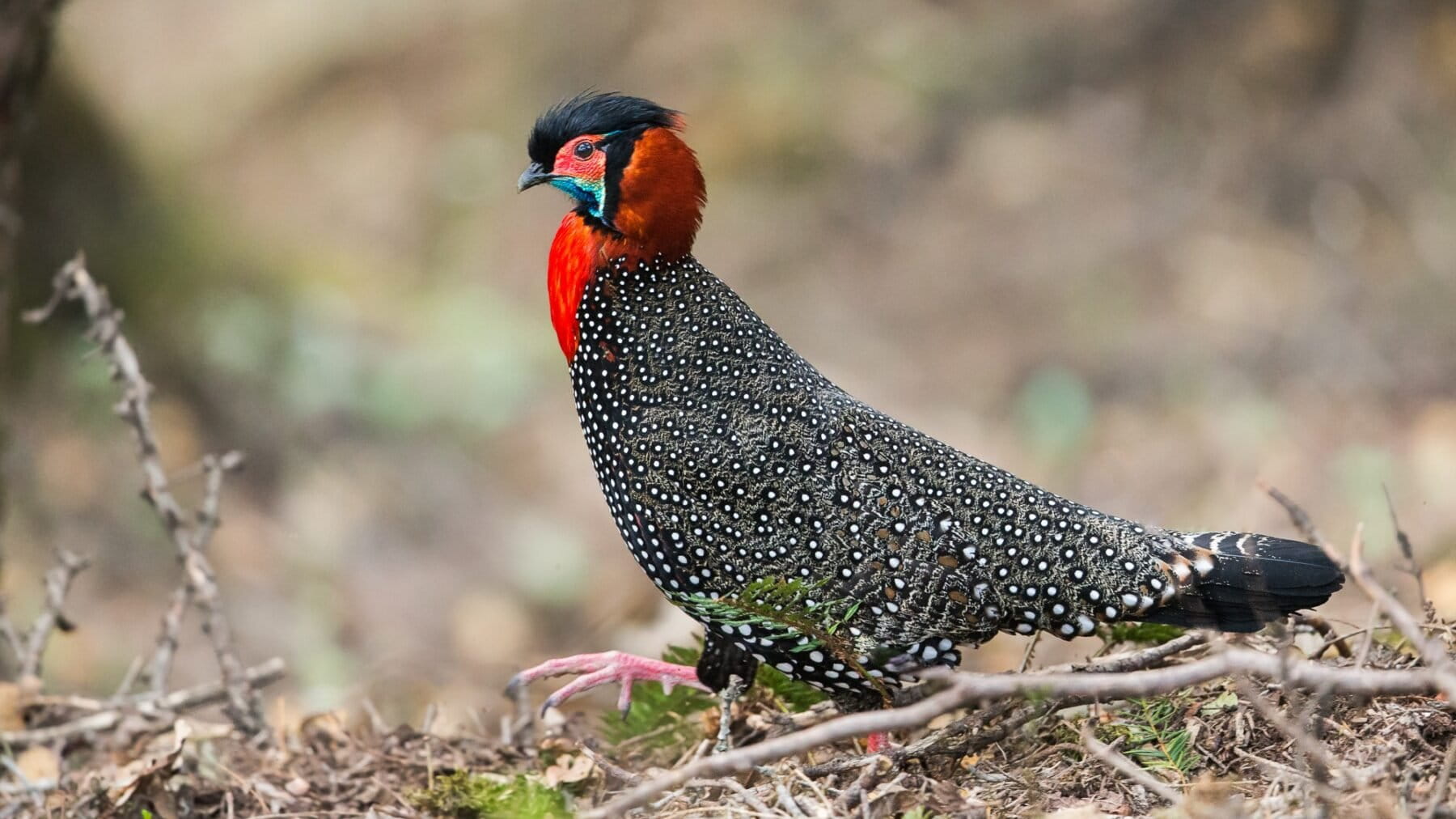
In the Indian Himalayas, numerous species of colorful pheasants roam the understory, pecking at seeds, roots, leaves, berries, and insects. These large, ornate birds are vital to the Himalayan ecosystem. But some species now face increasing pressures from habitat degradation and hunting, reports contributor Hirra Azmat for Mongabay India.
Among them is the white-crested kalij pheasant (Lophura leucomelanos hamiltoni). It’s a highly adaptable bird capable of living in habitats ranging from coniferous forests to scrublands and forest edges near human settlements.
“Like other pheasant species, it plays an essential role in Himalayan ecosystems by forming a major prey base for carnivores and raptors,” said Arif Nabi Lone, a researcher at the University of Kashmir’s Department of Zoology. “Besides, it also acts as a seed disperser and soil aerator.”
The white-crested kalij pheasant isn’t considered threatened on the IUCN Red List. However, in a 2025 study, Lone and his colleagues interviewed communities around two protected areas in the Indian-administered region of Jammu and Kashmir, and identified several threats to the bird, including habitat degradation, hunting, livestock grazing, and mushroom collection.
“Timber and firewood collection, resource extraction and deforestation are degrading its habitat,” Lone said. “Hunting and overgrazing are other serious threats. Mushroom collection is particularly concerning because it coincides with the breeding season, and people searching for mushrooms often disturb nesting females, reducing their breeding success.”
Human activities may also be threatening a rarer pheasant species: the western tragopan (Tragopan melanocephalus). Listed as vulnerable on the IUCN Red List, the bird is endemic to the western Himalayas, where it depends on undisturbed oak and conifer forests with a dense understory of shrubs.
Riyaz Ahmad, former head of the Jammu and Kashmir chapter of wildlife conservation for the nonprofit Wildlife Trust of India, told Mongabay India that the western tragopan is also vital to the Himalayan ecosystem as prey, predator, and seed disperser. However, it’s an extremely shy bird that flees at the slightest disturbance, making it difficult to study.
“The bird is usually detected during the breeding season, when males become more vocal and advertise for mates,” Ahmad said. Some estimates based on their calls suggest there may be fewer than 300 of the birds left in Jammu and Kashmir, though long-term population trends remain unknown.
What’s certain is that their forest home is increasingly being degraded and fragmented by livestock grazing, tree felling, collection of forest resources, and other human pressures, Ahmad said. Climate change could also push the species to higher elevations to find suitable habitats, a 2020 study suggested.
“The western tragopan is a barometer of pristine habitats,” Ahmad said. “If its numbers decline, it is a warning that something is going wrong in these ecosystems. Regular monitoring, especially within protected areas, can help us assess whether our conservation efforts are working.”
Read the full story by Hirra Azmat here.
Banner image: The western tragopan depends on undisturbed mountain forests for survival. Image courtesy of Jainy Maria.
