


Unlock the Editor’s Digest for free
Roula Khalaf, Editor of the FT, selects her favourite stories in this weekly newsletter.
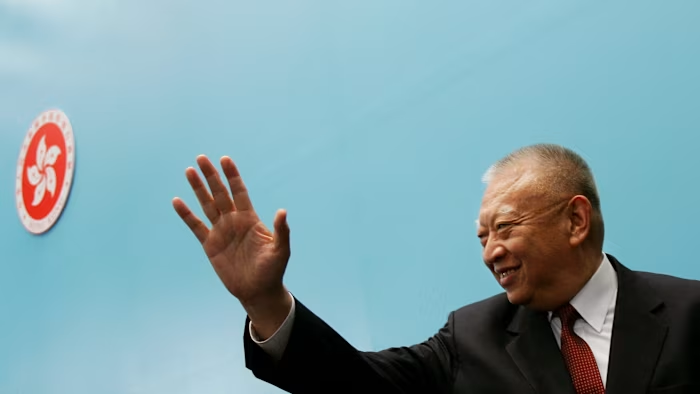
When shipping tycoon Tung Chee-hwa was handpicked by a group of pro-Beijing business and political elites to run Hong Kong as the former British colony’s first Chinese leader after its handover to China in 1997, he vowed to create “a better tomorrow” for the then freewheeling city.
But Tung, who died on Tuesday at the age of 89, set the city on a path that led to Hongkongers’ deepening divide with Beijing and spawned a desire for greater democracy.
Tung’s main mission during his tenure as leader was to put Deng Xiaoping’s “One Country, Two Systems” mantra — a vision of governance aimed at preserving Hong Kong’s capitalist system while aligning it with communist China — into practice.
But the first few years of his administration in Hong Kong were marred by the 1997 Asian financial crisis, the Sars epidemic and his mishandling of a controversial anti-subversion bill in 2003 that brought half a million people to the streets.
Born in Shanghai in 1937 and the eldest of five siblings, Tung arrived in Hong Kong at the age of 12. His family was among a group of Shanghai capitalists who fled Communist China and moved to Hong Kong in the late 1940s, benefiting from the city’s role as an entrepôt between east and west.
Tung’s arrival in Hong Kong coincided with a period of rapid growth for his family’s Orient Overseas Container Line, of which he was a second-generation scion. The company grew into one of the world’s largest container shipping groups before it was acquired by Chinese state-owned Cosco in 2018. His net worth was $3.2bn, according to Forbes.
Tung graduated from the University of Liverpool in 1960 with a BSc in marine engineering and went on to work as an engineer at General Electric in Massachusetts.
In 1969, he returned to Hong Kong to join the family enterprise, eventually assuming control in 1982 after the death of his father.
Tung entered the political arena a little more than a decade before the 1997 handover. He helped draft the Basic Law, Hong Kong’s mini-constitution, and worked as a member of the territory’s executive council, an advisory body for the British governor, and as a consultant to China’s top politicians. Nonetheless, he was little known to the public before he was tapped as the first chief executive.
“Prior to . . . becoming chief executive, he wasn’t directly involved with politics at all,” said Roger King, Tung’s brother-in-law and adjunct professor of finance at Hong Kong University of Science and Technology.
King argued it was Tung’s business acumen that Beijing, looking for a pragmatic leader who could make tough decisions for the city’s post-handover future, valued. “He was the right person at the right time.”
In 2002, he championed Article 23, a sweeping Beijing-backed bill that targeted treason and theft of state secrets, in the face of fierce resistance. The bill was seen by lawyers, journalists and businesses as a threat to freedom of speech.
A year later on July 1, the anniversary of Hong Kong’s handover to Beijing, more than 500,000 people took to the streets to protest against the legislation — as well as Tung’s handling of the Sars epidemic that year. Many of them demanded he step down.
The bill was eventually withdrawn following the protests but revived by current chief executive John Lee and passed in 2024.
The mass demonstrations in 2003 set in motion nearly two decades of street rallies by Hongkongers fighting for greater democracy, whose ideals clashed with Beijing’s ambitions for a more tightly controlled model of governance.

Apart from Article 23, Tung was known for bringing Disneyland to Hong Kong and setting goals for the mass construction of homes to tackle soaring house prices. But many of his plans backfired amid criticisms over crony capitalism and a weakening economy following the 1997 Asian financial crisis. Tung’s homebuilding policies also contributed to a collapse in property prices.
The benchmark Hang Seng index declined by nearly half between 1997 and 1998. It only returned close to the level at which he assumed power when he stepped down in 2005.
One of Tung’s favourite maxims was: “When Hong Kong succeeds, China will benefit. When China succeeds, Hong Kong will prosper.”
However, many Hongkongers lamented the city’s diminishing status as a financial centre in the years after the handover as its importance to Beijing declined.
Today, the territory contributes roughly 2 per cent of China’s GDP, significantly down from 18 per cent in 1997. Property prices, however, are among the world’s highest as a flurry of investment from mainland China over the past decade pushed prices to record levels.
Tung’s death comes as Hong Kong’s economy has begun to slowly recover, with growth, visitor numbers and investment all rebounding after a series of political crackdowns and stringent Covid-19 travel bans severely dented the city’s international prestige.
But the rebound has been driven by an influx of Chinese companies listing on its stock exchange and the city is binding its future ever closer to that of the mainland.
Tung had not made a public appearance for years and had been absent from official celebratory events, including the annual handover day flag-raising ceremony, since 2020.
