

Close Menu
NCIJ Network NCIJ Network
    What's Hot

    Yemen’s war is back: A new battle for Sanaa and the Red Sea | Houthis News

    September 8, 2026

    Iceland summons US ambassador over Trump’s stars and stripes map

    September 8, 2026

    UK announces sanctions on West Bank settlements prompting furious Israeli response

    September 8, 2026
    Facebook X (Twitter) Instagram
    Trending
    • Yemen’s war is back: A new battle for Sanaa and the Red Sea | Houthis News
    • Iceland summons US ambassador over Trump’s stars and stripes map
    • UK announces sanctions on West Bank settlements prompting furious Israeli response
    • Here’s Samsung’s Advice for Apple and Its Upcoming Folding iPhone
    • Windows 11 cumulative updates KB5124008 & KB5122880 released
    • Capital B Buys 376 Bitcoins In Its Biggest Purchase Of 2026
    • A choir of katydid ancestors filled the Jurassic rainforest with song
    • New-to-science Amazon frog stands out for its slow ‘lazy’ song
    • About
      • Our Team
      • Editorial Policy
      • Editorial Independence
      • International Support
    • Trust & Standards
      • AI Usage Policy
      • Conflict of Interest Policy
      • Corrections Policy
      • Ethics Policy
      • Fact-Checking Policy
      • Source Protection
    • Get Involved
      • Guide for Sources
      • Support Independent Journalism
    • Legal
      • Cookie Policy
      • Privacy Policy
      • Terms of Use
    Facebook X (Twitter) Instagram
    NCIJ Network NCIJ Network
    Tuesday, September 8
    • Home
    • World
    • Ai
    • Business
    • Politics
    • Health
    • Crypto
    • Science
    • Technology
    • Cybersecurity
    • Defense & Security
    • Economy
    • Energy
    • Europe
    • More
      • Fact Check
      • Investigations
      • Opinion & Analysis
      • Environment
    NCIJ Network NCIJ Network
    Home»Science

    A choir of katydid ancestors filled the Jurassic rainforest with song

    NCIJ NETWNCIJ NETWORKBy NCIJ NETWNCIJ NETWORKSeptember 8, 2026 Science No Comments5 Mins Read
    Share
    Facebook Twitter LinkedIn Pinterest Email

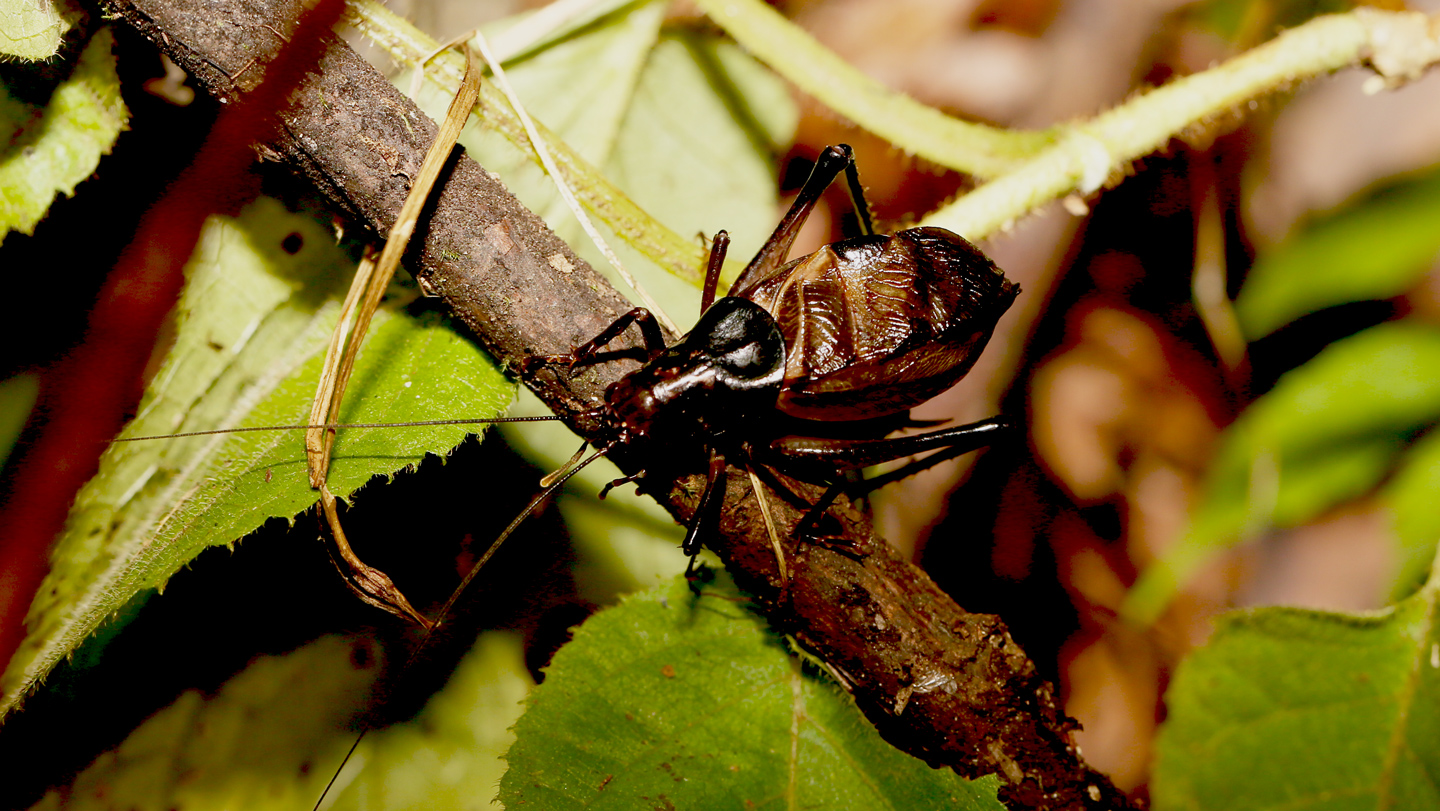
    A symphony of insect songs rang through the Jurassic rainforest, and scientists have now found the traces of this ancient soundscape.

    Based on an analysis of fossilized katydid ancestors, the notes these insects played by strumming their wings can be reproduced, researchers report August 25 in the Proceedings of the National Academy of Sciences.

    “Most fossils tell us about anatomy — shape, size, structure,” says Jun-Jie Gu, an evolutionary biologist at Sichuan Agricultural University in Chengdu, China. “But these fossils preserve something far more ephemeral: sound.”

    Sign up for our newsletter

    We summarize the week’s scientific breakthroughs every Thursday.


    The rocks holding the remains of these ancient insects come from rural Daohugou, China. This landscape of hills and grasslands was a hot, humid forest with giant ferns and ancient conifers during the Jurassic Period, 200 million to 145 million years ago. It hosted a stunning array of insects, Gu says, including ensiferans, the group that includes katydids, crickets and grigs.

    The fossils reveal the wing structures used to make mating calls. They’re like “nature’s violin,” says biophysicist Fernando Montealegre-Zapata, of the University of Lincoln in England. One wing sports a row of microscopic teeth. As the wings close, a scraper on the other wing hits the teeth, making vibrations that are amplified by the rest of the wing. This forms what the team calls a syllable, the basic unit of sound. The song emerges as the creatures rhythmically open and close their wings. 

    This high-speed video of a male two-spotted cricket (Gryllus bimaculatus) shows how its wings make vibrations when opening and closing.J.-J. Gu et al./Proceedings of the National Academy of Sciences, 2026

    For 20 fossils representing nine extinct species, the team simulated wing acoustics based on the teeth spacing, wing size and wings’ vibrating area. The researchers also used an evolutionary family tree to home in on each species’ call frequency, or its pitch. They checked their process by reproducing the calls of living katydids, crickets and grigs based on photos of these insects’ wings. This confirmed that the measurements needed to figure out the animals’ sounds can be obtained from the kinds of 2-D images of wings made from photos of fossils. 

    The cadence, or repetition, of those syllables isn’t clear from the fossils, Montealegre-Zapata says. So the team looked to living ensiferans, whose repertoire is related to body shape and size and changes with temperature. The team trained a machine learning model with those characteristics and used the temperature of the Jurassic rainforest to simulate ancient insect calls. The result was a chorus of katydid ancestor calls.

    The work is “very exciting,” says Roy Plotnick, a paleobiologist at the University of Illinois Chicago who was not involved with the study. The team is “able to show that each particular species had a distinctive sound,” or characteristic frequency, which could be used for mate recognition, he says.

    Scans of these ancient insects’ ears, which are located on their forelegs, support the notion that these insects hear those of their own kind.

    A Jurassic soundscape

    How can a fossil tell us what an insect sounded like 165 million years ago? Scientists used details preserved in the wings of Jurassic insects to reconstruct their calls. Listen to each call while seeing the fossil used to re-create the sound.

    J.-J. Gu et al./Proceedings of the National Academy of Sciences, 2026

    Sponsor Message


    The Jurassic insects’ sounds are clear and musical, unlike buzzing or hissing sounds, which contain many frequencies. The source of musical tones can be difficult for mammalian predators to identify based on the physiology of their ears. So these single note tones could have helped the creatures stay somewhat inconspicuous to predators while sending communiques to potential mates, says Daniel Robert, a biophysicist at the University of Bristol in England.

    One of the nine ancient species produced calls in the ultrasound, above the range of human hearing. This creature evolved nearly 100 million years before bats evolved with their ears attuned to ultrasonic frequencies.

    Meanwhile, other groups have found fossils of early mammals from the same formation in China. Their work on a shrewlike critter’s preserved inner ears suggests that their hearing range could capture the calls of some katydid forerunners. These insects may have been evolving to escape the hearing range of hungry mammals, which in turn may have evolved to hear higher pitches, Montealegre-Zapata says.

    “That’s a very stimulating thought — a very interesting hypothesis — but it needs to be tested,” says Zhe-Xi Luo, a paleobiologist at the University of Chicago who wasn’t involved with the study. Luo’s team is working to better understand the hearing capability of early mammals by comparing their hearing structures with those of modern mammals. But it’s likely, he says, that insects were just abundant in the Jurassic and early mammals evolved capabilities to exploit the glut of food.

    There’s still much to learn about the soundscape of the Jurassic and that of even earlier periods, Plotnick says. Researchers could search other fossils for insect body parts that make sound by rubbing together.

    “We often think of fossils as silent stones,” Gu says, “but our work shows that we can actually hear what 165-million-year-old animals were saying.”

    ancestors choir filled Jurassic katydid rainforest Song
    NCIJ NETWNCIJ NETWORK
    • Website

    Keep Reading

    New-to-science Amazon frog stands out for its slow ‘lazy’ song

    1,000 Museum Visitors Dive Into NASA Sea Level Science on World Ocean Day

    NASA Technique for Manipulating Satellite Photos Now Reveals Ancient Images  

    Innocent-looking AI reasoning can make bad behavior harder to catch

    The Otherworldly Geology of Vasquez Rocks

    Bovine TB: Gaps in evidence about impact of vaccinating badgers

    Add A Comment
    Leave A Reply Cancel Reply

    Editors Picks

    Yemen’s war is back: A new battle for Sanaa and the Red Sea | Houthis News

    September 8, 2026

    Iceland summons US ambassador over Trump’s stars and stripes map

    September 8, 2026

    UK announces sanctions on West Bank settlements prompting furious Israeli response

    September 8, 2026

    Here’s Samsung’s Advice for Apple and Its Upcoming Folding iPhone

    September 8, 2026
    Latest Posts

    Researchers Report 84 Flaws in 4G and 5G Cores, Including a Session Hijacking Flaw

    August 1, 2026

    AI in Formula One: Competitive advantage is all about the human in the loop

    August 1, 2026

    Pedro Sánchez hits out at EU leaders over criticism of Spain’s migrant crisis

    August 1, 2026

    Subscribe to News

    Get the latest sports news from NewsSite about world, sports and politics.

    NCIJ Network is an independent digital news platform delivering trusted investigative journalism, European and global news, in-depth analysis, and fact-based reporting with accuracy, transparency, and integrity.

    Facebook X (Twitter) Instagram Pinterest YouTube

    Yemen’s war is back: A new battle for Sanaa and the Red Sea | Houthis News

    September 8, 2026

    Iceland summons US ambassador over Trump’s stars and stripes map

    September 8, 2026

    UK announces sanctions on West Bank settlements prompting furious Israeli response

    September 8, 2026

    Subscribe to Updates

    Get the latest creative news from FooBar about art, design and business.

    Type above and press Enter to search. Press Esc to cancel.