


In November 1998, Gaza International Airport opened to much fanfare, a bagpipe and red carpet on hand to welcome the landing of the first jet. U.S. President Bill Clinton subsequently hailed this moment as a tangible outcome of the Oslo peace agreements. European countries had footed much of the airport’s $86 million bill.
Three years later, during the Second Intifada, Israeli forces bombed the airport’s control tower and later bulldozed the runway—while also destroying other EU-funded development projects. The fate of the Gaza airport came to symbolize the predicament Europe found itself in. When it comes to the Israeli-Palestinian conflict, Europe is seen as a “payer, not a player.”
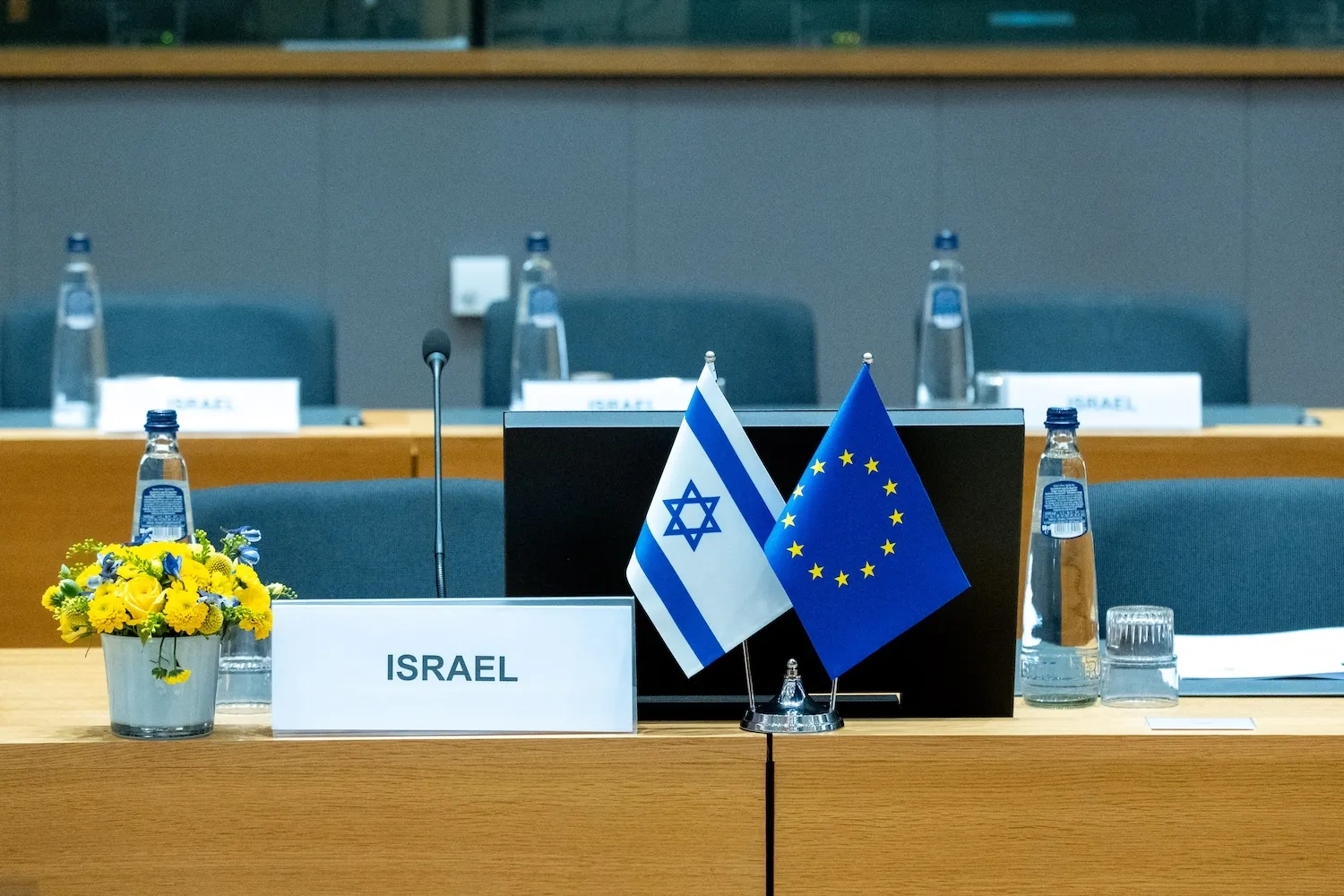
As Europe now faces a reckoning over its Israel policy and grows less willing to defer to Washington, the EU has a chance to become a player. Through “constructive conditionality”—backing Israel’s legitimate security needs while making further cooperation contingent on respect for international law and Palestinian rights—it can advance a more independent foreign policy and, by building a landing pad for eventual U.S. policy shifts, extend the weight of its choices beyond its borders.
For decades, European policy toward Israel has largely deferred to Washington. The 27 EU member states are deeply divided. Historically, a minority, led by Ireland, has strongly favored Palestinian independence, while a bigger group, led by Germany, has unwaveringly stood by Israel, with others shifting according to their government. These divisions have hampered Europe from taking any initiative beyond providing material assistance to U.S. peace efforts and to the parties directly. The EU was excluded from the Trump-orchestrated Abraham Accords, which normalized relations between Israel and four Arab states in 2020. It still contributed funds after the fact.
The EU started to change tack during the Biden administration. In these years, one of us served as the EU special representative for the Middle East peace process. The White House, laser-focused on creating official ties between Israel and Saudi Arabia, underestimated the international community’s wish to end the decades-long Israeli occupation. This meant Washington was following rather than leading when, on Sept. 18, 2023, the EU and Saudi Arabia, together with Egypt, Jordan, and the Arab League, launched their own peace initiative. It involved some 60 states, including a reluctant U.S., and focused on identifying political, economic, and security support that would facilitate a comprehensive regional peace.
But three weeks later the situation changed irrevocably, when Hamas launched an attack on Israel that killed roughly 1,200 people and took hundreds of hostages. Israel’s military response, backed by U.S. political and military support, has killed an estimated 73,000 Palestinians to date, reduced Gaza to rubble, and led to accusations of an Israeli-perpetrated genocide. It has also pushed both the U.S. and Europe to reconsider their long-standing Israel policies.
A majority of the U.S. public now holds unfavorable views of Israel, driven by growing public criticism of Israel’s treatment of Palestinians and its seemingly endless military actions across the Middle East, including a semi-dormant war with Iran. In a survey published in April, Pew found that 60 percent of Americans have an unfavorable view of Israel, up 7 points in a single year and almost 20 points since 2022. The shift is particularly pronounced under Democrats, but the decline in support is bipartisan, albeit generationally skewed. A majority of Republicans under 50—57 percent—now view Israel unfavorably. Among younger Democrats, 84 percent hold unfavorable views.
While the popular shift within the U.S. has not yet materialized in concrete policy changes, it has shaped the political narrative in the United States. Foreign-policy debates within the Democratic Party have focused on diagnosing the failings of the Biden administration on Gaza and identifying an alternative path forward that reckons with this legacy. In several recent Democratic primaries, progressive candidates challenged mainstream Democrats over their support for Israel. Within the Republican Party, isolationists and anti-war Republicans have tested the party’s traditional pro-Israel platform. Vice President J.D. Vance, who is widely expected to run for president in 2028, has sought to reemphasize his more isolationist rhetoric on Israel in recent months while also leaning into some of the party’s more right-wing, conspiratorial views.
The emerging recalibration in the U.S. trails a realignment already visible across Europe. Citizens in Western Europe have long advocated for Palestinian rights and supported a two-state solution even as many governments refused even the lightest pressure on Israel in that direction. This changed following Israel’s scorched-earth campaign in Gaza. Massive demonstrations in many European cities have coincided with a more critical turn in capitals. In the Netherlands, both of our country of origin, Foreign Minister Caspar Veldkamp resigned over disagreements about tougher measures on Israel, throwing the government into further disarray.
Several European nations have taken steps to hold Israel responsible. At least seven countries enacted full or partial restrictions on military exports to Israel. Among these was Germany, Israel’s second-largest arms supplier after the U.S., which announced a partial and temporary arms embargo in August 2025. At the level of the EU, a change also appears underway, though unanimity requirements have limited the results. The EU’s most powerful tool is the EU-Israel Association Agreement, which provides Israel with preferential access to EU markets and programs, contingent on “respect for human rights and democratic principles.” Despite an official finding that Israel was in breach of the agreement, Germany and Italy blocked a proposal for its suspension.
European nonaction on the association agreement is routinely justified by referring to ongoing U.S.-led peace efforts. But as U.S. policy toward Israel is increasingly viewed as one-sided and ineffective, this argument has lost value. Europe’s growing reluctance to defer to Washington could further embolden European capitals to take action on their own. But without coordination between a more Palestinian-minded Europe and an increasingly Israel-skeptical U.S., there will be no peace to broker—and no Nobel Peace Prize to win.
Instead of waiting for a new American policy, or for shifts following Israeli or Palestinian elections, European capitals should develop a more proactive foreign policy. This should focus on three tenets: 1) support for both legitimate Israeli security concerns and the security and well-being of the Palestinians and their regional neighbors; 2) practical support for—and commitment to—international law; and 3) a more transactional approach whereby cooperation with Israel hinges on adherence to the first two tenets.
First, even Israel’s harshest European critics must acknowledge that Israelis live in a volatile region, and that Europe carries a historic responsibility for the country’s safety. Europe must therefore be willing to support the protection of Israel against legitimate security threats. Yet this support must be paired with a demand for a durable Israeli strategy that meaningfully addresses the root causes of instability, rather than exacerbating them through violence and deprivation. It cannot come at the expense of Palestinians in Gaza, the West Bank, and East Jerusalem who deserve security, protection, and independence—the absence of which continues to be a major, and self-defeating, flaw in Israeli security policy.
Second, relations with Israel must be based on respect for international law. Protecting Israel against illegal aggression is unsustainable if one continues to turn a blind eye to Israel’s own illegal aggression. Europe should therefore also push back against Israeli military expansionism beyond its own borders, including illegal land seizures and the displacement of populations in Lebanon and Syria that continue to hamper mediation and regional stabilization efforts.
Third, any policy must have teeth. Under our proposed constructive conditionality approach, Israeli state-supported settler violence should not merely be condemned but checked by concrete actions. This means prohibiting trade with settlements and blocking the export of any materials that help build them. Israeli Prime Minister Benjamin Netanyahu’s decision to ignore the EU’s (and America’s) long-stated red line on building new settlements in E1—Palestinian land around East Jerusalem—must be met with a response, as is now cautiously being discussed in Brussels.
The EU, which remains the biggest provider of external assistance to the Palestinians, should also seek compensation for the destruction of its humanitarian projects. After Israel’s razing of the Gaza airport, the EU reserved “the right to claim reparations in the appropriate forums.” By 2026, the damage to EU-funded infrastructure was reported to have reached at least 150 million euros. Yet, to date, no action has been taken against the destruction of EU-funded Palestinian schools, even as Israeli universities and other entities have received some 1.28 billion euros under an EU research program dear to the Israeli state.
The basis for a European constructive conditionality policy already exists. The Arab-EU initiative that was cut short by Oct. 7 reemerged in 2024 as the Global Alliance for the Implementation of the Two-State Solution. It is now led by Saudi Arabia, France, Norway, and others. Based on a declaration supported by 142 states, the global alliance meets regularly to identify how it can advance an Arab-Israeli-Palestinian peace agreement focused on security, political, and economic integration, even when one or more of the parties is not yet ready to engage.
By investing in the global alliance and extending a hand to Washington, the EU can further strengthen the group’s reverse-engineering approach. The alliance starts from the desired end state—the establishment of a Palestinian state living side by side in peace and security with Israel—and works back toward the steps needed to achieve it. An initiative that was capable of uniting Germany, Ireland, China and Russia can surely find room for an America represented by President Donald Trump—and his successor.
A comprehensive European policy is unlikely to emerge piecemeal, given the continued differences among EU member states on smaller policy changes. Relevant changes come either in major crises such as over the stability of the euro, or during the budget negotiations forcing the 27 to agree on hundreds of billions of euros to be spent over seven years. A comprehensive EU approach can therefore take the shape of a grand bargain struck by the EU heads of state and government while they are engaged in high-stakes negotiations over the 2028-2034 expenses.
By then, with U.S. national elections approaching, any potential shift in American policy will also come into sharper focus. As Washington weighs a reset of its relationship with Israel, Europe would be well positioned to play a significant role. Ultimately, only constructive conditionality—pursued both by Israel’s most important ally, the United States, and its largest trading partner, the EU—stands a real chance of forging a more constructive relationship with Israel and building momentum for peace.
