


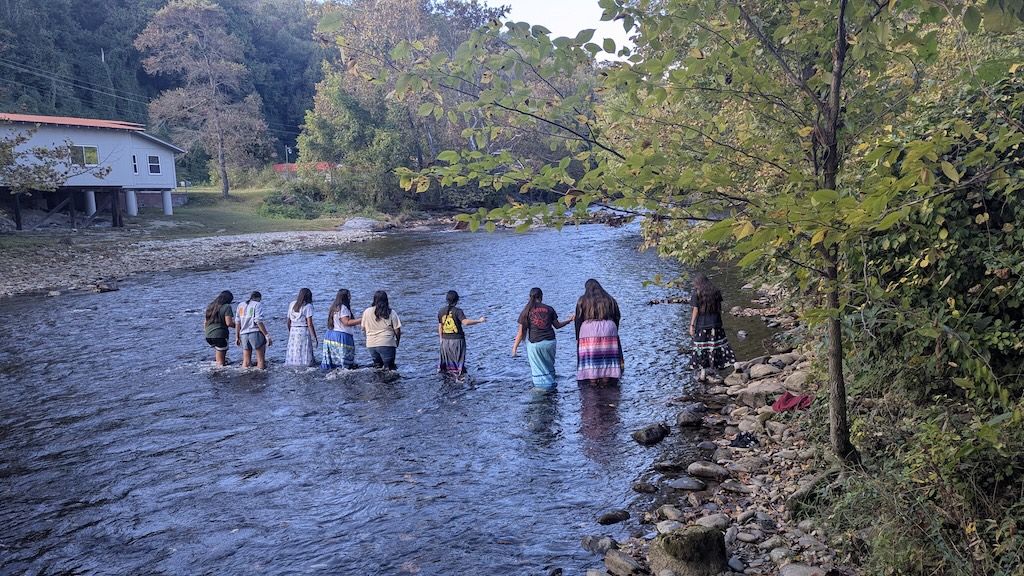
- On Jan. 8, 2026, the Eastern Band of Cherokee Indians Tribal Council unanimously passed a resolution recognizing the inherent legal rights of the Longperson (Ganvhidv Asgaya), an interconnected waterway system whose headwaters rise in the Great Smoky Mountains and end in the sea.
- The resolution was brought forward by the NAIWA Daughters, a group of Indigenous girls aged 10 to 17, making it the first all-female-led rights-of-nature effort in the U.S., and only the second such youth-led resolution passed by a Tribal nation.
- The effort followed 18 months of grassroots organizing and built on the foundations of the rights-of-nature movement, which holds that ecosystems and natural entities should have legal standing to exist and flourish.
- The Longperson resolution grants the waterway five inherent rights and has already spurred related action, including a separate tribal resolution to raise funds for removing the Ela Dam.
Before the proceedings began, the young women carried Longperson into the room with them, water gathered from the mountain headwaters and held in traditional pottery. The chamber filled beyond capacity, supporters spilling into the lobby. When the vote came, the council passed the resolution unanimously. The crowd and the council rose in standing ovation.
On Jan. 8, 2026, the Eastern Band of Cherokee Indians (EBCI) Tribal Council convened in Cherokee, in what is today the U.S. state of North Carolina, to consider a resolution brought forward by the NAIWA Daughters, the youth arm of the North American Indian Women’s Association, made up of a group of Indigenous girls between the ages of 10 and 17.
The resolution recognizes the inherent legal rights of the Longperson, or vwi Ganvhida, the interconnected waterway system whose headwaters rise in the Great Smoky Mountains and travel more than 1,270 kilometers (790 miles), branching through multiple states before its “feet,” as the Cherokee describe it, reach the Gulf of Mexico.
To the Tribe, Longperson (formerly Long Man) is a living entity of great cultural and spiritual significance.
“The room was heavy with the presence of Ancestors and community alike,” said Jasmine Smith, NAIWA Daughters chair and co-founder, describing the moment in a keynote speech at the Bioneers Conference in Berkeley, California. She delivered her speech wearing the moccasins of her Ancestor Ruth Littlejohn.
“That day crystallized in my memories,” she said. “The honor to bring Longperson into the chamber to speak for it, beside it.”
This marks the first all-female-led rights-of-nature effort in the U.S., according to the Earth Law Center, and only the second youth-led rights-of-nature resolution passed by a tribal nation.
“We look to [Longperson] for a lot of strength,” Juanita Wilson, an enrolled EBCI member who has led the Tribe’s annual Honoring Longperson cleanup efforts since 2021 but was not involved with the resolution, told Mongabay. “There are a number of rituals that people do for medicine, physical and emotional health.”
“Whatever’s on land is going to end up in the water,” Wilson added. “It’s literally the lifeblood of everything.”
After the vote, the NAIWA Daughters returned the vessel of water to the Oconaluftee River in a water ceremony.

Rights of Nature movement
The Rights of Nature movement holds that ecosystems and natural entities should have legal standing to exist and flourish, the same way an individual being is endowed with those rights. This framework has been recognized in laws across more than 40 countries. Ecuador added the rights of nature to its Constitution in 2008.
While Indigenous peoples are not universally advocates for the legal rights framework, some have been part of the movement globally, drawing on worldviews that have long considered the natural world as a web of relatives rather than a collection of resources.
In the U.S., many Tribal nations have adopted rights-of-nature legislation. The Ho-Chunk Nation became the first tribal sovereign entity to propose adding the Rights of Nature to its Constitution in 2016, followed by a cascade of resolutions across Indian Country: the Ponca Nation of Oklahoma recognized nature’s right to exist in 2017; the White Earth Band of Ojibwe affirmed the rights of manoomin, or wild rice, to flourish in 2018. The Yurok Tribe established the rights of the Klamath River in 2019. In 2020, the Nez Perce recognized the Snake River as a living entity, and the Menominee Indian Tribe of Wisconsin asserted the Menominee River’s right to remain unpolluted.
Tribes have carried the framework into the courts as well. In 2022, the Sauk-Suiattle Indian Tribe sued the city of Seattle with salmon named as the plaintiff, a case that ended with the city agreeing to build fish passages at its hydroelectric dams.
These efforts — constitutional proposals, resolutions, and lawsuits brought on behalf of rivers, fish, and food sources — form the lineage the NAIWA Daughters have now brought eastward to the Longperson.
“Do we see nature as something we own, or do we view it as something we have the responsibility to protect?” Kyndra Postoak, the group’s Rights of Nature project lead, said in a statement to the EBCI council.

The resolution grants the Longperson five inherent rights: to exist, persist, and regenerate its vital cycles free from harmful human disturbance; to maintain and restore its natural integrity, including freedom from pollution and invasive species; to serve as habitat for nonhuman relatives; to maintain free-flowing conditions; and to be protected under EBCI law and tradition.
“This historic resolution holds a mirror to the Cherokee understanding that the Longperson is a sacred, living relative — not mere property — and translates this relationship into a powerful legal framework,” Grant Wilson, executive director of the Earth Law Center, which supported the effort, told Mongabay in an email. “Those with the deepest cultural and spiritual connections to the land are often the ones best equipped to give Nature a voice in law.”

Old-fashioned organizing
The journey began when the girls were tubing down the river. They noticed tourists staking rocks, which disturbs the habitat for the eastern hellbender salamander (Cryptobranchus alleganiensis alleganiensis, known to the Cherokee as tsuwa). “We were frustrated,” Smith said. “We thought, what if we made a resolution that says you can’t do this?”
Then at the 2024 Indigenous Environmental Network Conference, the NAIWA Daughters met Britt Gondolfi, a lawyer who serves as the Rights of Nature project coordinator for the Bioneers Indigeneity program.
Gondolfi invited them to participate in Bioneers’ six-week rights-of-nature training, introducing the young women to the legal framework that could support their idea. They also connected with other Indigenous communities pursuing similar efforts, including the Mashpee Wampanoag youth, whose 2023 Rights of the Herring resolution had passed their tribal council unanimously.
The NAIWA Daughters initially set out to advocate for protections for the salamanders before elders guided them toward the foundational issue: the waterway itself.
With Bioneers’ support over the following 18 months, Smith said, the NAIWA Daughters were able to focus their efforts on advocating for Longperson. They spent a year and a half hosting community dinners, conducting input surveys, tabling at Cherokee events, and meeting one-on-one with council members to build support.
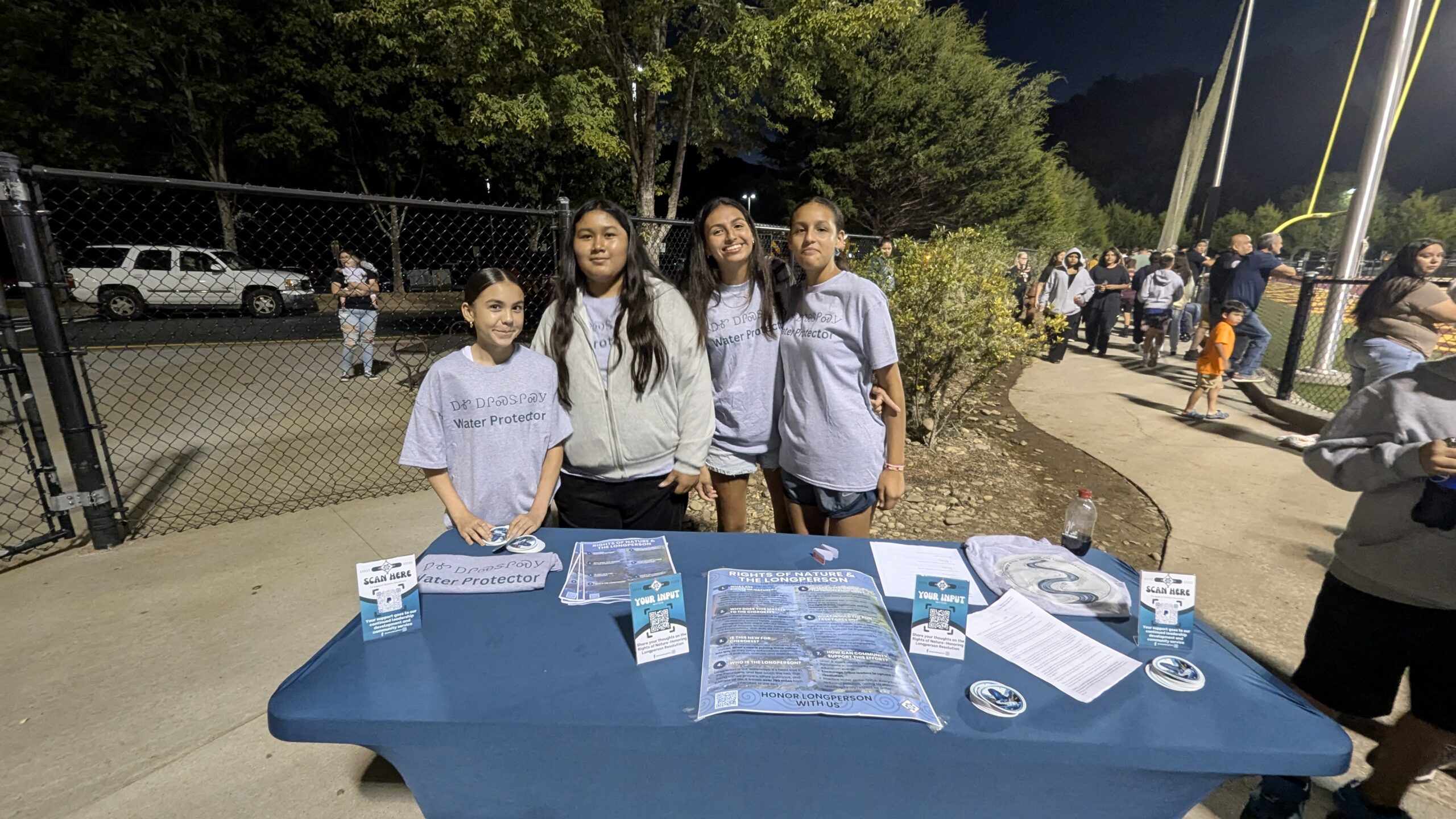
Smith said the efforts demanded real sacrifice from the young women. “I have watched them give everything to this, showing up tired, overwhelmed, emotional, sacrificing school breaks, weekends, and still fighting for our sovereign rights to be Cherokee,” she said.
“The young women behind this law didn’t AI themselves into this historic moment,” Gondolfi told Mongabay. “They consulted with elders, lawyers, experts in the field, and culture keepers. They put in 18 months of community organizing and created a grassroots movement to honor this ecosystem in law and deed. They revived a traditional customary Indigenous moral philosophy into law.”
“To have feedback from the community say we are 100% behind you,” Smith said, “that’s a win in and of itself, even if the resolution didn’t make it to the floor.”

What comes next
The NAIWA Daughters say their work is far from over. The first Rights of Nature task force meeting took place in May. The task force plans to monitor Longperson’s health, guide further policy implementation, and educate the community as well as other tribal youth.
Within weeks of the passage of the rights-of-nature legislation, the Tribe’s natural resources department and the NAIWA Daughters submitted a resolution committing the EBCI to lead a fundraising campaign to remove the now decommissioned Ela Dam. The resolution passed in March.
For more than a century, the Ela Dam has divided the watershed, blocking the migration path of the critically imperiled sicklefin redhorse (Moxostoma ugidatli). This culturally important fish has been called “the salmon of the south” and its scientific name comes from its Cherokee name meaning “it wears a feather.”
“Just removing the dam will provide safe passage for an aquatic relative,” Kimberly Smith, NAIWA Daughters mentor, told Mongabay.

Smith said removing the dam would also allow sediment buildup at the dam site to be used to create a new Cherokee mound, continuing a cultural practice that stretches back thousands of years.
The NAIWA Daughters plan to present their story at the next national NAIWA convergence in hopes of “inspiring Indigenous women across the country to pursue similar efforts,” Kimberly Smith said.
In the meantime, the annual event Honoring Longperson will take place Sept. 25, during which volunteers and community members clean up the river and NAIWA Daughters plan to hold workshops to teach their younger community members. This year, they also celebrate the success of their rights-of-nature journey.
“Success lives in the groundswell of community and collaboration,” Jasmine Smith said. “We are blessed to live in the oasis of our homelands … we hold the responsibility of stewarding the headwaters, so every living being downstream has water for life.”
New guidebook supports U.S. tribal nations in adopting rights-of-nature laws
Liz Kimbrough is a staff writer for Mongabay and holds a Ph.D. in ecology and evolutionary biology from Tulane University, where she studied the microbiomes of trees. View more of her reporting here.
FEEDBACK: Use this form to send a message directly to the author of this post. If you want to post a public comment, you can do that at the bottom of the page.
Cite this article
Liz Kimbrough (2026). Cherokee youth win legal rights for waterway in first all-female U.S. effort. Mongabay Conservation news. DOI: https://doi.org/10.66709/news-328483

