


Almost from the moment it began, the end of the Chinese economic miracle has been much anticipated. Thick and fast, the books have come explaining how it will end badly. Overinvestment. A country wallowing in debt. The collapse of the property market. Political repression. The demand for democracy from a growing middle class. All have been put forward as reasons for the inevitable terminal crisis.
Even those impressed by the country’s rapid growth took comfort from the notion that the west would continue to dominate advanced manufacturing while China would be stuck assembling TVs. And while the wait for its much-predicted demise has gone on and on, China has become the workshop of the world.
This process has come in two distinct phases. Initially, it is true, there was a concentration on low-cost manufactured goods because cheap labour costs provided a competitive advantage. Firms left for east Asia in search of higher profits. Without China 1.0, Donald Trump would have remained a New York property developer and Brexit might never have happened.
Yet, the Chinese were not content to remain solely the producers of low-cost consumer goods and began to invest heavily in higher-end manufacturing. China 2.0 shattered the illusion that it would forever remain a developing economy destined to produce low-grade products and little else.
The market in solar panels was captured. It became the world leader in batteries and electric vehicles. It no longer has to import machine tools from Germany because it is now capable of making its own. The rise of the far-right Alternative für Deutschland is in no small measure due to the threat posed by China to German manufacturing jobs.
Of course, China’s critics have a point. The model relies too heavily on investment and has much excess capacity. The country produces far more goods than it can consume domestically, particularly given the low level of wages and a relatively ungenerous welfare system. As a result, China can only keep growing at a rate that prevents rising unemployment from leading to social unrest if it exports its surfeit of goods to the rest of the world. China found itself isolated at the recent meeting of finance ministers of the G20 group of leading developed and developing countries, facing criticism from all sides for failing to boost domestic demand for its products.
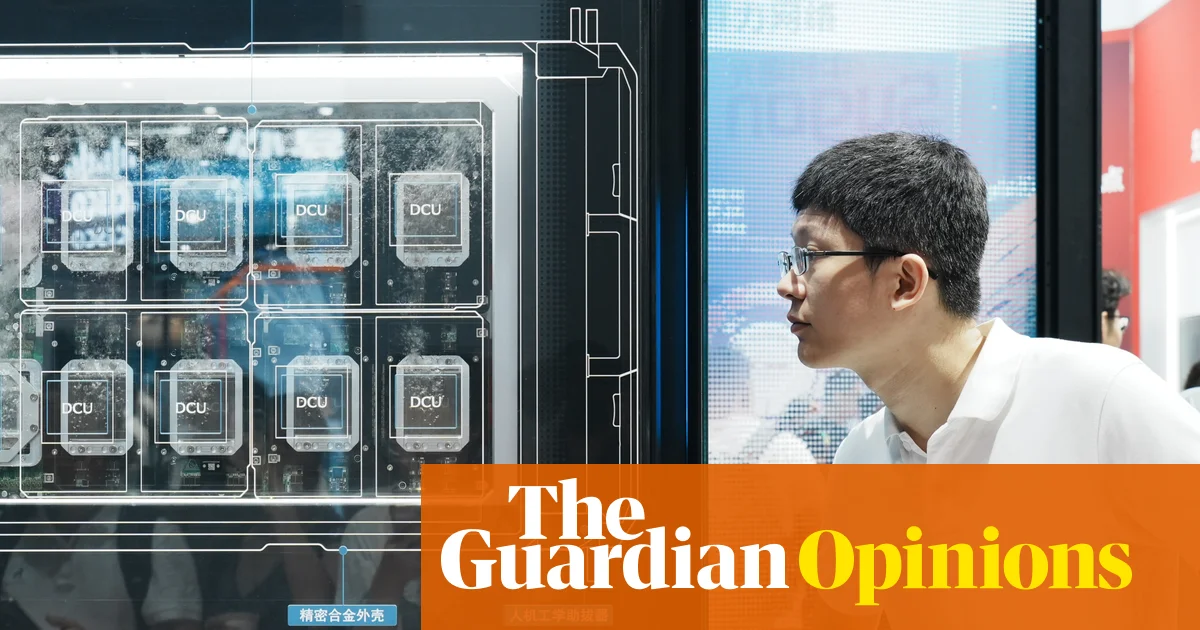
Perhaps this means the rest of the world has finally woken up to the threat. If it has, that would not be a moment too soon because China is now competing with the US for dominance in the race to develop artificial intelligence. Welcome to China 3.0.
In July, a Chinese startup called Moonshot unveiled its Kimi K3 model and it was an instant success. Just two days after its launch, the company suspended new subscriptions because demand was too great for its computing capacity. That was not surprising given that Kimi K3 was marketed as being able to match the models of its US rivals – such as the latest versions of OpenAI’s ChatGPT – at no cost. This was not a fluke or a random event.
As Edoardo Campanella of UniCredit notes, Beijing is pursuing a clear AI strategy: staying close to the technological frontier, diffusing its models throughout the global economy, and setting standards across international markets. “If this strategy succeeds, the third China shock might not just disrupt the global economy, but also the global balance of power,” says Campanella.
Beijing’s strategy might not succeed but even so there are three things that are striking about the AI development race. The first is that this would appear to be the worst possible time for Washington to antagonise its traditional allies by whacking them with punitive tariffs. The US needs all the friends it can muster.
The second is that the arrival on the scene of free Chinese AI models could spell big trouble for global markets. Until now, the US has been confident its technological prowess will give it the upper hand in the AI development race and that has justified massive investment in technology companies.
Despite rising oil prices, share prices on Wall Street have reflected confidence not just that AI will transform economies but that the US will be the main beneficiary. But if China can develop its AI models at a lower cost and offer them for nothing, investors will soon start to question whether the massive investment in the US justifies the sky-high share prices of tech companies. China’s success in AI could prick the stock market bubble.
after newsletter promotion
Finally, there are lessons that countries such as Britain need to learn from China if it is to re-industrialise. When China began to build up its manufacturing strength almost 50 years ago, it saw itself as a developing country. It had no illusions about the scale of the challenge but had a plan and stuck to it.
There was no aversion to picking winners. Nor would the strategy be left exposed to the whims of speculators. Instead, there was a willingness to use all the policy tools available: subsidies, tariffs, exchange controls and state investment.
The result is what we see now: a China that has shifted through the gears from an industrial policy dominated by cheap goods to an industrial policy of everything. Sure, China’s model has its flaws but there is a stark contrast with Britain’s negligent approach since the late 1970s. One country is serious about manufacturing and the other isn’t.
