



Thailand’s Securities and Exchange Commission has issued a Travel Rule that will require supervised crypto platforms to collect and transmit information identifying the people or entities behind coin transfers.
The regulator announced the rule on Sept. 2, and an associated notification is dated Aug. 25. It takes effect Feb. 27, 2027, after a 180-day implementation period from publication in the Royal Gazette.
The lead time lets operators prepare systems for exchanging transfer data, checking transactions, and requesting required information from customers, according to the SEC’s customer-facing Q&A.
How crypto transfers will change
SEC-supervised digital-asset operators must collect information on customers and their counterparties when coins are transferred. They must also check counterparties and verify the qualifications of digital-asset service providers or intermediaries in the transfer route.
An operator sending a transfer instruction must pass originator and beneficiary information to the operator receiving it. Transfer-related records must be kept for at least five years.
Customers will face different information requests based on transfer size. When sending coins from a wallet held with a regulated platform, a customer must identify the recipient even when the transfer is no more than 30,000 baht.
For transfers over 30,000 baht, the customer must also provide the recipient’s province or city and country. If the recipient is a legal entity, the customer must also provide its registration number. Smaller transfers require basic recipient identification, while larger ones require additional location or entity details.
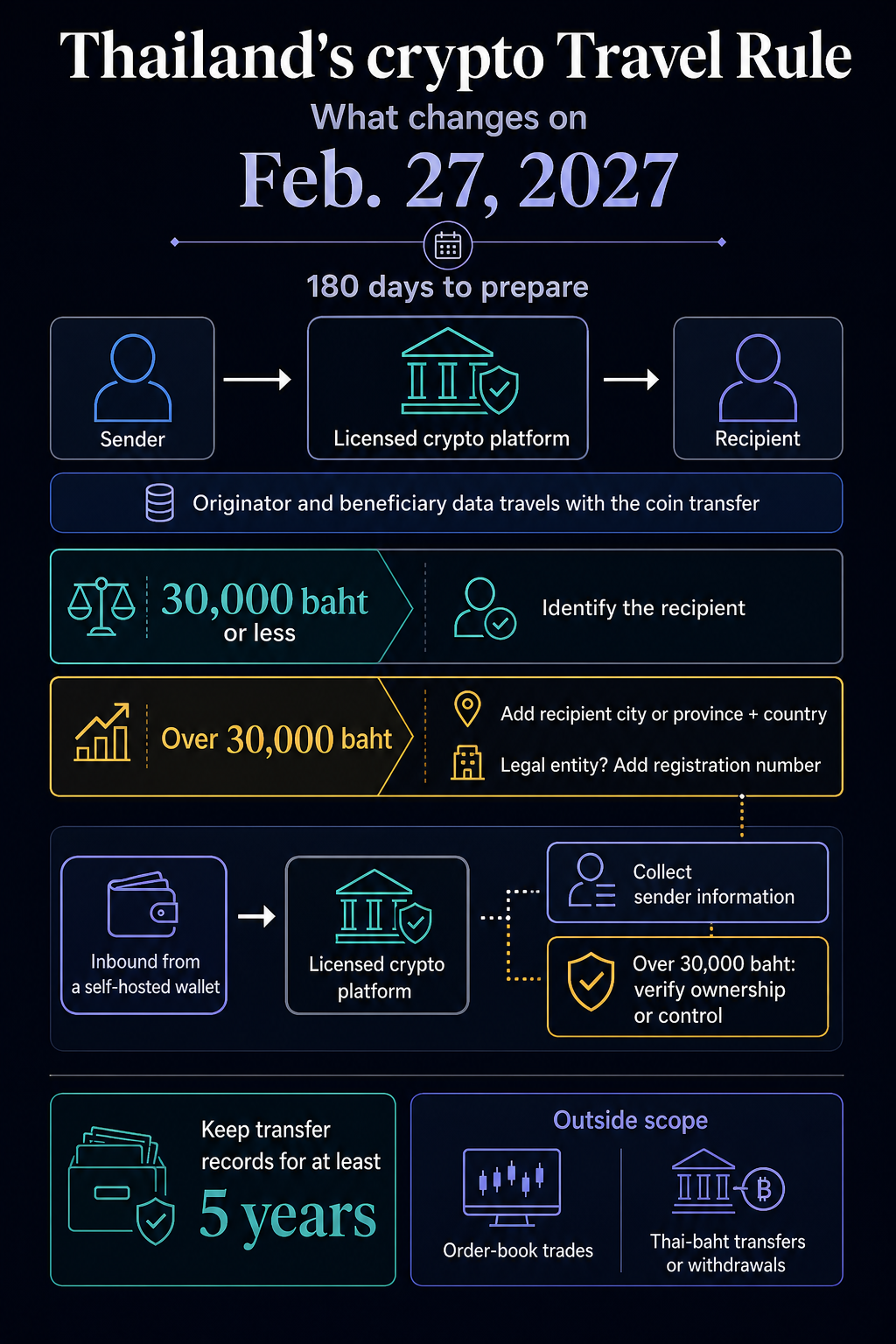
On incoming transfers between regulated operators, the recipient’s platform must collect information from the sender’s operator before allowing the recipient to move the coins out of the wallet.
The process becomes more specific when coins arrive at a regulated-platform wallet from a self-hosted wallet. The platform must collect sender information as it would for another transfer. If the transaction exceeds 30,000 baht, it must also verify that the user owns or controls the wallet by confirming the person can control or access it.
The obligation falls on supervised operators when a transfer touches their services, and the Q&A does not state that every coin transfer requires proof of wallet ownership.
The rule also stops short of extending the new data checks across all platform activity. It does not apply to trades on an operator’s order book or to transfers and withdrawals of Thai baht because it governs coin transfers.
The SEC said most transfers should continue through normal processes when customers provide complete information and platforms are ready. High-value transfers, cases with missing data, or transactions requiring added wallet checks may take longer.
