


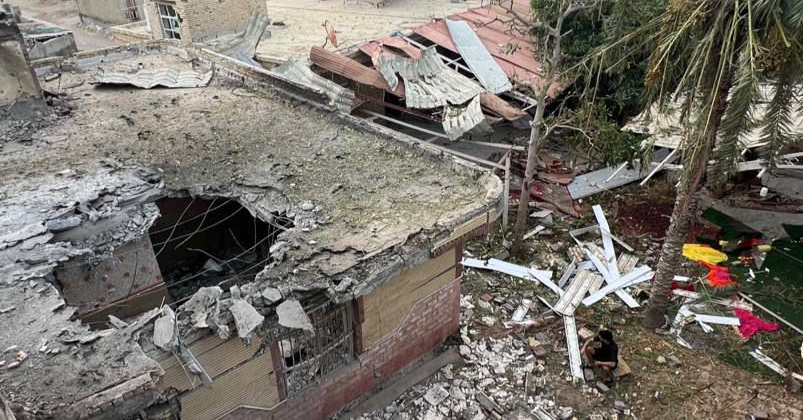
A JSOW bomb also appeared to be loaded under the wings of a U.S. fighter jet taking off in a video published by U.S. Central Command on Tuesday alongside the statement that it had conducted strikes on targets in Iran.
The attack on Kuhestak is the fourth episode reported by The Times in which strikes on structures with no military use were hit and civilians were killed. On Feb. 28, the first day of the U.S.-Israeli war in Iran, a U.S. Tomahawk missile hit an elementary school in Minab, Iran, killing over 150 civilians, most of them children, Iranian officials said.
Hours later, the United States used several PrSM missiles to strike near a residential area in Lamerd, Iran, killing 21, Iranian officials said. In July, the United States used a 2,000-pound bomb to strike a home in Qeshm Island, killing three civilians, according to Iranian officials.
Among those killed in the Kuhestak attack was Amir-Mohammad Karimi, an exuberant 6-year-old who was starting kindergarten, according to an interview given by his mother to the Red Crescent and published on the group’s official page.
His mother, whose name the Red Crescent did not publish, said her son had been so excited to attend the wedding, he had gone ahead of her with his 14-year-old sister, Kiana. When she heard explosions, the mother said, she ran into the streets to search for her children, and found them covered with dust and shrapnel.
A local photographer named Kian said in an interview that he had been at home about 500 yards from the Malahi family’s house when he heard a strange sound. “Almost like a whistle, a whistle coming from the direction of the sea,” he said. When the bomb struck, he said, “we all heard the explosion.”
Electricity and mobile phone connections went down. The air was thick with the smell of gunpowder. He could hear screams and crying as he headed toward the Malahi house, recounted Kian, who spoke on the condition that his last name be withheld out of fear of government reprisal.
“People were carrying small children in their arms,” he said, “trying to get them to the hospital in pickup trucks and any vehicles they could find.”
Kian said the bomb had struck the section of the wedding set aside for women. “That is why most of those injured are women and children,” he said.
Later that night, Kian said, he was with the father and brother of one of the people who were killed, Mohammad Malahi, 16, as they struggled to identify his body. The teenager was so badly disfigured, he said, that they used the mobile phone found on his body to confirm it was him.
The Fars News Agency, a semiofficial outlet affiliated with the Revolutionary Guards, identified two others killed: Kolsoum Malahi Najandnia, 43; and Zarkhatoun Taheri, 50.
The bride and groom survived the attack, Motahareh, the wedding guest, said in her post.
The Kuhestak wedding victims were taken to Hazrat Abolfazl Hospital in Minab — the same center that treated victims of the strike on Shajareh Tayebeh primary school. U.S. Tomahawk cruise missiles had razed the school on the first day of the war, and 168 people were killed, according to the Iranian authorities, most of them schoolchildren.
Ahmad Nafisi, the deputy governor of Hormozgan Province, where both Minab and Kuhestak are, told local news outlets that the United States “has once again committed a war crime in the province of Hormozgan.”
Video taken amid a chaotic crowd at the hospital entrance showed medical personnel waiting with stretchers as wedding guests streamed in for treatment. In one video, adults brought in a young crying boy and a girl with blood running from her forehead.
