


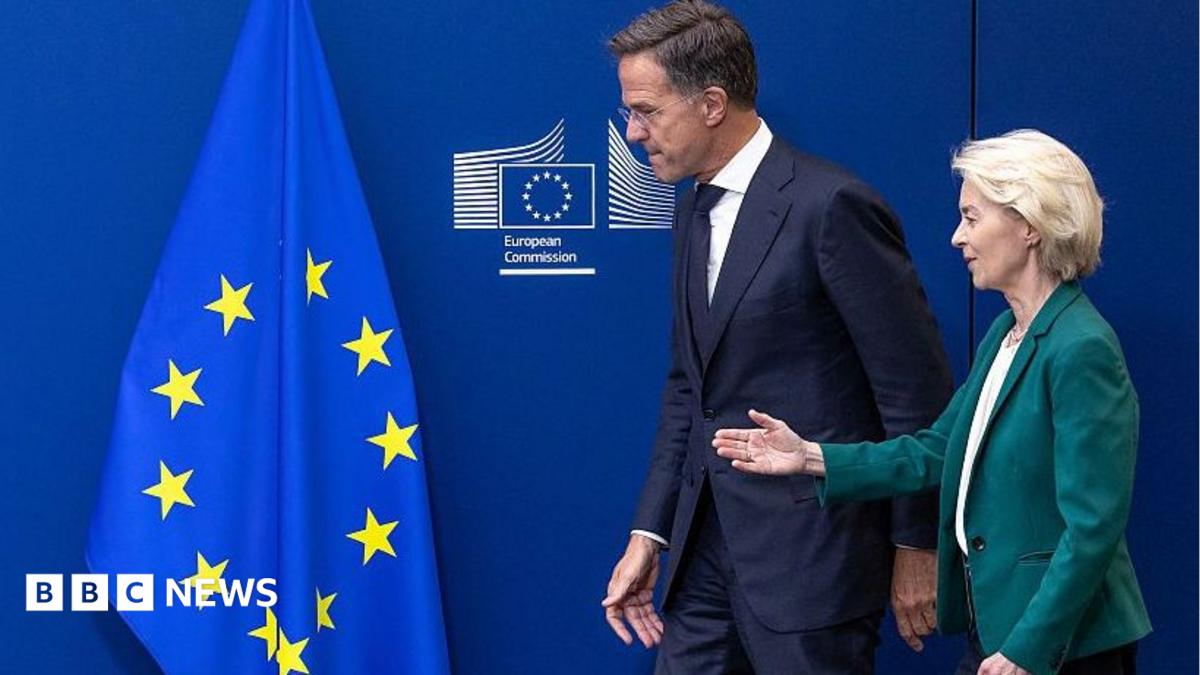
Von der Leyen was clear in her statement that the Leipzig attack had involved “military-grade material carried out by Russian operatives on European Union soil”.
“We will not tolerate it,” she said.
While she was meeting Rutte in Brussels, EU foreign ministers had gathered at Wicklow in Ireland, where France’s Foreign Minister Jean-Noël Barrot said action could be taken on a European level against Russia’s so-called “shadow fleet” of ships carrying oil and other cargo aimed at avoiding EU sanctions.
Barrot and fellow ministers from Belgium and the Netherlands said they had summoned Russian ambassadors in protest at the attack.
Lithuania’s Foreign Minister Kestutis Budrys said it was obvious that Russia saw no political cost in its hybrid operations against European allies.
EU foreign policy chief Kaja Kallas said they were working on how to tighten enforcement of existing sanctions, and added there was broad support for an EU visa entry ban on Russian ex-combatants as well as stricter visa limits on Russian tourists.
Several EU countries, including Sweden, the Netherlands, Poland and Spain, are pushing for more than €193bn (£165bn) in frozen Russian assets to be used to help Ukraine. The idea was first planned at the end of 2025, and rejected by Belgium where the money is held. However, Belgium’s position is unchanged because it fears being held financially liable by the courts.
The Leipzig attack was part of a broader pattern of increasingly dangerous incidents, including drones and interference with critical infrastructure, von der Leyen said.
Mark Rutte added there had been increased risk to Europeans from drones and missiles crossing into countries on the Alliance’s eastern flank, and there had been more “malign activities targeting our territory directly, whether it is fires set in factories producing defence equipment for Ukraine or indeed the Russian hybrid attack in Leipzig”.
