


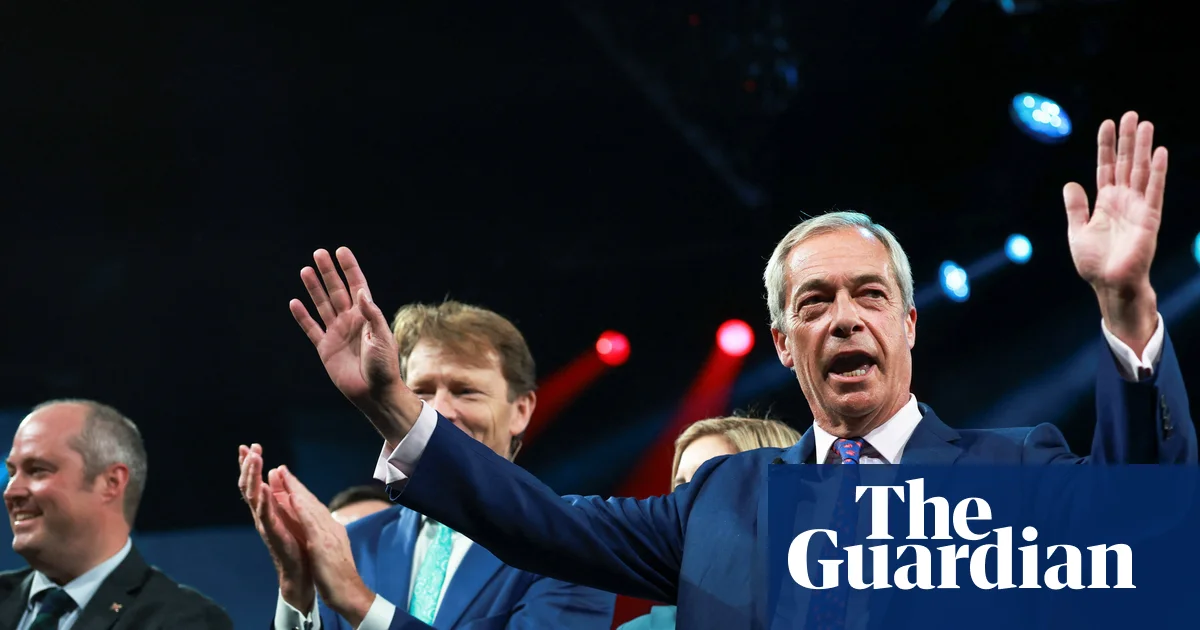
Reform UK has banned at least three journalists from its annual conference who have reported critically on the party and Nigel Farage.
The Guardian’s City editor, Anna Isaac, the investigative reporter Peter Geoghegan and the broadcaster and biographer Michael Crick were told this week that their credentials to cover the event, which begins on Thursday, had been declined.
The party has billed its conference, which will take place at the National Exhibition Centre in Birmingham, as “the most talked about event of 2026”. Reform figures are hoping to use it as a reset after a difficult summer consumed by questions about an undeclared £5m gift Farage received shortly before he was elected in 2024.
A Reform spokesperson said Geoghegan and Crick were refused accreditation because the party viewed them as minor figures. They declined to comment on why Isaac was not given accreditation.
After the Guardian contacted Reform for comment, all three received emails saying their conference passes had been reinstated. However, when contacted again by the Guardian, a Reform spokesperson said this had been an administrative error and that they were still not accredited for the conference. They then received further emails confirming their exclusion.
Isaac broke the story that Farage had accepted an undeclared £5m gift from Christopher Harborne. Her reporting also revealed that a host of transactions involving Reform UK’s most senior figures and donations to the party caused bankers to report potential money-laundering concerns to the National Crime Agency.
The story has caused issues for Farage all summer and he has drastically reduced his time in front of the press. He also resigned as an MP over the furore, prompting a byelection which the other main parties boycotted, leaving Count Binface as his main opponent. Farage won, and was sworn back into parliament on Monday.
Geoghegan runs the Democracy for Sale newsletter on Substack and has written for the Guardian and the New York Times. He received the news he had been banned from the conference shortly after publishing a piece revealing negative comments the pro-Reform journalist Isabel Oakeshott allegedly made about Harborne. Oakeshott declined to comment about the allegations when the Guardian contacted her.
Geoghegan said: “Reform clearly wants press coverage but it doesn’t want the scrutiny and accountability that comes with it. Farage and co like to present themselves as the anti-establishment insurgents, but banning independent journalists like me from party conference isn’t anti-establishment. It’s the establishment playbook.”
Crick said: “I can understand why the Reform high command might not want me talking to ordinary party members.” He published an unflattering biography of Farage in 2022, including details of a letter a teacher once sent to the head of Dulwich college when Farage was proposed as a prefect, complaining about his “publicly professed racist and neo-fascist views”. Crick has also said he believes Farage “panders to racists”. He told the Telegraph this summer that Farage’s fatal flaw was that he was thin-skinned and purged people he disagreed with.
On the party’s apparent reinstatements and then U-turn, Crick said: “What cock-up merchants!”
A party spokesperson said: “Reform UK accepted 950 of about 1,000 media applications from a variety of outlets, including the entire Guardian lobby team.
after newsletter promotion
“Mr Crick works for a university and Mr Geoghegan is a Substack blogger. Neither qualify for a media pass.”
The Reform spokesperson refused to give a reason for Isaac’s ban but said: “Anna will still be able to watch the conference proceedings on our livestream if she wishes.”
Laura Davison, NUJ general secretary, said: “Reports that Reform UK has chosen to ban journalists who have scrutinised the party from attending its conference are frustrating and concerning. A functioning democracy depends on a free press that can ask political parties difficult questions and hold those seeking power to account.”
Pointing to what she called “a wider pattern of intimidation and obstruction of journalists,” and noting that the Conservatives and Labour blocked or removed journalists from their conferences last year, Davison said: “We urge the government and all political parties to demonstrate their commitment to media freedom and uphold the public’s right to be informed. Reform UK should rethink its position and allow journalists full access to the conference.”
A Guardian spokesperson said: “Holding public figures to account is the role of a free press and an essential part of the democratic process. Our journalists should be able to ask questions in the public interest and not be deterred from doing their job.”
