


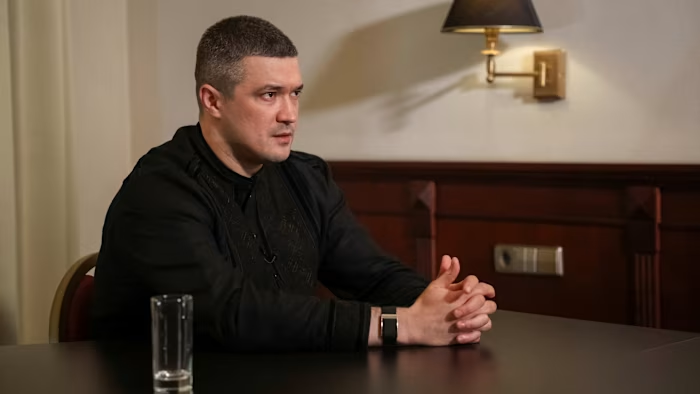
Ukraine’s former defence minister Mykhailo Fedorov is seeking US investment for a defence technology fund he hopes will write a “new history” of the war against Russia by building and managing companies to develop new weapons.
In an interview with the FT in Washington, Fedorov, who was sacked by President Volodymyr Zelenskyy last month, also said he would be happy to help the US “build an army of drones” in exchange for American supplies of Patriot missile interceptors to help Ukraine in coming months.
Fedorov is seeking backing for the proposed fund from venture capitalists, private investors and US tech companies and said he was in discussion with “a large number” of prospective investors interested in Ukrainian innovation.
“This isn’t exactly a classic venture fund,” Fedorov said. “We’re writing a new history of the war,” he said.
The vehicle would go beyond a conventional venture capital fund, being able to create companies itself as well as invest in existing Ukrainian start-ups, he said. It would use western capital to develop technologies critical to Ukraine’s ability to resist Russia’s ongoing invasion.
Fedorov did not give details of his role overseeing the fund or whether he might personally benefit from it financially.
He identified three initial priorities for the fund: battlefield robotics to reduce Kyiv’s reliance on manpower and the number of troops on the front line; cheap high-speed interceptor drones to combat Russia’s new jet-powered attack drones; and low-cost AI-enabled missiles.
It was likely Russia would drag out the conflict for another two or three years at least and the fund would develop state of the art “solutions for the battlefield” while also giving investors insights into the lessons Ukraine had learnt, he said.
Fedorov, 35, was Ukraine’s youngest-ever defence minister until he was sacked after just six months in office. The ousting sparked weeks of protest across the country and thrust Zelenskyy into the deepest political crisis of his presidency.
Ukrainian MPs, veterans and civil society leaders — including many who had supported Fedorov after his dismissal — were dismayed at news of his trip abroad. Many questioned his motives when he announced on Friday after a visit to Rome that he would serve as an unpaid adviser to the Italian defence minister.
Oleksiy Goncharenko, an opposition MP who chairs a parliamentary investigative committee, said in a post on social media site X that Fedorov’s Italian role could pose “a threat of leakage of knowledge about our cutting-edge military technologies”.

But Fedorov said helping Italy’s military innovate could open new doors for co-operation with a country that had air-defence capabilities Kyiv lacked. He said he would seek similar advisory positions with other partner nations, possibly including France and the US.
Fedorov declined to comment on whether he would meet anyone from the Trump administration while in Washington, but said he would be “very glad to help America build an army of drones — especially in exchange for Patriot [interceptors] so that we survive this winter”.
“I’m ready to make that trade,” he said.
Fedorov, who previously served as a deputy prime minister in charge of digital transformation of the government, built a reputation as the driving force behind Ukraine’s drone development. His start-up-inspired management style set him apart from the country’s political establishment but also unsettled parts of the country’s traditional military leadership.
Fedorov said he had run into resistance from the military establishment and political rivals as he set out to revamp a murky procurement system.

Zelenskyy fired him over what the president said was a failure to address problems with Ukraine’s military mobilisation and the minister’s unreconcilable differences with the military commander-in-chief Oleksandr Syrsky.
Syrsky was sacked days later after the public protests erupted. Fedorov has since broken the longstanding taboo against publicly criticising state power to maintain a united wartime front and has called for wartime national elections. He has further sparked controversy by saying his country was losing the war.

Fedorov told the FT that “unity” would be key to Ukraine’s survival, shrugging off criticism that he himself has put it at risk by speaking out. He declined to say whether his call for new elections was in effect a demand for Zelenskyy to be replaced.
“This isn’t against Zelenskyy, it’s not against some specific person,” he said. “It’s about the fact that we need to . . . update the state’s operating system.”
Fedorov this week triggered outrage in Ukraine when he said the country was “gradually, slowly losing” the war — after insisting in spring that it had turned the tide against Moscow.
The situation could “change from month to month”, he told the FT, noting that Russia’s recent air strikes and ever-intensifying use of missiles and advanced drones were critical challenges.
“Right now, if we don’t respond to these issues, they will smash us.”

Russia has pummeled Ukraine’s critical infrastructure, factories and warehouses with missiles and swarms of attack drones this summer. A critical shortage of Patriot interceptors caused by shrinking global stockpiles of the US-made weapon has left Ukraine struggling to shoot down Russia’s ballistic missiles.
Fedorov argued that his fund would in time offer one answer to that problem. He said high-speed drones capable of bringing down Russia’s jet-powered drones had already been tested in Ukraine and, with more support, could be produced at scale.
He declined to comment on whether he planned to meet Elon Musk while in the US but said he remained in close contact with the tech billionaire.
Zelenskyy has sought permission from Musk to use Starlink-equipped drones against ballistic missile launchers up to 200km inside Russia, something Fedorov said would probably have a big impact.

People familiar with the matter said Musk had previously told Fedorov he would be open to allowing Ukraine to use Starlink-equipped drones beyond its border to hit Russian targets. However, Musk, the people said, had told Ukraine that the decision was a political one that needed to be made in the White House.
Fedorov declined to comment on his conversations with Musk. Musk and SpaceX did not immediately respond to requests for comment.
Fedorov said Ukraine’s intensifying long-range strikes against Russia were the most viable path to forcing President Vladimir Putin to end the war, but more investment in the weapons used for them was needed.
“We need more jet drones, we need cheap missiles, we need missiles with artificial intelligence,” he said. “You can’t conduct any kind of dialogue with Putin any other way . . . He understands only force.”
