


KERMAN, Calif.—One hundred degrees on a steamy Thursday afternoon and not much can be seen along the dust-blown avenue in Kerman. A school bus cruises by. Cows lap up water or feed behind a fence. A tractor crosses the road.
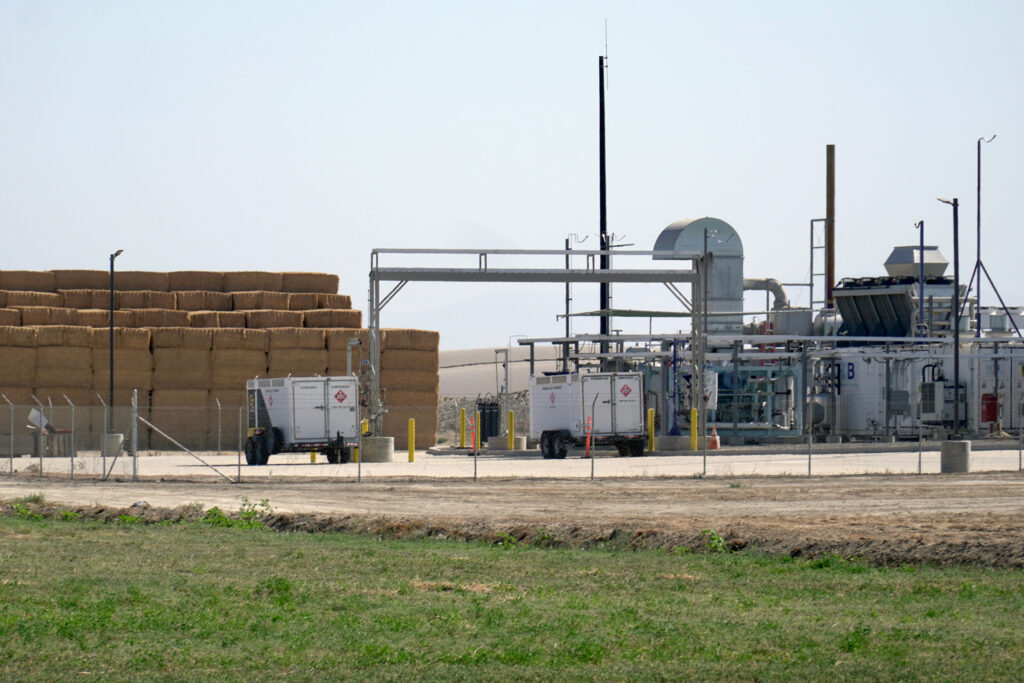
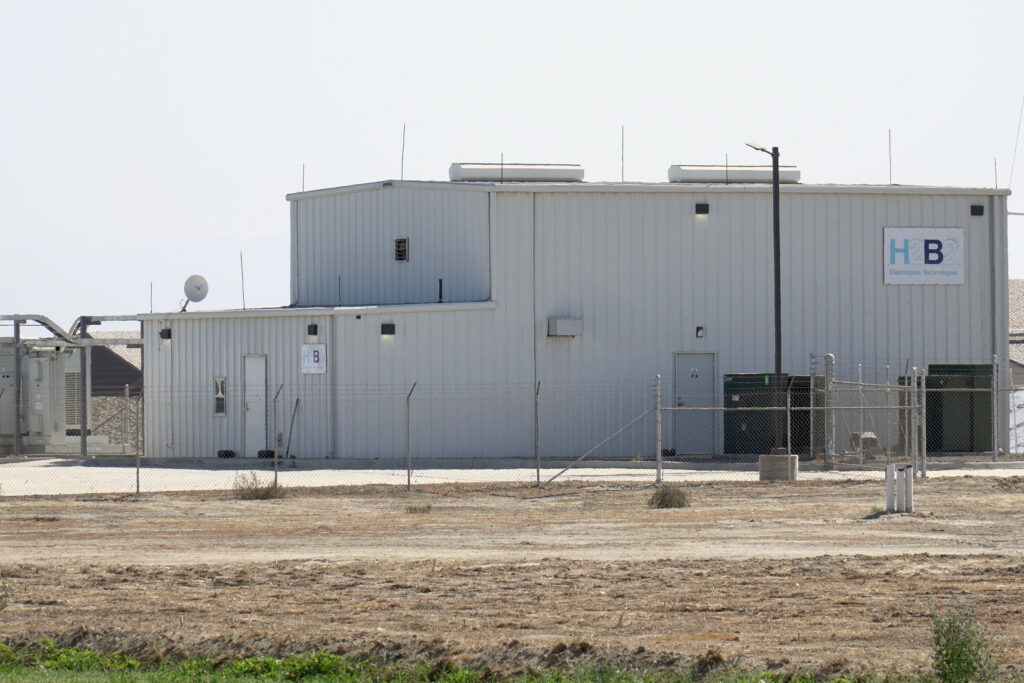
What’s most evident in this span of the San Joaquin Valley is a seemingly misplaced white building. Emblazoned atop it: “H2B2 Electrolysis Technologies.”
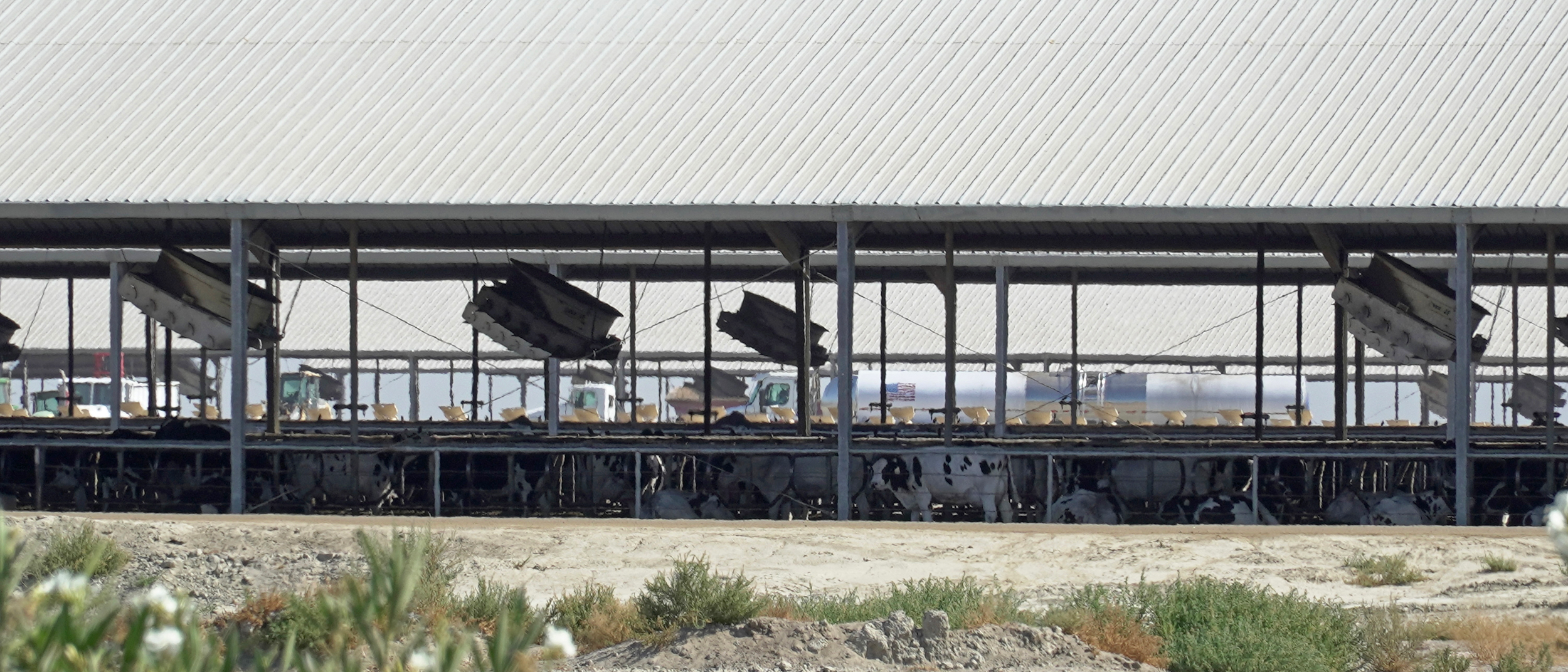
The roughly 13,000-cow dairy next to the building is quietly breaking new ground in the world of California dairy waste, according to regulators.
There’s nothing else quite like it in the state.
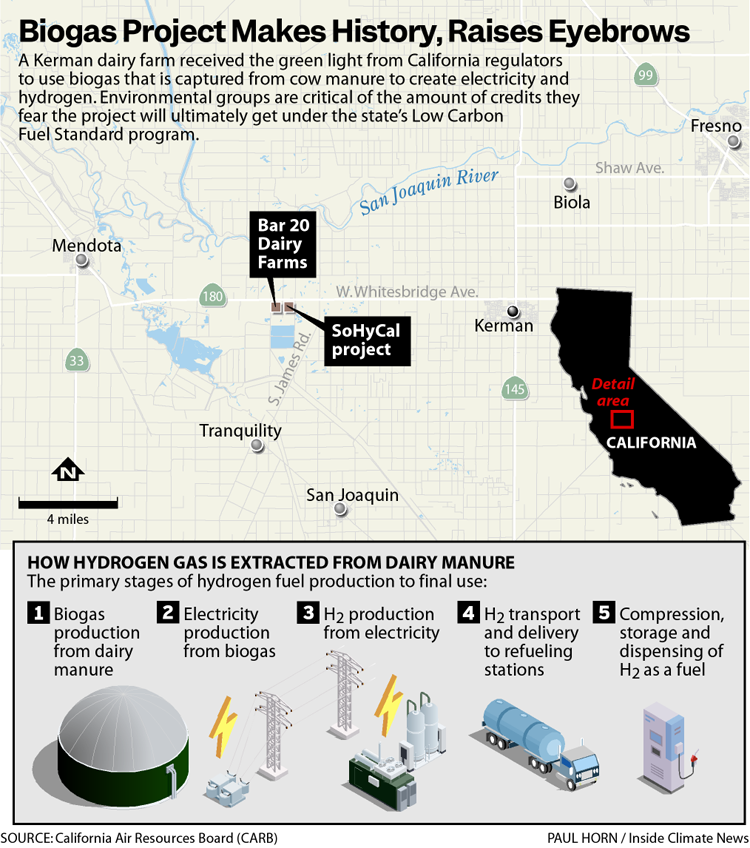
A company called H2B2 is turning biogas captured from methane waste lagoons at a giant dairy farm, Bar 20, into hydrogen for use as a transportation fuel under California’s Low Carbon Fuel Standard (LCFS).
The California Air Resources Board (CARB), which runs LCFS, assigned the hydrogen project the lowest carbon-intensity rating—a measure of how much climate pollution a fuel causes for each unit of energy it delivers—in the program’s history.
The move reignited an already raging debate over biogas between CARB and many members of the environmental community, who argue that the climate benefits from capturing methane and producing biogas do nothing to address nitrogen, phosphorus and ammonia pollution from the dairy waste lagoons that contaminate local water supplies and sicken nearby residents. They also worry about the long-term impacts of supporting a nascent biogas industry.
Lindsay Buckley, a CARB spokesperson, told Inside Climate News that the biogas-to-hydrogen project at Bar 20 is “groundbreaking and novel in two ways.”
“One, it converts a waste into electricity using a fuel cell, and two, it converts biogas into hydrogen,” Buckley said, following CARB’s approval of the project in July.
LCFS has been a hot-button program with scientists and environmental justice advocates, who say it incentivizes California dairies to expand herds, thus creating more waste and methane to be converted into biogas while increasing other pollution.
CARB has disputed that digesters—at least 165 of which dot a state with more than 1,000 concentrated animal feeding operations, or CAFOs—are a factor in accelerating herd growth on farms.
CARB in 2024 also highlighted that since LCFS began, more than 31 billion gallons of fossil fuels had been “displaced” by lower-carbon, cleaner options.
Still, Bar 20’s venture into biogas re-use—through H2B2’s technology—has spurred renewed anger among environmental groups and families who say the project’s purported climate benefits are far outweighed by local pollutants.
How does the latest project at Bar 20 work?
Dairy manure at Bar 20 is digested in a covered lagoon anaerobic digester that captures methane. The new project processes biogas that is captured from the dairy to generate electricity, said Buckley of CARB.
“The electricity is generated from biogas by using both a fuel cell and a reciprocating engine,” she said. “Some of this electricity generated is then used to produce hydrogen from electrolysis,” an energy-intensive process that separates hydrogen and oxygen from water.
Gaseous hydrogen from the project is supplied to hydrogen refueling stations in California via trucks. The businesses involved did not provide comment on the wider viability of hydrogen as a fuel, one that CARB itself has acknowledged has experienced headwinds amid high prices and low demand.
Nonprofit organizations—like the Leadership Counsel for Justice & Accountability and the Animal Legal Defense Fund—were frustrated by the lowest carbon intensity value ever assigned on record in California. The value for this project was set at -1887.35 grams of CO₂-equivalent per megajoule, which is a measure of how much greenhouse gas a fuel is responsible for relative to the amount of usable energy it produces.
The lower the carbon intensity of a fuel, the greater the carbon credit value for the company producing the fuel.
Tyler Lobdell, a senior staff attorney at Food & Water Watch, called carbon intensity values—created via LCFS’s structure—“bogus” in that they support a harmful biogas incentive structure.
“Approving the most extreme LCFS pathway for factory farm biogas ever seen underscores where CARB’s priorities are, and they are not with the Californians that live near and experience the pollution from these mega dairies,” Lobdell said Monday.
A CI Value That Is “Unheard of”
Christine Ball-Blakely, a senior staff attorney for Animal Legal Defense Fund, doesn’t mince words: Bar 20 is a mega dairy using a liquid manure management system that creates waste lagoons emitting large quantities of potent methane in order to raise its dairy cows, she said.
“Such intentionally created methane can never become renewable fuel,” Ball-Blakely, a senior staff attorney for Animal Legal Defense Fund, said in a statement in June when several groups opposed the hydrogen project. They argued CARB shouldn’t be selling carbon offsets for mitigating methane pollution that shouldn’t exist in the first place.
A Bar 20 owner was not available on-site for an interview.
The hydrogen produced by H2B2 via Bar 20’s digester provides “significant air quality benefits for the region and climate benefits consistent with state policy goals,” Brian Visser, a dairy manager at Bar 20, told Inside Climate News in an email in response to a series of questions.
Visser did not respond to questions about the new hydrogen project’s operations, the business’ use of LCFS or environmental concerns from residents.
Bar 20 officials deferred additional questions to H2B2, which did not return calls nor provide comment when reached by email.
Food & Water Watch, one of the environmental groups suing California over LCFS, called the carbon intensity value—applied to H2B2’s hydrogen produced from biogas at Bar 20—something that was “unheard of.”
Most biogas projects receive a carbon intensity value of -250, on grounds that they are removing a climate super-pollutant from the atmosphere, while solar panel and wind energy projects are limited to a CI of zero or higher, according to environmentalists and an independent university expert.
Does a lower carbon intensity value mean more money for credit trading? Yes, but how that exactly applies to the H2B2 project at Bar 20 will depend on how much biogas is produced and processed.
That the project includes a hydrogen component is notable although not the first, said Kevin Fingerman, a professor of energy and climate at California State Polytechnic University, Humboldt.
Fingerman focuses on the environmental and social impacts of energy technologies and policies. In July 2025, he authored a report called “Risks of crediting carbon offsets in low carbon fuel standards: lessons learned from dairy biomethane.”
Energy is lost with every conversion, he said. The H2B2 biogas project converts biogas into electricity, some of which is used to create hydrogen. Thus, for a given amount of methane captured, the amount of fuel delivered will be smaller than for other biogas projects.
A Dairy With a Long History
For many Californians who live in areas dense with dairies, the state’s Low Carbon Fuel Standard credit program has enabled farms to run as they have for decades.
The largest sources of methane emissions in the state of California are dairy farms.
Anaerobic digesters are meant to cover open-air manure pits with black tarps that expand as they trap gas—mostly methane and carbon dioxide. The gas is then intended to be burned for energy.
“In total, our recent research identified at least $589 million in funding from various state and federal agencies directed to dairy digester infrastructure since 2014 in California alone,” reads an excerpt from the report by Fingerman.
That figure does not include funds from market-based incentives such as the LCFS and the Renewable Fuel Standard (RFS).
LCFS and the money for carbon offsets it produces may skew the economics of dairy production toward large, lagoon-based operations by creating a substantial revenue stream for producing those offsets via biogas—revenue that is less accessible or just unavailable to farms without the same kind of point-source methane, said Fingerman.
“That may contribute to incentives for consolidation, herd growth or manure aggregation, although the extent to which the LCFS has caused observed consolidation is subject to debate,” he said.
Worries from families over the impacts dairies have on the air and water nearby have only mounted.
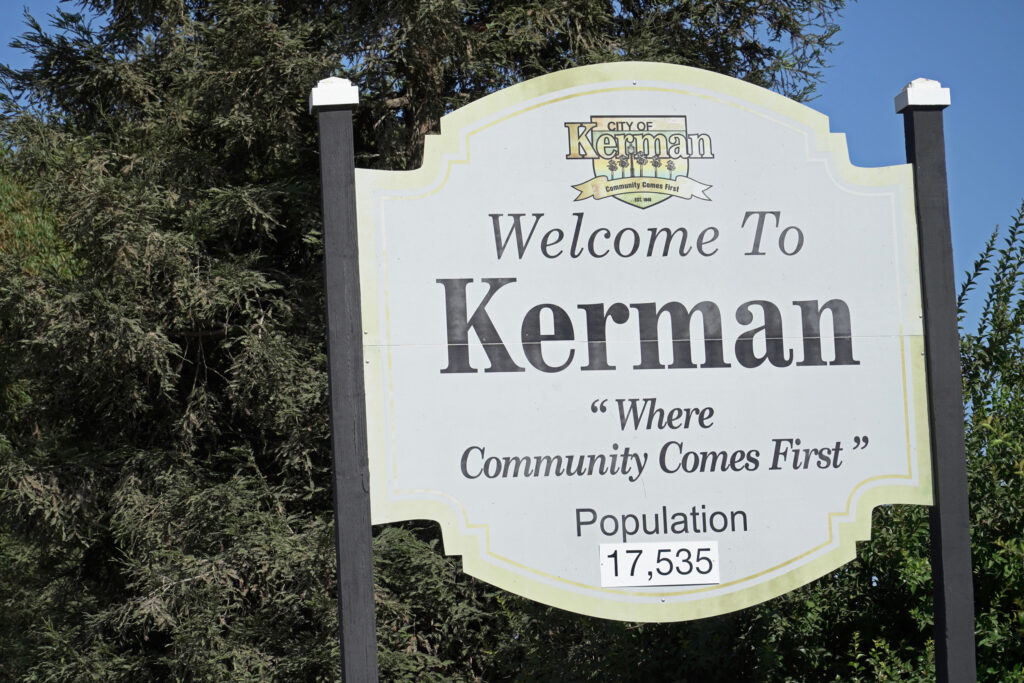
Environmentalists concerned about Kerman—a city of about 17,000 people—see Bar 20 in much the same way, despite the business being long championed for its sustainability practices.
California officials did not have records to reflect how many cows Bar 20 had when it first opened, but in 2003 the business had about 6,000 cows, according to regional water board documents. It has benefited from LCFS funds in the past.
LCFS, first implemented in 2011, has a mandate to reduce the carbon intensity of transportation fuels in California by at least 30 percent below the fossil fuel baseline by the year 2030 and 90 percent from 2045 onward.
Environmental groups, including Defensores del Valle Central para el Aire y Agua Limpio and Food & Water Watch, are suing the state alleging LCFS bolsters the biogas industry.
A study published last fall and recently updated from experts at Stanford University and Johns Hopkins University measured whether dairies expand with the addition of digesters and methane credits.
Three years after the planned addition of a digester, the experts found facilities analyzed grew by 1,825 square meters of barn area above matched controls.
The study estimated that this effect could undercut up to 9 percent of claimed methane emissions reductions and may inadvertently cause facility expansion.
Another study from July, led by a different Cal Poly expert and supported by the U.S. Department of Agriculture, spoke to the opposite. “Our findings dispute the theory that digesters are causing consolidation,” researchers found after analyzing new CARB data and other figures.
Regarding the carbon intensity value of H2B2’s project at Bar 20 being historically the lowest, CARB said the recent approval was “provisional” and may be adjusted in the future. A CARB spokesperson also said zeroing in on the CI value would be misleading.
“Focusing on the carbon intensity alone is not sufficient to get an understanding of the number of credits a project can produce,” said Buckley on behalf of CARB.
“The carbon intensity value reflects the lifecycle greenhouse gas emissions of the project per megajoule of fuel produced,” said Buckley. “The negative carbon intensity values for digester pathways are due [to] the capture of damaging methane emissions that would have gone into the atmosphere.”
Besides concerns tied to LCFS, Bar 20 in Fresno County has been linked to other local issues. According to documents obtained via a public records request by Inside Climate News, Bar 20 has been cited in the past.
That includes a citation from a California regional water board in 2011 for discharging manure, wastewater or surface water runoff to an area next to a lagoon. Six years later, an inspection report highlighted that “standing water/leachate” was seen next to a silage stockpile in a feed storage area.
A violation notice from 2019 from local regulators dinged Bar 20 for not consistently implementing groundwater monitoring. The board told the owner of the dairy that “failure to furnish” water-related reports may result in monetary penalties.
Three years later, an inspection informed Bar 20 that were it to continue to use one of the production areas, the business had to better manage on-site runoff.
Nonprofits point to similar issues at other California dairies as fitting a pattern: incremental problems are caught (or sometimes are not), the nearby air and water are adversely affected, the health of people nearby suffers in ways that are hard to measure, but the citations against business owners amount to a slap on the wrist. Those issues at Bar 20 were addressed without monetary penalties, a dairy manager there said.
H2B2 did not clarify if it had similar hydrogen projects in the works in another part of California or elsewhere.
The dairy farm manager at Bar 20 did not comment on whether the business may consider launching other projects like it in the future.
About This Story
Perhaps you noticed: This story, like all the news we publish, is free to read. That’s because Inside Climate News is a 501c3 nonprofit organization. We do not charge a subscription fee, lock our news behind a paywall, or clutter our website with ads. We make our news on climate and the environment freely available to you and anyone who wants it.
That’s not all. We also share our news for free with scores of other media organizations around the country. Many of them can’t afford to do environmental journalism of their own. We’ve built bureaus from coast to coast to report local stories, collaborate with local newsrooms and co-publish articles so that this vital work is shared as widely as possible.
Two of us launched ICN in 2007. Six years later we earned a Pulitzer Prize for National Reporting, and now we run the oldest and largest dedicated climate newsroom in the nation. We tell the story in all its complexity. We hold polluters accountable. We expose environmental injustice. We debunk misinformation. We scrutinize solutions and inspire action.
Donations from readers like you fund every aspect of what we do. If you don’t already, will you support our ongoing work, our reporting on the biggest crisis facing our planet, and help us reach even more readers in more places?
Please take a moment to make a tax-deductible donation. Every one of them makes a difference.
Thank you,

Reporter, California
Steven Rodas covers water, wildfires and agriculture throughout California for Inside Climate News. Based in Los Angeles, he previously reported on the environment in New Jersey, covering energy, pollution, wildlife and development. Steven’s work has appeared in the San Francisco Chronicle, NJ.com/The Star Ledger and Grist. He worked as a copywriter at Google. Steven has a master’s degree from Syracuse University’s S.I. Newhouse School Of Public Communications. He is fluent in English and Spanish (and welcomes your tips).
