


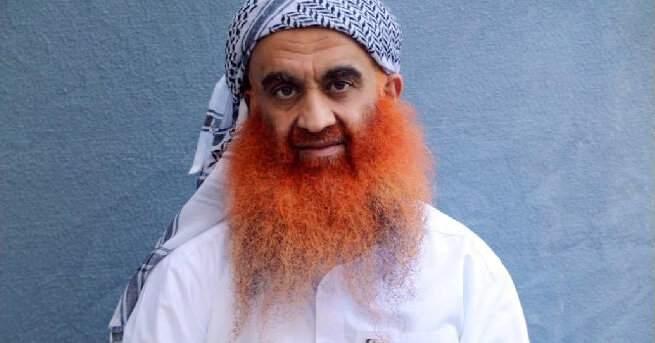
In a major blow to the U.S. case against Khalid Shaikh Mohammed, the man accused of plotting the Sept. 11 attacks, a military judge ruled on Friday that the prisoner’s confessions to F.B.I. agents were not voluntary and cannot be used against him at trial.
Prosecutors have described Mr. Mohammed’s interrogations in 2007 at the U.S. Navy base in Guantánamo Bay, Cuba, as the government’s most crucial evidence in the long-running death-penalty case.
The ruling, just before the 25th anniversary of the attacks, could further delay the start of a trial if prosecutors decide to appeal to reinstate it. Aging survivors and families of victims have said they worry they may never see a final resolution to the case.
Just this week, the judge set a trial date of June 5, 2028.
Mr. Mohammed is accused of being the mastermind of the hijacking attacks that killed nearly 3,000 people in New York, Pennsylvania and the Pentagon.
He was brutally interrogated by the C.I.A. in secret overseas prisons after his capture in 2003 and held incommunicado until his transfer to Guantánamo in 2006. Prosecutors excluded statements from those interrogations from the case.
But the trial judge, Lt. Col. Michael Schrama, went further, concluding that Mr. Mohammed’s subsequent interrogations in 2007 at Guantánamo were also inadmissible.
“The prosecution has failed to prove by a preponderance of the evidence that Mr. Mohammad’s statements to the F.B.I. were voluntarily given,” Colonel Schrama wrote in the conclusion of his 45-page ruling, which was not immediately released to the public but whose unclassified contents were confirmed by several lawyers who had seen it.
Colonel Schrama cited several factors, including an “unbroken continuation of the C.I.A.’s psychological conditioning and severe coercion” at the time of Mr. Mohammed’s questioning at Guantánamo in 2007.
He also found that F.B.I. agents intentionally failed to explicitly tell Mr. Mohammed that he had a right to be silent and to consult a lawyer, and that what he told them could be used against him at a trial.
The chief prosecutor, Rear Adm. Aaron C. Rugh, said his team would review the ruling “and will make a decision on whether to appeal in the near future.”
The judge gave prosecutors five days to decide but said they could request an additional five days.
The question of the taint of torture has hung over the case for years.
Defense lawyers had argued that Mr. Mohammed was essentially conditioned by the C.I.A. through torture coupled with years of isolation and solitary confinement to later tell the F.B.I. what they wanted to hear. He was not allowed to consult a lawyer until long after he had confessed and was charged.
Colonel Schrama has yet to rule on the confessions of two other defendants in the Sept. 11 case, Walid bin Attash and Mustafa al-Hawsawi. An earlier judge, Col. Matthew McCall, threw out the confessions of Mr. Mohammed’s nephew, Ammar al-Baluchi, who is accused of helping some of the 19 hijackers with finances and travel arrangements.
A different judge, Col. Lanny Acosta, suppressed the confession of the defendant in the U.S.S. Cole bombing case, Abd al-Rahim al-Nashiri, in an explicit finding that he had been tortured by the C.I.A. His death-penalty trial in the 2000 attack, which killed 17 U.S. sailors, is scheduled to start in October.
The Sept. 11 case has been mired in pretrial proceedings since arraignment in 2012. Over the years, four other judges gathered evidence on the question Colonel Schrama decided on Friday. An earlier judge found a fifth man, Ramzi bin al-Shibh, mentally incompetent to stand trial, a condition the defendant’s lawyer blamed on torture.
