


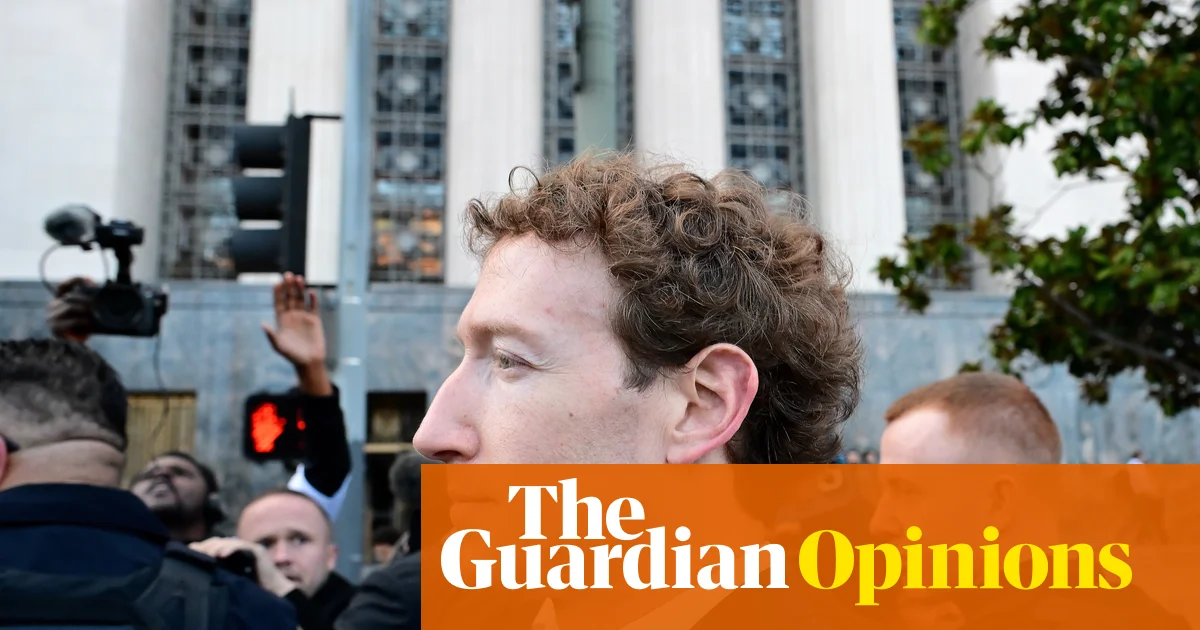
Follow the money. If you want to know how the tech giant Meta really feels about the $18bn it agreed to fork out to end a landmark lawsuit against it – an outcome widely hailed as a victory for campaigners – just look at its share price. It didn’t go down when word came on Wednesday that Meta had settled with the 29 US states that had argued that the company’s Facebook and Instagram platforms harmed children. On the contrary, Meta stock went up, initially surging by 5%, before levelling out at a gain of just over 1.25%. There could be no clearer proof that the money men reckon Meta dodged a bullet.
To be sure, there was plenty to hearten those who have long believed that social media damages teenagers especially, whether by exposing them to content they shouldn’t see or by sapping their self-esteem, offering them filters that show how much prettier they would look if they had cosmetic surgery or giving them a metric of their popularity – and unpopularity – in the form of a running tally of “likes” and views.
For one thing, $18bn is a lot of money. For another, Meta has agreed to a series of changes in the way young people use their platforms. There’ll be a two-hour daily cap on use; restricted access during the night and the school day; likes will not be shown automatically and assorted safety and parental supervision measures will no longer be opt-in extras but the default standard. You can see why Lori Schott of Colorado, who believes the content her daughter encountered on Instagram played a part in her suicide aged 18, declared Wednesday to be “a good day”.
But look closer and you see that, for Meta, $18bn is not exactly a bank-breaking sum. It amounts to less than a month’s revenue. And it has 10 years to pay it out: the monthly payments could come out of petty cash. What’s more, nearly a third of that sum is contingent on Meta’s rivals YouTube and TikTok agreeing to the same restrictions. All told, the financial penalty is less than a tenth of the $200bn the 29 states were seeking, and a tiny fraction of the $1.4tn the company told the court it feared it would have to cough up. No wonder Meta’s shareholders were doing fist bumps on Wednesday.
Beyond the money, Meta will be thankful it has escaped a court ruling against it, a legal verdict on the behaviour detailed so compellingly in the California courtroom in the first week of the trial before it was abruptly halted. Jurors heard from the former Meta safety engineer Arturo Béjar, who spoke of his own teenage daughter’s experience on Instagram – how she received unwanted sexual advances, crude misogynistic insults and photos of male genitalia on the platform – and of a survey he had conducted that found 51% of teen users had had bad or harmful experiences on Instagram within the previous seven days, and that content was taken down only 0.02% of the time. Béjar reported his findings to Mark Zuckerberg directly, but got no reply. As Béjar told me when we spoke on Thursday: “They knew that harm to kids was happening, but they were telling the world it wasn’t.” Under Wednesday’s settlement, Meta hasn’t even made an admission of liability.
As for the new restrictions, anyone who has seen a teenager on a computer or phone will have little confidence that they won’t find a way around them. If they do, then, according to this week’s deal, Meta will not be accountable. And crucially, says Béjar, it is Meta itself that still gets to define what constitutes harm.
No less frustrating, these new terms apply inside the US only, even though Meta’s reach, and its capacity to do damage, is global. As the gagged former Facebook employee Sarah Wynn-Williams described in her riveting book Careless People, the company was assiduous in hunting for new users in those overseas territories with few legal safeguards. There’s a parallel here with the tobacco industry: long after the US and Europe had cracked down on cigarettes, big tobacco was energetically selling into developing countries that had not yet put up their defences.
Above all, this week’s settlement addresses only the safety of children, despite the copious evidence of danger to adults, whether in the form of addiction or exposure to toxic misinformation. The danger lies not in this or that specific feature, but rather in the fundamental business model of social media: namely, tracking and surveilling individuals online, using the data gathered to construct a profile, which is then sold to advertisers eager to target potential consumers with extraordinary precision.
It’s this model that keeps users hooked, scrolling for hour after hour, as they are served content aimed directly at their interests and anxieties. As Ravi Naik, the lawyer who acts for Wynn-Williams and others, told me: “The algorithm preys on you.” The trouble with this latest settlement, he explains, is that “it reaches the features of Meta’s platforms but not the engine that drives them. The recommendation algorithm is untouched.”
What, then, can be done? For Béjar, the answer is to approach social media as a public health crisis, akin to the road traffic accidents that led to mandatory safety belts in cars (and not only for children). Governments need to say that any company involved in this crisis has to be involved in tackling it. And no one should fall for the line that the nature of the internet is such that it cannot be subject to meaningful regulation. When the music industry objected to copyright infringements online, incentives were swiftly arranged to fix the problem. As Béjar so damningly puts it: “A song has more protection than a kid.”
after newsletter promotion
There are ample other precedents that can serve as guides to action, though none of them will please the titans of big tech. For decades, they have avoided being viewed as publishers, liable for what appears on their platforms. Nor do they want to be treated like carmakers, responsible for product safety. And they don’t like being likened to cigarette firms, selling a product they know is dangerous. Perhaps policymakers need to make a new comparison.
More than a century ago, when Standard Oil’s de facto monopoly was deemed harmful to consumers, it was broken up by order of the US supreme court into 34 smaller companies. Meta operates like a monopoly, with users feeling they can’t move, because all their friends and contacts are on the same few platforms. “Meta knowingly exploit this and refuse to make changes to their platforms that they know would deliver safer user experiences,” Damian Collins, a former chair of the UK parliamentary committee that oversees the digital realm, told me. If users could move their data and contacts over to new services, giving them more options, “break-up would work”.
This week’s settlement has been a disappointment to those longing to see the tech giants finally brought to heel, found guilty by courts and made to pay for it with costs too big to ignore. For now, Meta has swerved judgment day. But that day must surely come.
