


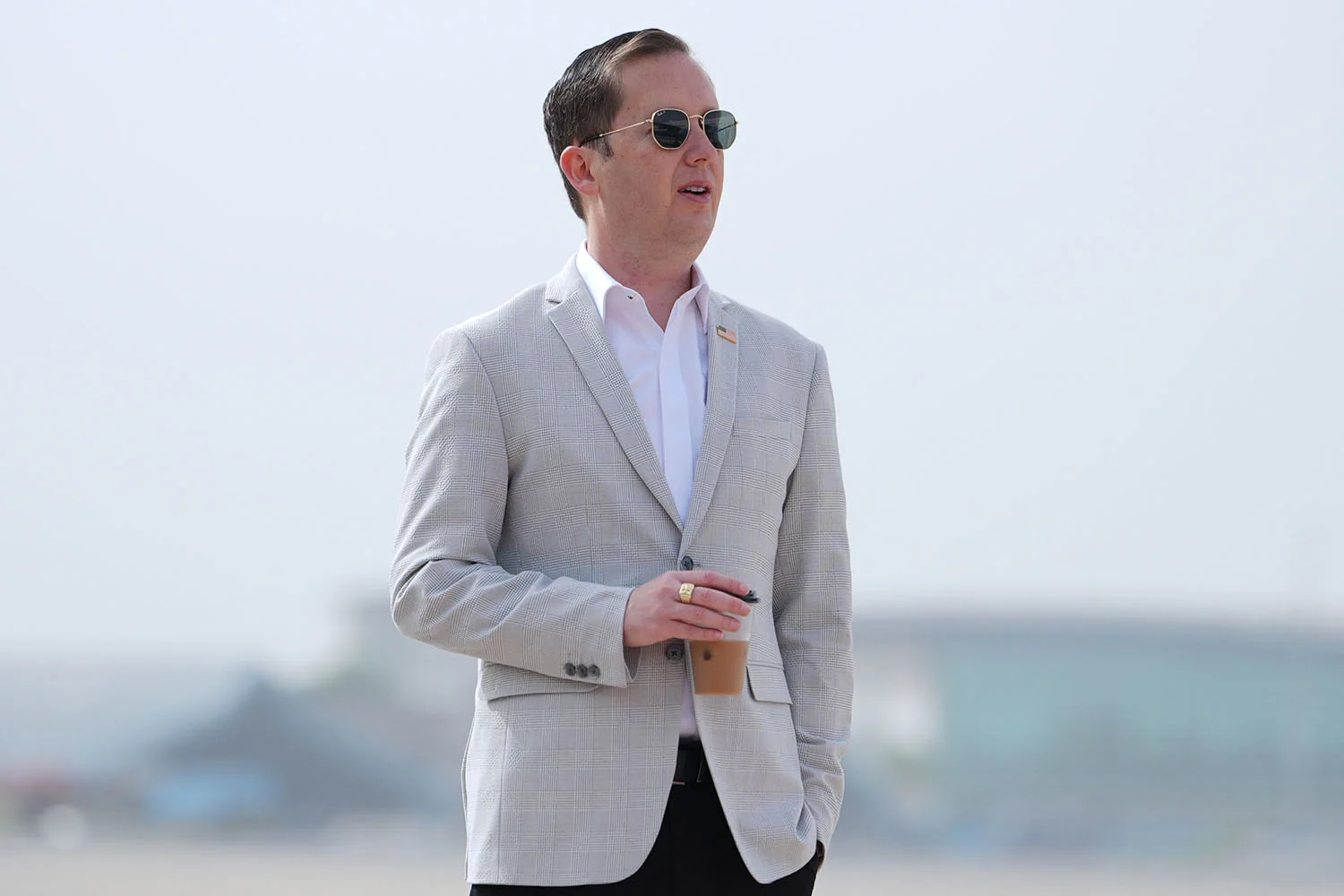
The U.S. ambassador to India, Sergio Gor, has become somewhat of a celebrity—though mostly for the wrong reasons. Since starting his post in January, Gor’s mission has been to restore the U.S.-India strategic partnership after U.S. President Donald Trump took a wrecking ball to it last summer. In several ways, he has succeeded: For example, he has prioritized getting free trade agreement negotiations back on track. But his recent eyebrow-raising statements, coupled with his expansive view of his role in the region, have both complicated and confused Washington’s South Asia policy.
Last week, for example, Gor visited Srinagar—the largest city in Indian-administered Kashmir—and uttered four words that are without historic precedent. Standing alongside the Jammu and Kashmir Chief Minister Omar Abdullah, Gor characterized the territory, which is still disputed between India and Pakistan, as being an “important part of India.” His statement essentially reversed decades-long U.S. policy to remain neutral amid the dispute. Even during Trump’s first administration, when Indian Prime Minister Narendra Modi revoked Article 370 under the country’s constitution to effectively eliminate the semi-autonomous status of Indian-controlled Kashmir, Washington remained extremely cautious, noting that there was no change in U.S. policy and that it supported “direct dialogue between India and Pakistan on Kashmir and other issues of concern.”
The U.S. ambassador to India, Sergio Gor, has become somewhat of a celebrity—though mostly for the wrong reasons. Since starting his post in January, Gor’s mission has been to restore the U.S.-India strategic partnership after U.S. President Donald Trump took a wrecking ball to it last summer. In several ways, he has succeeded: For example, he has prioritized getting free trade agreement negotiations back on track. But his recent eyebrow-raising statements, coupled with his expansive view of his role in the region, have both complicated and confused Washington’s South Asia policy.
Last week, for example, Gor visited Srinagar—the largest city in Indian-administered Kashmir—and uttered four words that are without historic precedent. Standing alongside the Jammu and Kashmir Chief Minister Omar Abdullah, Gor characterized the territory, which is still disputed between India and Pakistan, as being an “important part of India.” His statement essentially reversed decades-long U.S. policy to remain neutral amid the dispute. Even during Trump’s first administration, when Indian Prime Minister Narendra Modi revoked Article 370 under the country’s constitution to effectively eliminate the semi-autonomous status of Indian-controlled Kashmir, Washington remained extremely cautious, noting that there was no change in U.S. policy and that it supported “direct dialogue between India and Pakistan on Kashmir and other issues of concern.”
Gor’s recent statement threw caution to the wind and predictably prompted Islamabad to express its solemn unease at the apparently newfound U.S. position, calling Gor’s remarks “irresponsible” and arguing that they “negated the long-standing and well-documented position of the United States on the Jammu and Kashmir dispute.” To be sure, Washington has much political capital to spend with Islamabad as the latter strongly desires a reset in U.S.-Pakistan relations after the bottoming-out of the relationship during the so-called global war on terror, when Washington discovered that 9/11 mastermind Osama Bin Laden had been hiding in Pakistan. Gor’s statement, however, threatens to significantly dampen the U.S.-Pakistan reset at a particularly delicate moment, as Islamabad has served as the mediator between the United States and Iran to end the war in the Middle East.
Furthermore, both Islamabad and New Delhi remain highly sensitive to the U.S. position on Kashmir—the focus of renewed hostilities in May 2025—and any shift in Washington’s position could increase the chances of miscalculation and escalation along the Line of Control if one side or the other feels emboldened to take action.
Gor has not only frustrated Pakistan, as it turns out, but India, as well. Speaking at a media event on Aug. 22, he told an unusual story about how, during the G-7 summit, India’s Ministry of External Affairs (MEA) requested that Modi and Trump take no questions after their opening statements. Gor said that Trump agreed, but Trump then decided to take questions anyway and held a 45-minute press conference, contrary to Modi’s wishes. It was later reported that Gor’s unscripted anecdote “upset the government,” and the MEA felt the need to push back on Gor’s narrative by noting that leaders typically agree to the format ahead of time and that New Delhi had conveyed its “standard practice” of not entertaining questions from the media. This specific incident aside, the real concern in New Delhi is that Gor is simply shooting from the hip, like Trump, making it impossible to view him as a predictable and consistent messenger.
Another significant concern that I heard a lot about during my recent travels across South Asia is that Gor is dual-hatted as ambassador to India and Trump’s special regional envoy. In the latter capacity, he has visited most of India’s neighbors—including Bangladesh, Bhutan, Maldives, Nepal, and Sri Lanka—meeting not only with their foreign ministers, but also their leaders whenever possible, effectively diluting the power of U.S. Assistant Secretary of State for South and Central Asia S. Paul Kapur. Although Gor is authorized to do this as Trump’s official regional representative, it also raises legitimate structural questions about how the Trump administration views South Asia. Since Gor’s other hat is that of India ambassador, it appears that the administration views the region from a predominantly India-centric lens, potentially alienating the Muslim-majority nations of Bangladesh and Pakistan and complicating the United States’ ability to successfully compete against China in the region. Gor’s Kashmir remarks only reinforce this point.
But it’s obviously not all about Gor. Indeed, stable leadership and consistent messaging must start from the top, and in this sense, Washington’s South Asia policy is becoming muddled because Trump himself has been unable or unwilling to offer consistency, let alone strategic clarity. When Modi visited the White House in February, for example, Trump offered to sell F-35s to India out of the blue. Then, for several weeks last summer, Trump publicly berated India for continuing to import sanctioned Russian oil. Trump was also privately angered by Modi’s reluctance to nominate him for the Nobel Peace Prize for his self-touted role in resolving the May 2025 dispute—a framing that New Delhi categorically rejects but Trump keeps raising publicly. Moreover, Trump strengthened U.S.-Pakistan relations with Field Marshal Asim Munir, who is suspected by New Delhi of having orchestrated the terrorist attacks at Pahalgam, Kashmir, in April 2025. However, at the G-7 summit in June, Trump said, “We don’t have a contract … but if [India] were attacked, we would be there to help them.” He further personalized the U.S. commitment to India by making it about Modi, saying, “If anybody attacks that man, we’re going to be there … If they’re attacked and he’s the leader, we’re going to be there to help.” The policy whiplash can make anyone nauseous, and perhaps Gor is simply a messenger of the chaos rather than being an agent of it himself.
It is also fair to point out that Gor has had two major policy successes in the short time that he has served as ambassador. Shortly after taking up his post, Gor was able to revive and accelerate negotiations on a U.S.-India free trade agreement, which had been stuck in neutral for months, particularly after Trump and Modi’s falling out. On Aug. 22, Gor noted that “almost everything is done” on the deal and all that remains is to work out some legal and technical language before the signing ceremony. A second major accomplishment is Gor ushering India into the Trump administration’s Pax Silica initiative, where New Delhi is poised to play a substantial role in the global supply chain for semiconductors used for artificial intelligence and other critical technologies. For helping to strengthen the U.S.-India strategic partnership in these ways, Gor deserves considerable credit.
But the totality of his time as ambassador tells a different story: He has been impulsive and has undermined the United States’ South Asia policy while pursuing an unusually expansive role with India’s neighbors. Trump should rein him in, but there is no evidence that this is in the offing. A more plausible solution going forward is for Trump to strengthen the connection between his own endorsement and Gor’s words and deeds. If that is too much to expect of Trump, then an alternative might be to empower the National Security Council, U.S. State Department, and the U.S. Defense Department to coordinate their messaging with Gor so that at least it seems more like he speaks on behalf of the U.S. government than just himself.
