


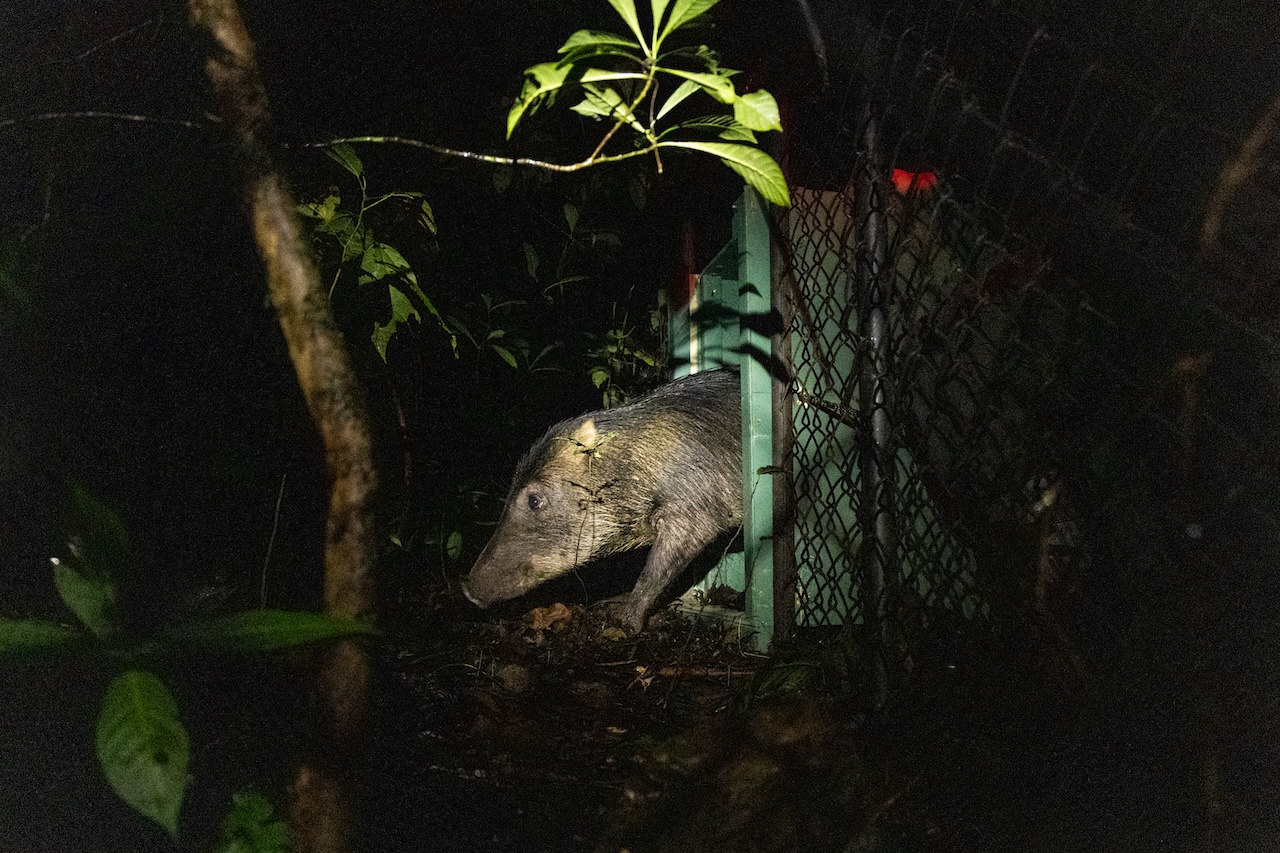
- Costa Rica’s Osa Conservation moved 13 white-lipped peccaries by truck and boat across the Golfo Dulce to reintroduce the threatened species to Piedras Blancas National Park, where hunters had wiped it out roughly 18 years ago.
- The peccaries function as ecosystem engineers, churning soil, dispersing seeds, and digging wallows that become microhabitats, and serve as key prey for jaguars, which had also vanished from the park.
- The translocation followed more than a decade of population study, community outreach, and patient corral-baiting, culminating in a 16-hour, 20-person relay to capture, transport, and soft-release the herd, which now appears healthy and cohesive based on tracking data and camera-trap monitoring.
- The herd’s long-term safety still hinges on curbing poaching and sustaining local support, and Osa Conservation plans further translocations this year toward a target of 25-30 peccaries in the park.
It’s after midnight, and veterinarian Dennise Ortiz Angulo is in the middle of Golfo Dulce, surrounded by shooting stars, bioluminescent water, and 13 boar-like beasts. “That moment, it felt like the movie Life of Pi,” Ortiz told Mongabay.
After years of preparation, hours of fast-paced decision-making, and a tedious truck drive, Ortiz, 13 white-lipped peccaries (Tayassu pecari), and a few other humans were midway through a voyage from Costa Rica’s Osa Peninsula to Piedras Blancas National Park. The peccaries had finally settled, and Ortiz had a moment to catch her breath and take in the scene: stars, glowing water, and a boat full of gently breathing threatened mammals.
This group had been carefully captured on the Osa Peninsula, where the species still ranges in strong numbers. White-lipped peccaries also used to be found in Piedras Blancas until hunters wiped them out roughly 18 years ago. The plan: reintroduce the peccary to a forest across the water, an ecosystem the animals themselves had helped build.
Peccaries are a force. You often smell them before you see them, a musky, garlicky scent that clings to the forest after the herd has passed. They travel in tight, noisy groups that, in Costa Rica, can number 70 to 100 animals, and elsewhere in their range, up to 300.
On the night the herd reached Piedras Blancas, the animals began to hum and call in unison from their crates, a sound Ortiz had only ever heard from a distance. “You feel the floor vibrating,” she said. To her, it sounded like the herd reassuring itself: I’m here, I’m OK.
Peccaries’ value to the forest is immense. As the herd roots through the leaf litter for seeds, fruit and palm nuts, it churns and aerates the soil and scatters seeds across the landscape in its scat. The peccaries wallow out shallow pools that fill with water and become tiny ecosystems of their own. Ortiz has watched bats swoop in to hunt insects over water the pigs left behind.
“They are the biggest engineer of the forest,” she said. She compares them to tractors, turning the soil and making it fertile so the next generation of trees has somewhere to grow.

They are also a favorite meal of the jaguar (Panthera onca). A mammal survey of Piedras Blancas a few years ago confirmed that both the peccary and the jaguar had disappeared from the park. Osa Conservation, the nonprofit behind the reintroduction, says the loss of this prey pushed the region’s jaguars toward smaller, scarcer targets, and raised the risk of conflict with people.
That local disappearance is part of a wider retreat. In Costa Rica, both species are listed as endangered, even as their global populations on the IUCN Red List are considered vulnerable for peccaries and near threatened for jaguars. Hunting, habitat loss, and the fragmentation of the large, unbroken forests the animals need have squeezed them out of much of their former range.
“We knew one day there could be peccaries in Piedras Blancas, but that day could take 100 years. So we are accelerating, using the science,” Carlos Manuel Rodríguez, executive director of Osa Conservation, who also served three terms as Cost Rica’s environment minister, told Mongabay on a call. “What we are doing is basically giving medicine to the forest of Piedras Blancas,” he said. “You can look at them as a pill. Each of those pigs is a pill.”
Moving a herd of wild peccaries across a gulf took years of plotting. About a decade was spent understanding their populations, threats, and distribution, as well as working with local communities. Osa Conservation and Costa Rica’s Osa Conservation Area (ACOSA) began collaborating in 2023 and set their sights on returning the species to Piedras Blancas.
In 2024, the team set up camera traps around the nonprofit’s land at Piro, on the southern tip of the Osa Peninsula, to learn where a nearby herd fed and rested. They then built a capture corral and began baiting it with corn and coconuts. After about a year and a half, the peccaries were walking into the corral to eat on their own.
“These animals are very motivated by food,” Ortiz said.


“We studied the structure of the herd,” Guido Saborío-R., rewilding program manager for Osa Conservation told Mongabay when asked about how they selected these specific peccaries. “But it’s also just what you can catch.”
On the day of the capture, the peccaries showed up at the baited enclosure earlier than expected. Ortiz, watching a live feed as the connection flickered in and out, pushed the button that dropped the gate once more than 10 animals were inside.
“We closed the door and see what we have,” Saborío said. “Thirteen animals. Three males, the rest females and all healthy. We were lucky.”
What followed was a relay that ran roughly 16 hours and involved more than 20 people. The team weighed and examined each animal, loaded them into dark crates, and sprayed water through the boxes to cool the peccaries, whose body temperatures had climbed in the humid heat.

“It was 13 animals that all needed water at once,” Ortiz said. She described being very stressed and hypervigilant, checking on the peccaries constantly to be sure they weren’t overheating.
A convoy of pickup trucks, escorted by ACOSA park rangers, carried the crates overland to Puerto Jiménez, past onlookers who spilled out of roadside bars near midnight to see what the procession of boxes and police was about. From there, a boat provided by Cativo Lodge, a local ecotourism resort, ferried the herd across the Golfo Dulce. The crates were carried the final 2 kilometers, nearly a mile and a half, into the park by hand, to a soft-release corral.
The animals stayed in the corral to acclimate. It took four days before they entered the feeding area, Ortiz said. The team watched on camera traps as a single limping animal recovered on its own. About three and a half weeks later, they fitted two of the peccaries with satellite collars to follow the herd’s movements.
So far, according to the radio collar and camera-trap monitoring data from the rewilding program and park rangers from Piedras Blancas, the park’s new herd appears to be healthy and sticking together.

Now the question is: will the peccaries remain safe? Piedras Blancas is connected by forest to Osa Peninsula’s Corcovado National Park, near where the peccaries were captured. But poaching persists outside the national parks, the same pressure that emptied Piedras Blancas in the first place and stopped white-lipped peccaries from naturally migrating from Osa to Piedras Blancas.
Safety may come down not only to park rangers, but to the people living around the park. Osa Conservation started an education and outreach program with local communities years before any peccary moved, teaching communities about the unique species and its role in the forests. In 2024, the team surveyed 335 residents across 13 nearby communities around Piedras Blancas; 72% supported bringing the species home, and more than half saw a tourism draw.
“Just to have this kind of movement in Central America is a success,” Joares May, a wildlife veterinarian with Brazilian NGO Ampara Silvestre, told Mongabay. May has consulted for Osa Conservation and has worked on peccary translocations in Brazil. He noted the difficulty of the process, not just with the animals but coordinating all of the people and government agencies.

“[In] these kinds of places with a lot of pressure from human activity we need to replace some pieces, and the white lipped peccary is an important one,” he said. “In future [this allows us to] have top predators like jaguars.”
Osa Conservation’s Rodríguez called the translocation “super exciting.” He was in government when Costa Rica’s first endangered species programs began, and said it’s significant that this project “was done by a Costa Rican organization. It was done with Costa Ricans.”
Another translocation is planned this year to build toward a target of 25 to 30 white-lipped peccaries in Piedras Blancas. Osa Conservation is also working toward translocations for other species such as harpy eagles (Harpia harpyja) and giant anteaters (Myrmecophaga tridactyla).
“My generation worked on conservation and stopping deforestation,” Rodríguez said, “and the generation of my kids will work on rewilding the planet.”

Banner image of the first ever release of white-lipped peccary into Piedras Blancas National Park. Photo by Ian Rock
Rewilding Rio: Conservationists restock an ‘empty forest,’ one species at a time
Liz Kimbrough is a staff writer for Mongabay and holds a Ph.D. in ecology and evolutionary biology from Tulane University, where she studied the microbiomes of trees. View more of her reporting here.
FEEDBACK: Use this form to send a message directly to the author of this post. If you want to post a public comment, you can do that at the bottom of the page.

