


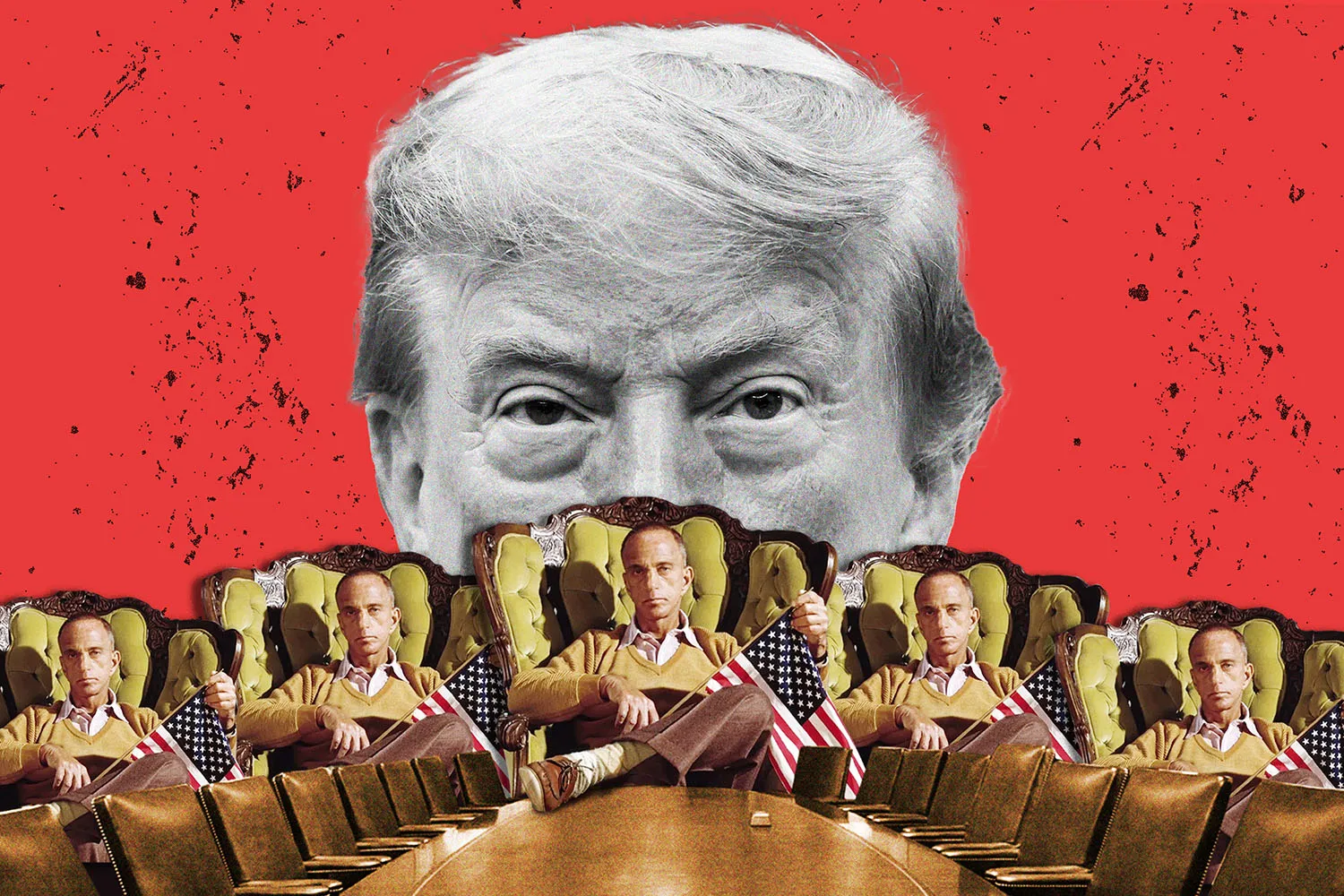
To understand the differences between Donald Trump’s somewhat restrained first term and the outrageous abuses of his second, you need to appreciate the long afterlife of the president’s late mentor.
Roy Marcus Cohn was the kingmaker from hell. An odious man born of an odious mother—Dora Cohn was “mean, vicious, ugly, and foul-mouthed,” one family member said—Cohn was an only child spoiled shamelessly by his doting heiress mom. Dora created “a person who was totally free of the rules that you and I or most people go by,” one of Cohn’s law partners later said.
A brilliant lawyer who graduated Columbia Law School at age 20, Cohn brought that vicious sensibility to the national stage in an extraordinary career of political skullduggery. It was a career that extended from McCarthyism in the 1950s—Cohn was the brains behind that American Inquisition—to mentoring dirty-trickster extraordinaire Roger Stone during the Ronald Reagan era to Cohn’s molding of an ambitious boy builder named Donald Trump in 1970s New York.
American Scoundrel: Roy Cohn’s Dark Journey From Joe McCarthy to Donald Trump, Kai Bird with Susan Goldmark, Scribner, 528 pp., $32, September 2026
Cohn’s brutish course through the corridors of power was, to a large extent, a template for Trump’s later on. In their new book American Scoundrel: Roy Cohn’s Dark Journey From Joe McCarthy to Donald Trump, biographer Kai Bird and his wife and chief researcher, Susan Goldmark, tell the long, sordid tale of how one “narcissistic con artist”—as they characterize Cohn—did so much to create another, the man who now occupies the most powerful office in the world.
Trump and Cohn were blood brothers of the political netherworld. Born to wealthy New York families, indulged endlessly by their parents, the two shared a common sense of entitlement and a dearth of morality. Neither man really believed in anything except his own aggrandizement. Their anti-establishment populism was “purely opportunism,” Bird and Goldmark write.
Most of the familiar tactics we have seen Trump use in his rise to political power sprang out of Cohn’s playbook, the authors contend. Among them: lie to the public relentlessly and without fear of contradiction; deny unflattering facts and drown them out with strident counterclaims; never admit error or defeat; goad and threaten your political enemies constantly; threaten to sue offending press outlets; never leave a paper trail; and always counterattack by accusing the accuser. Above all, never apologize.
Trump even adopted the practice of belittling political opponents with cruel nicknames, employed by Cohn and his former boss, U.S. Sen. Joseph McCarthy. Just as Cohn and McCarthy sought “to establish McCarthyism as Republicanism,” in the words of C.D. Jackson, an aide to then-President Dwight D. Eisenhower, Trump has done pretty much the same with what is now called Trumpism, remaking his party’s ideology top to bottom in his image. And like Cohn, who was indicted several times in his life, accusations of financial corruption swirl around Trump.

Donald Trump with attorney Roy Cohn in 1984.Bettmann Archive/Getty Images
“Roy Cohn not only mentored Donald Trump, but in many ways Roy Cohn was Donald Trump,” said veteran journalist Steven Brill, who covered both men in New York in the 1970s and ’80s. “Trump’s phrases are all Cohn’s phrases.”
It is a useful bit of perspective to have at the moment. Because what we are seeing today, in Trump’s second term, is effectively an administration full of Roy Cohns.
In contrast to his first term, as Maggie Haberman and Jonathan Swan document in another new book, Regime Change: Inside the Imperial Presidency of Donald Trump, Trump has filled his cabinet with slavishly obsequious loyalists. And most of them seem willing, in Cohn-like fashion, to promote any lie, take out any enemy, and break any law that he desires.
In August, Trump managed to muscle Todd Blanche, his devoted personal attorney, through Senate confirmation as U.S. attorney general. As a result, Trump will likely be served by the most Cohn-ish apparatchik of them all—one willing to harass and prosecute his political enemies to the very end.

U.S. Sen. Joseph McCarthy (left) with Cohn during a U.S. Senate hearing in Washington on June 7, 1954.Bettmann Archive/Getty Images
Cohn took a long time to perfect the dark arts of demagoguery. During his first spell in the spotlight in the 1950s—when he was still only in his mid-20s—Cohn worked hard to turn his boss, McCarthy, into a successful demagogue.
Serving as the senator’s chief counsel on the powerful Senate Subcommittee on Investigations, Cohn perjured himself again and again to concoct outrageous and never-proven charges against distinguished American statesmen, including Eisenhower and George C. Marshall. Much as Trump later brilliantly exploited social media to shape his public image, Cohn in the pre-internet age mastered the techniques of innuendo from top columnists such as Walter Winchell and George Sokolsky, who “taught him how to plant gossip,” Bird and Goldmark write.
Meanwhile, McCarthy was seriously flawed. The man whom Cohn once called his “alter ego” was a drunk and not terribly bright. After a few years of spreading fear and falsehood far and wide—and never proving the existence of a single communist in the government—McCarthy slunk off the national stage in humiliation, censured by the Senate.
His attempt to break the Washington establishment had failed.
Some six decades later, however, Cohn’s tactics finally succeeded, albeit posthumously, in striking demagogic gold, not to mention destroying the political establishment. This time Cohn had much more promising material. Trump, a vastly more talented huckster than McCarthy, learned many if not most of these dark arts at Cohn’s knee as a young real estate mogul in New York City in the 1970s and ’80s. At that time, Cohn was the uber-connected fixer of Manhattan high society. Indeed, Cohn was there—buying votes illegally on a promised tax abatement—on the very first deal that made Trump famous in New York, his 1970s conversion of the Commodore Hotel.
Read More
-

An illustration shows a golden globe on a pedestal labeled “Trump.” The globe has Donald Trump’s hair atop it, seen from the side in profile. An illustration shows a golden globe on a pedestal labeled “Trump.” The globe has Donald Trump’s hair atop it, seen from the side in profile. So This, Finally, Is the ‘Trump Doctrine’
A property developer who sought to remake skylines in his image is now doing the same to the global order.

-

President Franklin D. Roosevelt as he spoke during a radio broadcast from his home in Hyde Park, New York, on Nov. 4, 1938. President Franklin D. Roosevelt as he spoke during a radio broadcast from his home in Hyde Park, New York, on Nov. 4, 1938. Trump Is Doing What FDR Could Not
But the president’s success at purging his party could cost the GOP in the long term.
Cohn, by many accounts, took a special interest in molding Trump for the national stage. In an interview with Bird and Goldmark, Trump said that before Cohn died of AIDS in 1986, the lawyer had told him many times: “‘You’re going to be president someday. If you want to.’”
The main thing McCarthy, Cohn, and Trump had in common was a ruthlessness and cynicism rarely, if ever, seen before in U.S. politics. They “used their personal resentments to tap into raw populist emotions that have long festered in American society,” Bird and Goldmark write. “All three were serial fabulists, shamelessly making up stories to stoke tabloid headlines. They uncorked political resentments against immigrants, intellectuals, scientific expertise, feminists, and most particularly, Blacks and any other non-white minorities.”
In an email to Foreign Policy, Bird said, in his view, “historians have gotten it wrong when they conclude that McCarthyism failed,” as opposed to McCarthy himself. “It was not vanquished. It survived even though Roy was fired and Joe drank himself to death.” The reason, Bird said, was that Eisenhower and the establishment never really stood up to it—just as the Republican Party isn’t standing up to Trump today.
“Roy’s story is the dark side of America—a story that keeps repeating itself.”

Trump, flanked by members of his cabinet, speaks during a meeting at the White House in Washington on March 26. Jim Watson/AFP via Getty Images
The story of Cohn, and his influence on Trump, does help explain what is happening now, as Trump displays increasingly open contempt for the rules and laws of a constitutional republic.
Early in his first term, incensed that then-Attorney General Jeff Sessions refused to be his personal fixer, Trump complained to his aides: “Where’s my Roy Cohn?” Sessions, who had outraged the new president by recusing himself from an investigation into Russian election tampering, was only one of the establishment types who frustrated Trump by their unwillingness to bend or break the rules. Each of the many who dared to second-guess Trump even mildly, including White House chief of staff John Kelly, National Security Advisor H.R. McMaster, Secretary of State Rex Tillerson, and Defense Secretary Mark Esper, were fired summarily and relegated to the Trump enemies list.
In his second term, Trump solved this problem by sidelining anyone, even longtime supporters, who had questioned his conduct in the first. Not to mention anyone with a smidgeon of integrity.

Regime Change: Inside the Imperial Presidency of Donald Trump, Maggie Haberman and Jonathan Swan, Simon & Schuster, 496 pp., $34, June 2026
“Singed by his experience with staff he saw as ‘traitors’ in his first term, Trump harbored a suspicion and paranoia that could be set off by the flimsiest of accusations,” Haberman and Swan write in Regime Change, which, like American Scoundrel, is brilliantly reported. “Some candidates had already begun packing for Washington, only to have their offers withdrawn when a stray criticism or guilt by association surfaced.”
Even the slightest deviation from Trump’s first-term liturgy—especially the outright lie that he won the 2020 election—was grounds for exile in the second term.
Robert O’Brien, for example, finished out Trump’s first term as national security advisor and repeatedly defended the former president in media appearances. “But Trump had a long memory,” Haberman and Swan write, especially when it came to what his staffers said after the notorious Jan. 6, 2021, assault by his supporters on the U.S. Capitol. At the time, “O’Brien had committed a cardinal sin in Trump’s judgment; he had praised [Vice President] Mike Pence after he presided over the certification of Joe Biden’s victory.” Trump, watching O’Brien support him on TV during the 2024 transition, told his advisors, “‘Get him off of here,’” the authors write. “‘He’s another one like Pompeo.’”
Trump’s former secretary of state, Mike Pompeo, also a longtime loyalist, had committed the sin of considering a challenge for the 2024 Republican nomination against Trump and questioning his fiscal policies.
“To Trump, this was unforgivable,” Haberman and Swan write. And nothing was more important to the new president than the staffing of the Justice Department, the authors write. His last attorney general, William Barr, had also refused “to go along with Trump’s stolen-election conspiracy” despite serving him loyally.
“Trump would soon fill the senior ranks of the Justice Department with his most devoted loyalists—shattering the department’s post-Watergate history of independence and effectively turning the DoJ leadership into his personal law firm,” Haberman and Swan write.
And this was where Cohn really set the standard. Because what was plainly most important to Trump in his second term was to harass and pursue political enemies from his first term, no matter how flimsy or absurd the grounds. Trump demonstrated that last September when he seemingly accidentally posted on Truth Social what he intended to be a private dressing-down of Attorney General Pam Bondi for her delays in indicting former FBI Director James Comey (for posting a picture of seashells forming the numbers “86 47,” which Trump’s minions insisted meant that Comey wanted to kill the president); Sen. Adam Schiff, who had led the first-term impeachment trial against Trump; and New York Attorney General Letitia James, who had sued Trump for fraud.
Trump, again echoing the tactics of his mentor Cohn, said it didn’t matter whether any of the charges against James were true. “The President’s true goal was to drag into court the New York attorney general who had won a nearly half-billion-dollar civil fraud judgment against him,” Haberman and Swan write. “I want to make her life miserable,” Trump said.
Cohn would have heartily approved.

A portrait of Cohn from the 2019 documentary Where’s My Roy Cohn?Sony Pictures Classic
It’s worthwhile to ask why Cohn’s tactics succeeded in destroying the Washington establishment with Trump when they failed with McCarthy.
True, Trump was plainly the more talented demagogue. Trump figured out before anyone else—and long after Cohn’s death—how to exploit cable TV’s hunger for controversy and how to manipulate the fact-free world of the internet, transforming outrageous innuendo into viral certainty.
Even so, Bird and Goldmark note that McCarthy at his height was often seen the same way. They quote the famed political journalist Richard Rovere writing in March 1954 that McCarthy was “no ordinary demagogue but a political figure of first rank” with a following that was “large and fanatical.” That sounds familiar.
One reason for the different outcome, the authors write, is that the “Republican and Democratic establishments destroyed McCarthy via sexual innuendo.” Cohn was gay, and the notorious Army-McCarthy hearings that did so much to bring his boss down focused on Cohn’s obsession with a young male aide.
But another possibility is that the old order was not quite as ripe for toppling in the 1950s as it was in the 2000s.
There are periods in history when society and politics are so deranged, and fear so widespread, that it brings forth the worst in people—and, of course, the worst kinds of leaders. One can point to the Reign of Terror during the French Revolution, when fears of the ancien régime and foreign invasion led to out-of-control paranoia; the rise of Nazi Germany, when fear generated by a drumbeat of disaster (the unfair Treaty of Versailles, the chaos of the Weimar Republic, and then the Great Depression) elevated Adolf Hitler from a mocked, minor politician to absolute dictator; and Russia after the collapse of the Soviet Union, when fears of foreign plots helped enable Vladimir Putin’s rise.
The throughline of these periods is always societal fear, which “leaders can manipulate into a sense of existential threat,” said James Waller, the author of Becoming Evil: How Ordinary People Commit Genocide and Mass Killing.
And in the aftermath of the failures of globalization and U.S. leadership extending from 9/11 and the Iraq War, and amid widening income inequality, many of those fears are rampant, opening the door wide to demagoguery. “Today, it is difficult to escape the conclusion that the darker qualities of leadership—rather than the nobler—are gaining the upper hand in far too many places,” Waller said.
That was not true of the United States in the 1950s, despite the genuine threat of the Cold War—at least not as much as it is today. Social equity was not as much in danger—except, of course, in the Deep South—and politics were far more stable.
“While there was fear during the McCarthy era, it wasn’t the deep existential sense of fear and a ‘longing for the past’ that followed the Obama presidency and set the stage for a significant backlash,” Waller said.
Still, the parallels are alarming. Cohn and McCarthy were calling up nationalist demons very similar to what Trump is doing today—even though Cohn’s earlier demagoguery was ostensibly about rooting out communism at the height of the Cold War.
“Not unlike the bedrock supporters of Donald Trump’s ‘Make America Great Again’ (MAGA) movement decades later, McCarthy’s constituency included Midwestern, agrarian populists, who often harbored suspicions against urban sophisticates, college professors, pin-striped diplomats, Jews, immigrants, and Blacks—anyone who might be labeled ‘the other.’ Their instincts were isolationist and nativist,” Bird and Goldmark write.
One factor that may have made Trump more successful in the current era: He has also captured the capital-owning class—the economic establishment—in a way McCarthy never did. Here, too, Cohn may have been an invaluable tutor to Trump; after the McCarthy era ended, the lawyer cagily cultivated the very rich in New York as part of his “favor bank,” including George Steinbrenner, Rupert Murdoch, Si Newhouse, and Ronald Perelman. Trump later followed suit.
“Roy’s story really suggests that Trump is not an aberration,” Bird said in his email to Foreign Policy. “Neither was Joe McCarthy. … Given the pace of recent globalization and now AI, many Americans rightly fear they are being left behind—by the elite, the establishment—and men like Cohn and Trump easily tap into these fears. They are very adept at the politics of resentment.”
Even back in the 1950s, Bird and Goldmark write, quoting the historian Richard Hofstadter, the real function of McCarthyism “‘was not anything so simply rational as to turn up spies or prevent espionage … but to discharge resentments and frustrations. … Communism was not the target but the weapon.’”
In a disturbing closing of the circle, Trump and his team are now targeting “communism” again, resurrecting the Red Scare and tarring all Democrats—whether centrist or socialist—with the same noxious label that Cohn once applied.
It is a trend that seems to vindicate Bird’s point: McCarthyism never really went away. And it is why Cohn has enjoyed such a long afterlife.
