



Bitcoin price is trading near $78,900, close enough to $80,000 to revive the old treasury-company pitch on paper: higher Bitcoin should lift the value of corporate holdings, pull the shares back above net asset value, and reopen common-stock issuance as a source of fresh coins.
That sequence did not return. At Strategy, Twenty One Capital, and Metaplanet, three listed companies built around corporate Bitcoin treasuries, common market capitalization remained well below the gross value of reported Bitcoin holdings. Yet the apparent discount was not uniform, and it did not amount to directly redeemable, cut-price Bitcoin. Debt, preferred stock, pledged coins, cash balances, warrants and different share-count conventions all changed what was left for common shareholders.
The result is a funding problem, not just a valuation puzzle. If common stock no longer trades at a reliable premium, issuing it can dilute Bitcoin per share. Debt and preferred stock avoid immediate common-share dilution but move value and risk toward senior claims. Retained operating cash is the only recurring route that adds neither, but Metaplanet’s disclosed cash generation was nowhere near the scale of its recent Bitcoin purchases.
Bitcoin treasury premiums: three mNAVs, three different answers
BitcoinTreasuries’ Aug. 27 snapshot put Bitcoin at roughly $78,900 and produced the following rounded comparison. The figures are a same-day analytical snapshot, not a perfectly synchronized market close: U.S. overnight quotes and a delayed Tokyo quote were observed at different times, and the dataset displayed different holding dates for the companies.
| Company | Reported BTC | BTC value | Market cap | Enterprise value | Enterprise mNAV | Basic mNAV | Diluted mNAV |
|---|---|---|---|---|---|---|---|
| Strategy | 840,447 | $66.18B | $48.1B | $66.6B | 1.01x | 0.73x | 0.74x |
| Twenty One Capital | 43,514 | $3.43B | $2.2B | $2.6B | 0.75x | 0.64x | 1.20x |
| Metaplanet | 43,000 | $3.39B | $2.2B | $3.0B | 0.88x | 0.66x | 0.83x |
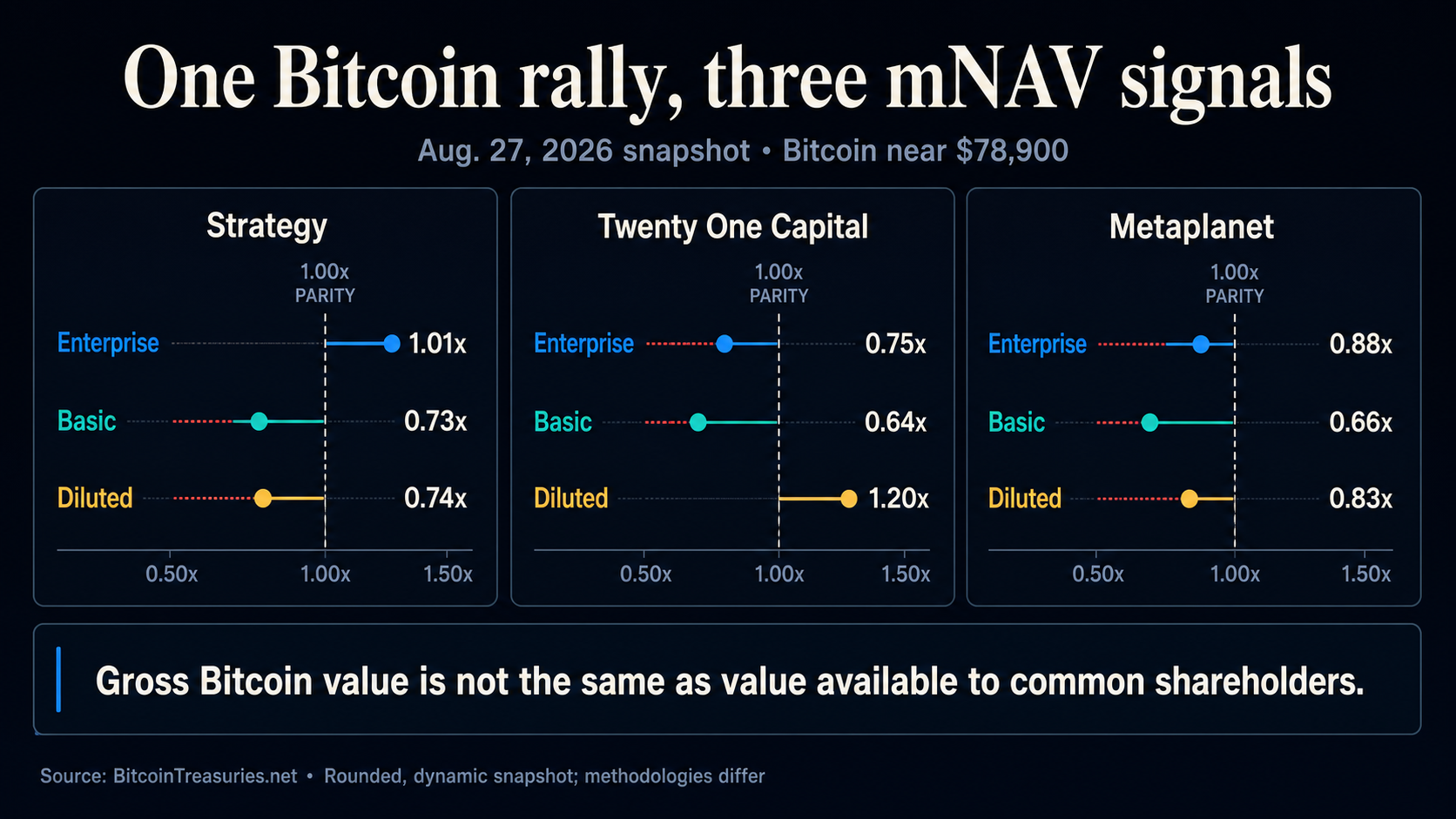
Those ratios are not interchangeable. Basic mNAV compares basic common market capitalization with gross Bitcoin value. Diluted mNAV expands the share denominator. Enterprise mNAV adds debt and preferred stock and subtracts cash before comparing enterprise value with the Bitcoin stack.
That is why “market cap below Bitcoin value” is an incomplete claim. A share is a residual interest in a company, not a withdrawal ticket for its coins. Common holders sit behind creditors and preferred investors, absorb future dilution, and remain exposed to operating costs, taxes, governance decisions and restrictions on assets. The table’s own disagreement is the warning: Twenty One screened at 0.64x on basic mNAV but 1.20x on the dataset’s diluted measure.
Strategy’s $2 billion sale bought liquidity, not Bitcoin
Strategy offers the clearest test of the old equity flywheel because its enterprise value had recovered to roughly parity with gross Bitcoin value, while both common-equity measures remained near 0.74x.
The company nevertheless sold 18.26 million MSTR shares from Aug. 17 through Aug. 23 for $2.0065 billion of net proceeds. Its Aug. 24 filing reported no Bitcoin purchase for the week. Instead, Strategy allocated $136.4 million to repurchase STRC preferred stock, $300 million to its USD Reserve and the remainder to USD Cash.
By Aug. 23, Strategy reported 840,447 BTC, a $5.10 billion USD Reserve and $1.59 billion of USD Cash. The cash figures included expected proceeds from shares sold but not yet settled.
That choice matters. Common issuance did not mechanically increase Bitcoin per MSTR share; it reinforced liquidity and managed a senior security. Strategy’s June-quarter filing showed about $6.75 billion of debt principal, with a carrying value near $6.71 billion. Its June digital-credit framework estimated about $1.76 billion of annual preferred dividends and debt interest combined.
The reserve reduces near-term pressure to fund those obligations from Bitcoin sales, but it also explains why common investors do not own the gross coin stack free of claims. Strategy can still sell shares for corporate purposes when the stock screens below gross Bitcoin value. What it cannot do at that price is assume that every dollar raised and converted into Bitcoin will increase Bitcoin value per old common share.
Common issuance only lifts Bitcoin per share when the coins bought per new share exceed the pre-issue ratio. Fees, cash retained for obligations and differences between basic and diluted share counts all raise that hurdle.
Twenty One’s collateral shows why gross holdings overstate flexibility
Twenty One Capital presents a different capital structure. It reported 43,514 BTC at June 30 and 346.8 million Class A shares, alongside 215.7 million Class B shares. Its basic mNAV was deeply below 1x in the Aug. 27 snapshot, while diluted mNAV was above 1x.
The company’s second-quarter filing supplies the missing bridge. Twenty One had $486.5 million of convertible-note principal, with a carrying value of about $484.5 million. Approximately 16,116 BTC, or 37% of the reported stack, were pledged to secure the notes and were unavailable for general liquidity while pledged.
The pledge creates no automatic sale signal. It does make gross holdings and unencumbered financial flexibility different quantities. A common investor valuing all 43,514 BTC as freely deployable while ignoring the convertible claim is not buying the same exposure measured by enterprise mNAV.
Twenty One also reported a $1.273 billion net loss for the first half. About $1.249 billion came from a fair-value decline in Bitcoin, so it was not an equivalent cash drain. Even so, the filing illustrates why accounting equity, cash liquidity and Bitcoin per share must be kept separate. A fair-value loss can dominate earnings without consuming cash, while collateral restrictions and note principal can limit choices without changing the reported coin count.
Debt can still fund more Bitcoin without issuing common shares today, but it creates a senior claim, interest or conversion exposure, and sometimes encumbers the asset being accumulated.
Metaplanet built the mNAV gate into its financing
Metaplanet reported 43,000 BTC and 1.281 billion issued common shares at June 30. The Aug. 27 dataset valued the coins at about $3.39 billion and the common equity at $2.2 billion, but the company’s warrant structure makes a basic-share comparison especially fragile.
Its effective diluted-share KPI includes outstanding options and funded convertibles, while excluding several stock-acquisition-right series until exercise proceeds are received. An April disclosure listed 15.9 million potential shares in the 25th series, 107.4 million in the 26th and 100 million in the 27th, plus 210 million combined in two suspended series.
Metaplanet said mNAV remained below 1x for most of the first half. It did not conduct a company-initiated common-share third-party allotment in the second quarter, although rights exercises still issued shares. Crucially, the 27th-series rights may be exercised only when mNAV is at least 1.01x. The company has therefore written a version of the funding constraint into the instrument itself, although fees, market slippage and denominator differences mean the gate alone does not guarantee accretion.
Operating revenue does not yet replace the market-access engine. Metaplanet generated ¥349 million of operating cash in the first half against ¥99.782 billion of Bitcoin purchases. Retained cash can add Bitcoin without a new senior claim or new shares, but those figures show the scale gap.
Metaplanet’s planned Super League investment had been signed but had not closed at the snapshot. Subject to approvals, it would contribute 2,100 BTC and $2.5 million for common stock, warrants and strategic preferred stock, and Super League was expected to become a consolidated subsidiary. The coins should therefore remain in the current 43,000-BTC snapshot rather than be treated as sold; under the group’s current policy, they are expected to remain consolidated and fair-valued, with a minority portion attributable to non-controlling interests.
The surviving engine is smaller and less automatic
Each alternative to premium-priced common equity carries a tradeoff.
Retained operating cash is the cleanest route because it adds neither dilution nor a financing senior claim, but it is currently too small to sustain acquisition at the recent pace. Existing cash can be converted into Bitcoin, though that swaps one corporate asset for another rather than creating new net value.
Premium-priced common equity is the scalable route that avoids a new senior claim, but only when net issue proceeds clear a consistent per-share Bitcoin-value threshold and are used to buy coins. A basic mNAV below 1x is a warning, not a complete test; the relevant hurdle must include dilution, cash and senior obligations.
Debt and preferred stock can preserve the common share count initially, but coupons, dividends, conversion rights and collateral transfer part of the economics to senior investors. A cash-funded buyback mechanically raises gross Bitcoin per remaining share while reducing cash. A Bitcoin-funded buyback reduces total coins and raises Bitcoin per share only when the repurchase price is below pre-buyback gross Bitcoin value per share. Neither route accumulates new Bitcoin. Strategy’s $1 billion MSTR repurchase authorization remained unused through Aug. 23.
Bitcoin’s rally repaired the numerator. It did not repair the financing terms. Until these companies generate much more operating cash or regain a defensible common-equity premium, the next Bitcoin purchase will depend less on the size of the treasury than on who funds it, what claim they receive and whether the transaction actually leaves existing common holders with more Bitcoin per share.
