


In a coastal village on the Indonesian island of Sumatra, an oil palm and pineapple grower named Harisyah is fighting rapid coastal erosion.
The region’s northern coastline, which sits on carbon-rich tropical peat soils, is losing ground to the sea at a rate of more than 6 meters (20 feet) annually. Researchers attribute the retreat to a combination of subsiding drained peatland and the loss of mangrove forests cleared for charcoal production, aquaculture, and oil palms.
Harisyah’s hands-on activism began in 2011 after he attended an aquaculture training course in the Meranti Islands, off the eastern coast of Sumatra, reports contributor Suryadi for Mongabay Indonesia. He spent the next few years learning how to restore mangrove forests, from raising seedlings to organizing community volunteers.
In 2018, when he became the head of Tanjung Kuras village, on the Sumatran mainland, he used local funds to kick-start mangrove restoration efforts around his village. In 2024, after leaving office, he partnered with local and international nonprofits to scale up restoration in Tanjung Kuras, aiming to revive 25 hectares (62 acres) of degraded mangrove forest.
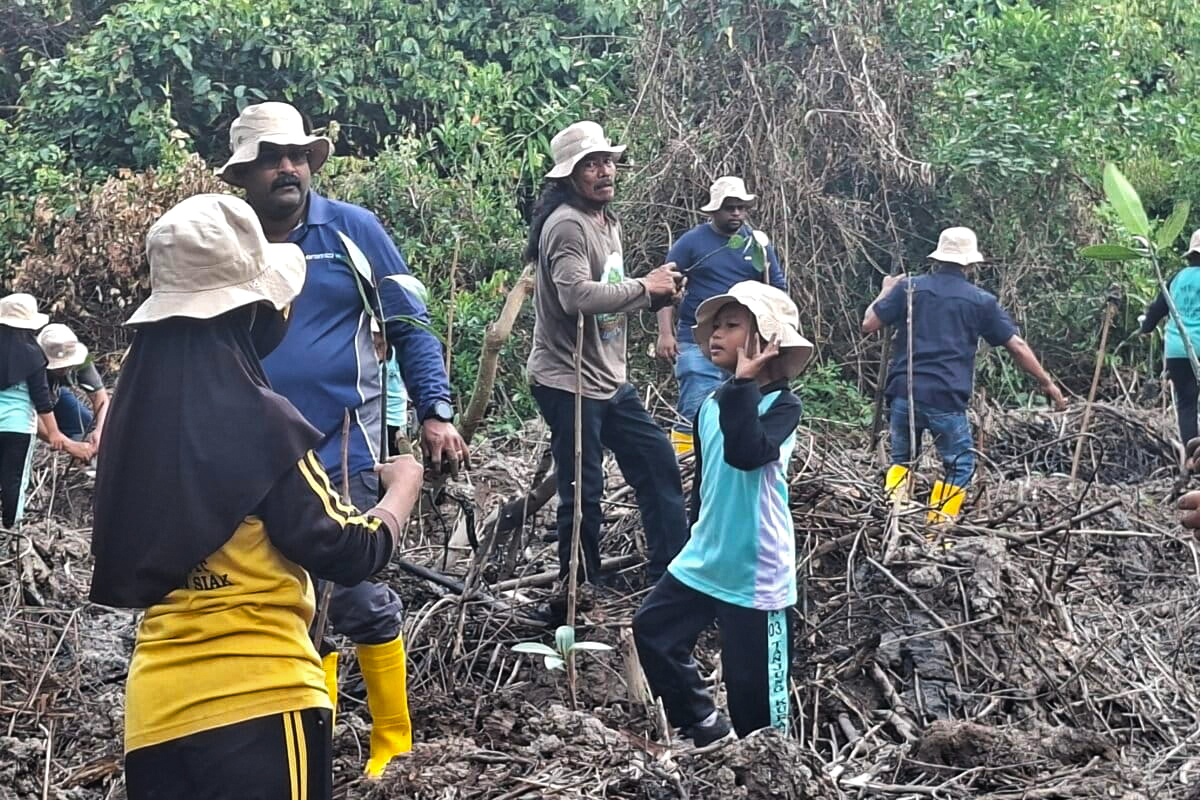
A key part of Harisyah’s current strategy is involving local youths to ensure long-term stewardship. One of the restoration sites is near an elementary school, and local schoolchildren and residents joined him to plant seedlings along the riverbanks.
“This new generation will grow up close to mangroves, and they can learn more about them through playing and activities,” Harisyah said.
The replanting efforts highlight a shift from unmet national targets toward locally led action. The Indonesian government in 2020 pledged to rehabilitate and protect 600,000 hectares (1.5 million acres) of mangroves by 2024, but missed that goal, the Peat and Mangrove Restoration Agency acknowledged.
“This isn’t only about planting,” said Mulyadi, director of the nonprofit Yayasan Gambut, with which Harisyah collaborates. “There’s also a series of capacity-building and economic alternatives, such as nipah palm sugar production.
“If these kids already in their phase of growing up learn about mangroves, hopefully they’ll start caring for the natural environment in their village in the future,” Mulyadi added.
Local leaders are seeking to compound these community actions through new regulations that tackle river pollution and mangrove conservation, according to the current Tanjung Kuras village head, Badaruddin.
“This mangrove planting is for the future — for our children and grandchildren,” said Hendri Yadi, an official with the Sungai Apit subdistrict, where Tanjung Kuras village is located.
Though the fragile seedlings planted along rivers face ongoing threats from local oil spills, logging, and erratic weather, Harisyah remains undeterred. “We keep going,” he told Mongabay Indonesia. “Even if you’re by yourself, keep going.”
Read the full story by Suryadi here.
Banner image: Students from Tanjung Kuras participate in a mangrove-planting effort. Image by Suryadi for Mongabay Indonesia.
