


- More than 40% of the population in Japan suffers from hay fever, or kafunsho, an annual affliction.
- The majority of Japan’s hay fever sufferers are allergic to the pollen of two trees — sugi and hinoki. Both trees were widely planted in the years following World War II as a much-needed source of timber.
- In 2023, the Japanese government announced a solution: Fell 750,000 hectares of sugi and hinoki trees in a bid to cut the problem off at the root.
- After decades of work, researchers have developed more than 30 strains of low-pollen and no-pollen sugi trees, which will replace some of the trees cut down.
TOKYO — For Mariko Aoki, the new year began with an itch.
“Right after the New Year in January, my nose starts to get a little itchy,” Aoki said. “It peaks in March, and the sneezing, runny nose, itchy throat and itchy eyes are really bad. It lasts all the way until just before Golden Week [April 29-May 5].”
Aoki, like many in Japan, suffers from hay fever, or kafunsho, an annual affliction that affects more than 40% of the population — nearly double the rate in the U.S. The seasonal allergies leave many with red eyes, a stuffy nose, a sore throat and feelings of exhaustion. The combined lassitude annually costs Japan an estimated 245 billion yen ($1.5 billion) in economic losses per day during hay fever season, according to one survey.
“My head feels so foggy that I can’t concentrate,” said Aoki, who works as a secretary at the National Diet — Japan’s legislature. “When it gets really bad, I go to the doctor.”
In Japan, hay fever has been called a national disease. But it’s a man-made one. The majority of Japan’s hay fever sufferers are allergic to the pollen of two trees: sugi (Cryptomeria japonica) and hinoki (Chamaecyparis obtusa). Both trees were widely planted in the years following World War II as a much-needed source of timber.
The trees helped fuel Japan’s post-war recovery. Now, decades later, they’re fuelling a national health crisis.
“People wanted wood resources as fast as they could, so planting sugi was a good solution,” said Hitoshi Yonenobu, a tree-ring researcher at the Naruto University of Education, in Tokushima prefecture. “It is a rapidly growing species. Ironically it [also] caused hay fever.”
Recently, the annual pollen season has become longer and more severe. In some corners of Tokyo, sugi pollen is showing up earlier as a result of the impacts of global warming. So, in 2023, the Japanese government announced a solution: Fell 750,000 hectares (1.9 million acres) of sugi and hinoki trees in a bid to cut the problem off at the root.
“We will gradually increase the amount we cut each year,” said Makoto Nakamura, the assistant director of the wood industry division at the Ministry of Agriculture, Forestry and Fisheries. “We’re already cutting 50,000 hectares (123,500 acres) annually, as a result we’re consistently using about 12 million cubic meters of sugi. We’re accelerating that process — we’re looking to increase production from around 12 million to 16 million cubic meters.”

Japan is one of the most forested industrialized countries in the world. Approximately 70% of the country — more than 25 million hectares (61.8 million acres) — is covered by forests. One reason is topographical. Japan is a mountainous country and the slopes of its mountains and hills are covered in lush green forests that rise above many small towns and cities. The trees hold back the hillside, absorb water during the rainy season and, even, help combat the brutal heat during the summer months.
But another is practical. Throughout Japanese history, forests have remained an important source of natural resources, from charcoal for fuel to timber for houses. And two species have been favored for their fast growth rates and straight tree trunks: sugi and hinoki.
“We selected these two species specifically in the early modern times,” said Taro Takemoto, a senior assistant professor at Tokyo University of Agriculture and Technology.
The trees were first distributed widely across Japan during the Meiji era, a period of rapid industrialization that ran from 1868 to 1912. But it was the post-World War II period that accelerated the conversion of natural forests into planted forests dominated by sugi and hinoki. Takemoto wrote about this period in the Handbook of Environmental History in Japan, explaining that several intersecting shifts in the second half of the 20th century pushed Japan to favor sugi and hinoki trees.
Between 1950 and 1985, Japan’s planted forests grew to account for some 10 million hectares (24.7 million acres) — more than a quarter of the country’s total land area — with much of it converted from natural forests. Deciduous species formerly used for firewood like kunugi (Quercus acutissima) and konara (Quercus serrata) fell out of favor as fossil fuels became widely available.
Yet, the natural trees were still being felled as technological advances in the pulp and paper industry drove the forestry industry to cut deeper into Japan’s broadleaf forests.

Meanwhile, the construction industry drove demand for timber from sugi and hinoki trees. By the war’s end, aggressive bombing campaigns by the U.S. had left the country in need of some 4.2 million homes, according to a 2021 case study. Japan rebuilt at a staggering pace, spending as much as 40% of the national budget on construction projects. By 2020, the construction industry had built more than 76 million apartments and houses, the study found, with detached single family homes made of wood accounting for the largest share of new housing units.
“The timing was very good,” Takemoto told Mongabay. “We switched from energy forests to construction trees like sugi, hinoki trees. So we cut the deciduous trees, we used the pulp, then we replanted sugi and hinoki trees.”
Today, some 41% of the country’s forests are planted, with sugi trees accounting for the largest share. Around 40% of planted forests, or 4.4 million hectares (10.9 million acres), are sugi — the main source of Japan’s annual hay fever. Another 25% are hinoki, which releases pollen later, further extending the allergy season.
It’s these forests that the government is focused on cutting. Nearly all of Japan’s planted sugi trees are older than 20 years, totaling some 4.3 million hectares (10.6 million acres). These trees not only produce a significant amount of Japan’s pollen, but they are also large enough to be used in the timber industry. The government is now working to reduce that 4.3 million hectares of sugi by 20% by 2033.
“The plan is to start cutting down the trees as they become usable — starting with those that are ready for use as lumber,” explained Nakamura, of the forestry ministry.
Trees in hard-to-reach locations, like mountain slopes or deep within the forest, will be replaced with a variety of local trees. Those felled closer to the roadside or timber facilities will be replaced with new strains of sugi.
“In areas that remain suitable for forestry, we’re planting sugi saplings that produce less pollen,” said Akimi Kobayashi, of the forestry ministry’s forest use and conservation division.
It’s these trees, developed through a painstaking process of selective breeding, that present a best path forward for Japan’s efforts to reduce seasonal allergies, while still preserving the industries that rely on sugi trees.

A ‘lucky’ discovery
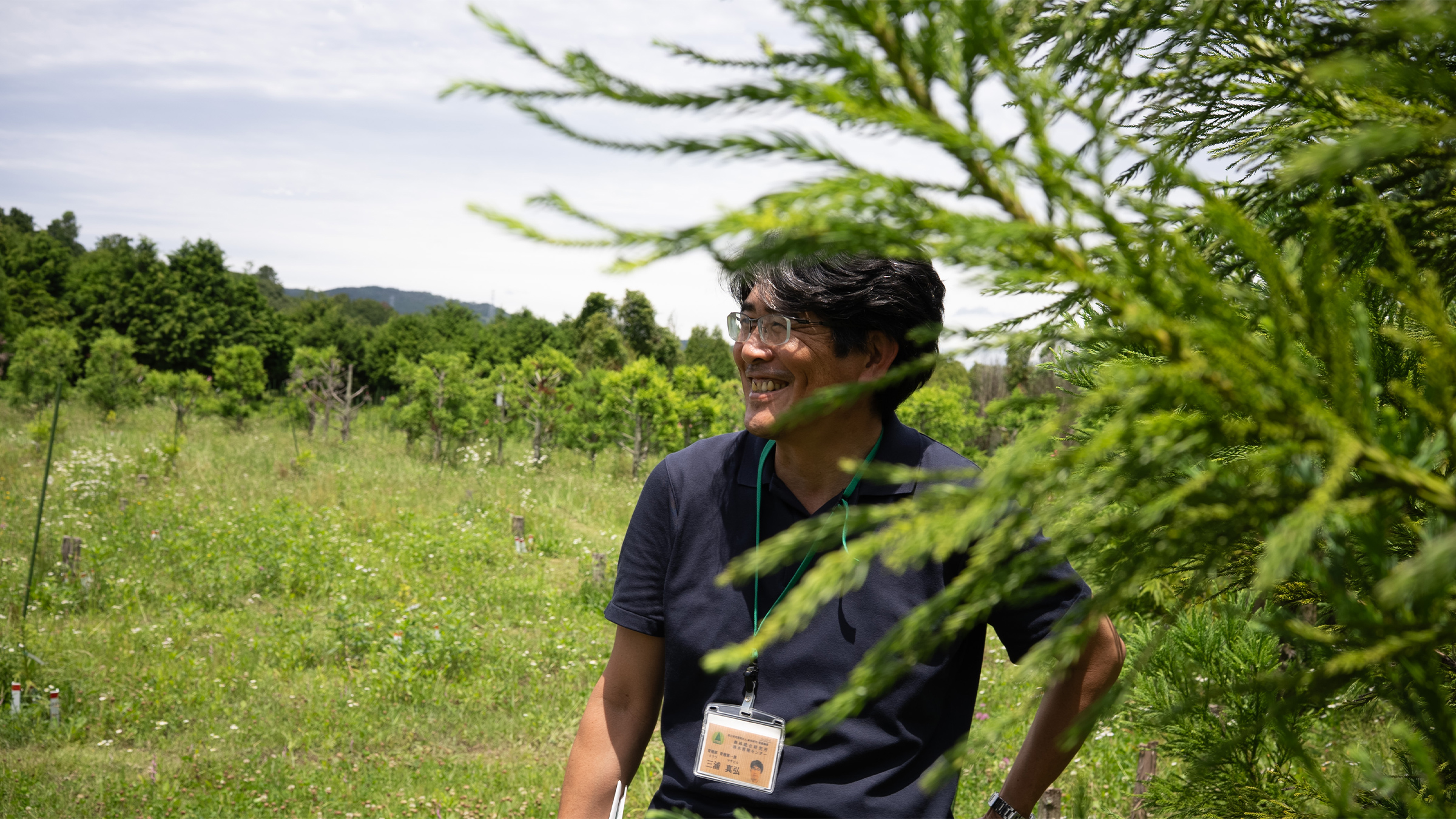
At the Forest Tree Breeding Center, in the seaside city of Hitachi, researcher Masahiro Miura walked between tall rows of sugi and hinoki trees that release a fraction of the pollen of regular trees. Some release no pollen at all. Each is tall and rigidly straight — the result of a highly selective process that visually evaluates the trees at each step of the breeding process.
“Many people suffer from hay fever,” Miura said. “One of main objectives is to make lower pollen varieties and pollen-free varieties for sugi and hinoki species.”
Miura personally spent five years cataloguing the trees by the number of flowers that appeared on the ends of their branches. Both sugi and hinoki become laden with clusters of small brown flowers that produce a fine yellow pollen during allergy season. The pollen easily catches the wind, collecting into dense clouds that can travel hundreds of kilometers.
“I spent five years counting … well, ‘counting’ isn’t quite right — I visually assessed the quantity of flowers using a 55-point grading scale, similar to an A,B,C style report card,” Miura explained. “We classified those that consistently failed to produce pollen throughout that five-year period as ‘pollen-free varieties.’”

Today, after decades of work, researchers have developed more than 30 strains of low-pollen and no-pollen sugi trees. All are the descendants of just a handful of trees that were first discovered growing naturally in Japan’s forests.
“This [no-pollen] variety was just discovered by chance — it wasn’t specifically bred by crossing it with a variety that produces less pollen,” Miura said. “We were very lucky.”
In 2004, a professor at Niigata University conducting research on low-pollen varieties of sugi discovered the first tree that produced no pollen at all. Soon after, other researchers discovered similar trees. These trees became the seed of all subsequent generations of no-pollen trees developed at research centers nationwide.
In some corners of Japan, no-pollen trees have already taken root. Toyama prefecture, on Japan’s western coast, was one of the first to plant these varieties in the wild. The prefecture has planted around 100,000 no-pollen saplings in a single year, mostly in mountainous areas. Other prefectures have since followed suit.
“Currently, we’re growing 34 varieties in the Tohoku, Kanto and Kansai regions,” Miura explained.
But while research centers nationwide have successfully grown no-pollen trees, getting them planted in the wild remains a difficult task. It takes a significant amount of labor to produce new no-pollen trees. Saplings can either be created by cloning — growing a new tree from a cutting — or by cross-pollination.
Some of the most successful cross-pollination efforts involve spraying trees with a hormone that is usually used to create seedless grapes. But even then, the offspring aren’t entirely of a no-pollen variety. While genetic testing has reduced the number of generations needed to produce a no-pollen sugi tree, reproduction through cross pollination will still result in a 50/50 split between trees that produce pollen and those that don’t.

In order to determine which of the offspring are no-pollen varieties, researchers have to physically examine the trees one by one, crushing the flowers between their fingers to see if pollen is inside. It’s a demanding and time-consuming task that has to be conducted wherever the trees are grown.
“That’s why this isn’t catching on,” Miura said. “You can’t tell just by looking which individuals will produce pollen and which won’t.”
It’s not the only problem that threatens to slow Japan’s sugi reduction plan. The forestry industry, like much of rural Japan, is struggling with severe labor shortages. In 1985, more than 126,000 people worked in the forestry sector, according to Japanese census data. By 2020, that figure had dropped to less than 44,000. The rate of decline has since leveled off, but efforts to expand the rate of clearing will add new demands on an already diminished workforce.
“Of course, since jobs in the primary forestry sector — working in the mountains — can’t exactly be called popular, we’re likely to face a labor shortage, so we need to raise awareness about the jobs,” said Nakamura, of the forestry ministry.
The ministry is betting on advances in automation and robotics to help offset a shortage of human workers.
“We plan to expand our manufacturing capacity,” Nakamura said. “As technology continues to advance — and we’re seeing rapid progress toward labor-saving measures and an increase in unmanned factories — we’ll continue to expand our capacity.”
Then there’s the problem of what to do with all this new timber. As Japan’s population continues to drop, the home construction industry is in decline. The construction of new homes, known as housing starts, fell to a 62-year low in 2025, according to land ministry data. The rental housing market is heading toward a deeper decline, with one industry research paper predicting that the construction of rental units in 2040 will be down 29% from 2025’s numbers.

The forestry ministry is looking to diversify the sector to find new sources of demand that could offset a decline in the residential construction industry.
“As demand for housing declines, we’ll increase the amount of domestically produced lumber used in residential construction and also expand the use of wood in a wide range of non-residential buildings,” Nakamura explained, adding that there was still room to grow the pulp and paper, as well as the biomass energy, sectors.
But for Aoki, who spends the start of each year suffering the ill-effects of Japan’s previous government-backed forestry projects, a future free of hay fever still feels like a distant dream.
“These trees were planted in such large numbers,” Aoki said. “When I go to the mountains, I see this incredible amount of pollen floating around like smoke.”
“I wouldn’t say it’s a failure, but I feel like it’s not really going very well,” she added.
Banner image: Masahiro Miura, a researcher in the national breeding division of the Forest Tree Breeding Center, in Hitachi, Ibaraki prefecture. Image by Jonathan Vit.
In coastal Japan, one project is planting forests to stand against tsunamis
Cite this article
Jonathan Vit (2026). As hay fever sufferers grow in Japan, the country is looking to plant no-pollen trees. Mongabay Conservation news. DOI: https://doi.org/10.66709/news-326395

