


Saudi Arabia has a growing list of problems in its escalating war against the Houthis in Yemen, which has entered one of its deadliest chapters since it began more than a decade ago.
The Iran-backed Houthis made major territorial gains along the Red Sea coast in a blistering offensive last month, and there’s been a sharp rise in deadly attacks on Saudi territory by the Houthis in recent weeks, including a strike on Oct. 10 on Riyadh’s King Khalid International Airport that killed at least 13 people and injured more than 300.
Saudi Arabia has struggled to convince international partners to join the fight or offer support beyond defensive assistance—with powerful allies such as the United States refusing to intervene. The Saudi-backed coalition fighting to push back the Houthis on the ground in Yemen has also had mixed success.
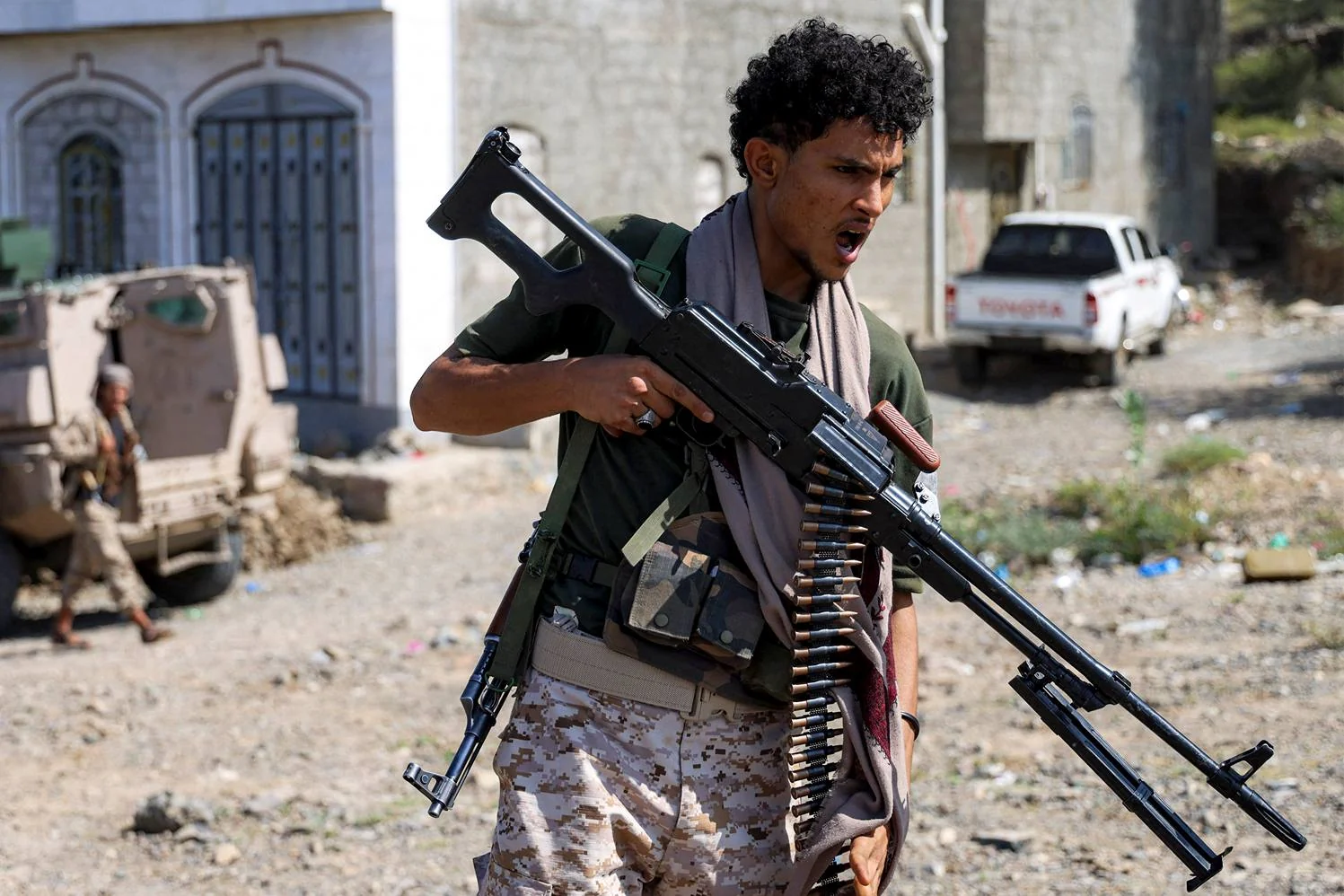
A huge part of the problem in the fight is the lack of cohesion among anti-Houthi forces in southern Yemen, which is linked to tensions between Saudi Arabia and the United Arab Emirates. A leading Yemen expert said that Riyadh and Abu Dhabi reconciling—and leveraging both the UAE’s military effectiveness and influence over anti-Houthi Yemeni factions—could be a gamechanger in the fight.
“It’s the most important thing that could happen to change the course of the battle on the ground,” said April Longley Alley, a senior fellow at The Washington Institute whose research focuses on Yemen and the Gulf. But it’s also a “complicated challenge to reconcile,” Alley said, due to “bitterness” between Riyadh and Abu Dhabi over what’s happened in Yemen, as well as tensions over Sudan and “wider regional competition.”
The war in Yemen began in 2014, when the Houthis seized the capital, Sanaa, and overthrew the country’s government. In response, a Saudi-led coalition of Gulf countries, including the UAE, launched a military campaign against the group to try and restore the government. But although Riyadh and Abu Dhabi entered the conflict as allies, their regional ambitions have since driven a wedge between them.
Those tensions reached a boiling point last December, leading the UAE to disengage from Yemen. Analysts see this as among the many factors contributing to fragmentation among anti-Houthi forces.
“If there could be some kind of alignment between the Saudis and the Emiratis that brought the Emiratis back” in a way that helped reinforce the southern front and along the Red Sea coast, Alley said, then that would “probably be the best chance the Yemeni government and the Saudis have to really have a more effective counteroffensive.”
“To turn the tide on the ground, there needs to be more effective command-and-control systems to these local groups,” Alley said. The UAE could be essential in this regard, Alley said, because of their experience working with local forces in Yemen and the networks they still have.
Given that both countries view the Houthis as a threat, there have been some signs of rapprochement between Saudi Arabia and the UAE since full-scale war returned to Yemen.
Following recent discussions between the two, the UAE has reportedly agreed to resume funding for forces in southern Yemen. The latest known talks occurred on Oct. 18, when Saudi Defense Minister Khalid bin Salman met UAE President Sheikh Mohamed bin Zayed Al Nahyan in Abu Dhabi. But details of progress and precisely what’s been agreed to are still hazy. The UAE’s Foreign Ministry did not immediately respond to a request for comment on this.
Differences remain on a range of issues, and further UAE involvement in Yemen is likely to depend, in part, on how Riyadh approaches questions over Yemen’s political future—including the aims of separatist groups with long-running ties to Abu Dhabi like the Southern Transitional Council (STC). Southern separatist forces have been allied with the UAE for years, and Abu Dhabi “would want their demands represented very clearly in a political settlement,” Alley said.
Abu Dhabi also has concerns about what role any group associated with the Muslim Brotherhood, such as the Islah party, will play.
Yemen was divided in two from 1967 to 1990, with the Yemen Arab Republic in the north and the People’s Democratic Republic of Yemen in the south. The STC has pushed for an independent state in southern Yemen with the borders prior to the unification of the country in 1990. Saudi Arabia, which wants a united Yemen, has opposed this.
The STC has a deeply complicated relationship with the Saudi-backed government in Yemen, largely because of its secessionist aims. It has been aligned with the Saudi-backed government in the past but has also fought against it—most notably in January, after the STC seized two provinces the month before. Riyadh saw this as a threat to its national security and helped government forces retake those areas. The group subsequently went through a contested dissolution, and the STC’s leader, Aidarous al-Zubaidi, fled to Abu Dhabi. The STC retains influence in southern Yemen despite the setbacks that it faced earlier this year.
Saudi Arabia also bombed a UAE arms shipment to Yemen in late December as it moved to reverse STC advances. This led Abu Dhabi to withdraw its forces from Yemen. Riyadh subsequently took up the mantle of restructuring anti-Houthi forces—and it has struggled to fill the void and unify rival militias after the UAE’s exit.
“Since Abu Dhabi left, there was a huge vacuum of deterrence against the Houthis and managing the situation, especially regarding the operational capabilities on the ground,” said Amr al-Bidh, a top STC official.
“We worked with the UAE for a long time in countering terrorism, fighting the Houthis, managing the areas in the south, doing all of the humanitarian work together. We’ve done a lot of work together, and we trust them,” Bidh said, describing the UAE as a “very efficient ally.”
But Bidh said that it remains unclear in what capacity the UAE would return to the conflict in Yemen. “Is it just financing as we’ve heard, or something more?” he said, adding that if Abu Dhabi does get directly involved again, it will “definitely help” politically and militarily in certain aspects.
The STC has signaled that it will not fight beyond the borders of old southern Yemen until Riyadh agrees to its call for an independence referendum.
“Our main concern is to defend our areas. Defending the south is our main objective here,” Bidh said.
The Saudi ambassador in Washington did not immediately respond to a request for comment.
As things stand, it does not appear that Riyadh would be willing to make a grand compromise to bring the UAE back in. “It doesn’t seem like they’re there yet,” Alley said.
Given the stakes and how rapidly the situation is changing on the ground, however, the Saudi government may feel compelled to rethink its position.
When asked whether Yemen’s internationally recognized government would welcome more involvement from the UAE in the fight, Ambassador Marwan Ali Noman, political advisor to Yemeni Foreign Minister Afrah al-Zouba, said, “We welcome every step to have a united position in the region.”
“The Houthi threat is a threat to everyone,” Noman said, noting that Abu Dhabi was attacked by the Houthis in 2022. “But I’m not aware, of course, about the talks between the Saudis and the Emiratis.”
