


In a suburb west of Toronto, Martin Richards, who runs Imperial Productions, is on the frontline of an intensifying US trade war just by exporting concrete columns and wood railings.
Over the weekend, sending some of his 10,000 architectural products to the US became dramatically more expensive.
“Tariffs mean higher prices and fewer buyers,” he said. “The unknown is how much will I lose?”
On Saturday, President Donald Trump imposed an additional 50 per cent tariff on $20bn worth of exports “to offset Canadian discrimination” after Prime Minister Mark Carney suspended trade talks with the US late on Friday night.
Carney said he could not accept a “bad deal” from the US, which he accused of making “unacceptable” last-minute changes after weeks of tense trade negotiations. Washington, in turn, blamed Canada for the trade war eruption.
On Monday Trump threatened an additional levy of 50 per cent on Canadian cars and steel from January 1, on top of earlier tariffs of 25 per cent and 50 per cent respectively, adding to the turmoil.
But as US and Canadian officials trade barbs over why talks collapsed, Imperial Productions and thousands of Canadian businesses face an uncertain future.
“This will affect jobs for both the US and Canada due to the nature of the integrated economy. It will result in higher prices for all involved,” Richards said. “It must be taken seriously.”
From producers of hockey sticks, greaseproof paper and flags to makers of machinery, wood, plastic and packaging, food, wine and jewellery, Trump’s new tariffs are already adding costs to Canadian companies.
As yet, that strain is unlikely to seriously damage Canada’s economy.
Frances Donald, the Royal Bank of Canada’s chief economist, said the latest tranche of levies accounted for about 5 per cent of trade to the US, with more than 80 per cent of exports remaining duty free.
“The size of the (latest) tariffs is likely not large enough to derail Canada’s economic growth backdrop,” said Donald, adding that the trade uncertainty “increased the chance” that the Bank of Canada will not raise interest rates this year.
But this offers no relief to Richards and other affected Canadian business owners, who face not just financial turmoil but a significant “emotional toll”.
“With looming chaos, economic activity is thwarted, thus many firms are in a cloud of confusion,” he said. “Individuals fear losing their jobs, and future plans are put on hold for everyone.”


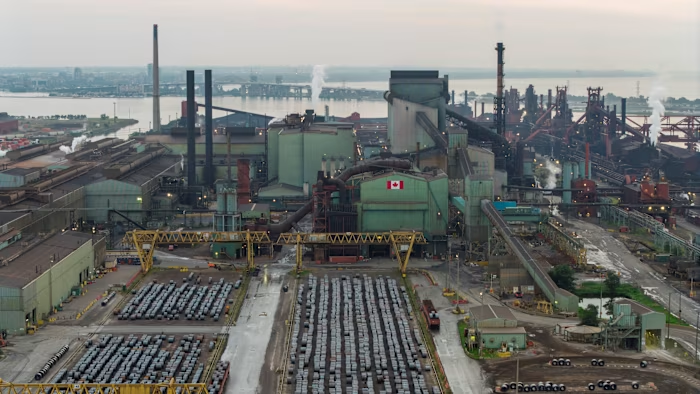
Since Trump launched the first raft of trade measures in March last year, Canada has sought relief from 50 per cent tariffs on its steel and aluminium sector and 25 per cent on vehicles as well as tariffs and anti-dumping levies on lumber, which have forced factory closures and caused thousands of job losses.
But Trump’s tariffs have also had perverse impacts.
There has been a mild economic stimulus as the burst of Trump-inspired economic patriotism sparked a domestic tourism boom and Canadians have bought more local goods.
Similarly, rising oil prices prompted by Trump’s Iran war have produced a potential C$90bn windfall for Canadian oil producers, helping to write down significant government debt caused by Ottawa’s big-spending agenda.
Nadia Senchuk, of Leaning Post Wines near Hamilton on Lake Ontario, said the producer had sold an extra 3,000 cases over the past 18 months after American wines were forced off Canadian shelves in response to US tariffs.
“When you only make 8,000 cases, that’s a significant increase,” she said.

The newfound success brought interest from a New York importer, but Trump’s new measures “will completely price us out of the market”, she said.
Anthony Scilipoti, founder of Toronto-based Veritas Investment Research, said the longer it takes to end or reduce tariffs, “the worse it is for Canada because it won’t encourage foreign investment”.
Attracting investment is one of Carney’s main tenets in a bid to make Canada the “strongest economy in the G7”. But this agenda comes at a time when Canada’s financial system has stalled.
In July, the Bank of Canada said GDP had remained flat between the first quarter of 2025 and the first quarter of 2026.
“Growth is expected to strengthen from 0.7 per cent overall in 2026 to 1.8 per cent in both 2027 and 2028,” it said, but added “new US tariffs were an ever-present downside risk to growth”.

US trade representative Jamieson Greer alluded to this on Friday when he accused Canada of rejecting an opportunity “to partner with the US, which is the fastest-growing economy in the G7”.
Carney has instead announced “dollar-for-dollar” retaliation on US imports, expected from September 8.
Polling released on Sunday found three quarters of Canadians surveyed by the Angus Reid Institute supported the prime minister’s decision to pull out of talks, while two-thirds said that, despite the expected turbulence ahead, Canada would emerge “stronger”.
But Dan Kelly, president of the Canadian Federation of Independent Business, questioned whether provoking an unpredictable US administration was the best course of action.
“Earlier rounds of Canadian retaliatory tariffs had a major negative impact on many small businesses,” he said.
Richards warned that Carney’s latest action would hurt Canadians and was bad for business.
“It creates a vortex of downward pressures,” he said. “If we retaliate, the US in turn will retaliate on more goods, expanding the problem.”
