


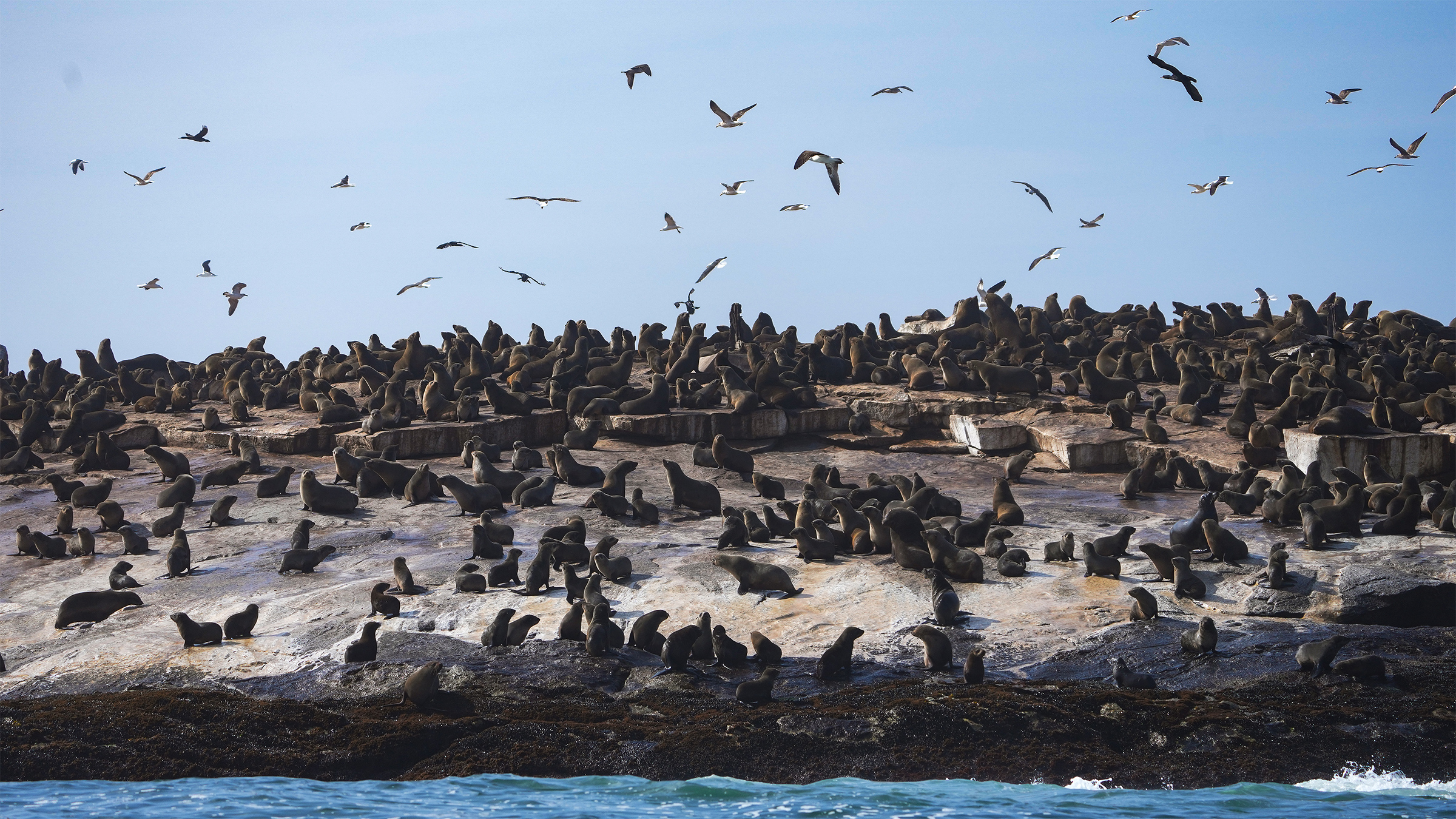
- Cape Town, South Africa, has recorded 135 incidents of aggressive seal behavior toward humans since September 2021, including injuries that led to hospitalizations.
- Researchers suspect the cause is rabies, a disease normally associated with land animals but has leapt to Cape fur seals.
- Since May 2024, rabies cases have been confirmed in Cape fur seals along the Western Cape and Northern Cape coastlines of South Africa — the first time the virus has established itself in a marine mammal population anywhere in the world.
- Beyond attacks on humans, researchers worry whether the disease will spread to other marine mammals, as seals interact with different species.
CAPE TOWN, South Africa — Debbie Hendrikz was walking along her usual route on the shoreline when she crouched to photograph a seal. She is familiar with seals and has captured similar images along the beach.
But this was different.
“It just went for me,” the 49-year-old said. “I knew instinctively by the sound it made that I was its prey. It grabbed my arm and bit hard into a metal bracelet I was wearing, which saved me. I knew I had to get away and not let it get my feet in the soft sand. I managed to shake it off my arm and just got away.”
“I never imagined anything like this could happen. It took me a long while to get over it.”
Seals do not normally see humans as prey, but Hendrikz’s encounter is one of a growing list of recent attacks by the marine mammals in Cape Town. According to Gregg Oelofse, the City of Cape Town’s coastal manager, the city has recorded 135 incidents of aggressive seal behavior toward humans since September 2021. More than half, 73 incidents, resulted in bite injuries ranging from broken skin to those requiring hospitalization in an intensive care unit.
Researchers in South Africa suspect the incidents stem from a disease normally associated with land animals that appears to be leaping to Cape fur seals (Arctocephalus pusillus) — rabies. According to South Africa’s National Institute for Communicable Diseases (NICD), reports of rabies in seals around the world prior to 2024 were exceedingly rare. But since May 2024, multiple cases have been confirmed in Cape fur seals along the Western Cape and Northern Cape coastlines of South Africa.
The government agency said it believes it is the first time rabies has established and maintained itself in a marine mammal population anywhere in the world.
Now South African government officials and researchers are examining how seals contracted the disease in the first place. They are taking steps to stop the spread of rabies, but say they are also worried that, as seals travel great distances and interact with other species, the virus could jump to other marine mammals and perhaps even bring rabies to Antarctica, where it has never been.
‘No longer eradicable’
Experts at a July 2025 scientific workshop in Cape Town attended by Mongabay concluded that the disease is now likely endemic in Cape fur seals and is no longer eradicable. They categorized it as a persistent threat requiring long-term management.
Scientists are now asking deeper questions about whether this outbreak is slowly burning itself out or if the cases are a prelude to something far larger, with rabies spreading to other sea mammals. To date, the NICD says rabies has not been found in any other marine mammal species along South Africa’s coast.
South African scientists say they believe the rabies in seals started on land. According to a July 2024 outbreak update report by South Africa’s Department of Agriculture, Land Reform and Rural Development (DALRRD), genetic sequencing of the virus found in infected seals points to a canid origin, most closely linked to a rabies strain from black-backed jackals (Lupulella mesomelas) from Namibia.
The DALRRD report came the same month as a Cape Town workshop with a wide range of participants, including leading scientists from different countries.
DALRRD’s working hypothesis, developed further in an updated report published in October 2024, is that a rabid jackal bit a seal somewhere on the Namibian coast — a plausible scenario given that jackals are known to prey on seal pups there, biting seals and getting into skirmishes with adults protecting their young.
DALRRD also reported there may be more than one event that introduced rabies into the seal population, including a secondary link to a strain of rabies from a bat-eared fox (Otocyon megalotis) from South Africa’s Western Cape.
What happened next was then perhaps inevitable.
Cape fur seals are social animals living in enormous, densely packed colonies. Physical contact, including biting, is constant. In the terminal stages of rabies infection, the virus drives animals to bite. In a colony of thousands of seals in close confines on an island or outcrop these factors would create a near perfect transmission environment. According to the DALRRD October 2024 report, genetic sequencing of multiple samples showed sequences clustering together, indicating the virus was already circulating within the seal population and representing what scientists now describe as a canid rabies Cape fur seal cycle.
The NICD’s August 2025 briefing document records that between May 2024 and January 2025, a total of 39 cases were confirmed from the Western Cape and a further 16 from the Northern Cape province. In June 2025, the first case was confirmed in the Eastern Cape.
Critically, DALRRD’s October 2024 report also documents that the outbreak is not new: Retrospective testing of stored samples from Cape fur seal deaths dating back to 2021 returned some positive results, indicating the virus has been present longer.
Coastal manager Gregg Oelofse’s statistics from the field suggest a more specific timeline. The city first recorded a marked change in seal aggression in September 2021, beginning with an incident at Miller’s Point in the Western Cape. In the previous two decades, his team logged only two comparable cases.
Within months of September 2021, however, reports of aggressive seals were coming in from across the peninsula, Oelofse said. Surfers showed photographs of bitten surfboards, swimmers recalled being chased from the water. At the time, rabies was not considered, since the disease had never before been recorded in a marine mammal. The working theory that first emerged was domoic acid poisoning from harmful algal blooms. That theory did not hold up.
The earliest confirmed positive case of rabies came from retrospective testing of a brain sample taken from a seal removed from Kommetjie, in the Western Cape, after it had bitten an elderly woman walking on the beach in early July 2022. The seal died en route to the Cape of Good Hope’s Society for the Prevention of Cruelty to Animals.
At the time, no one suspected rabies, Oelofse said. It was only in April 2024, when four seals were tested and three came back positive, that the city and its scientific partners recognized rabies was established in the population. Retrospective testing of stored samples, including the 2022 Kommetjie case, confirming the earlier presence of the disease and its link with aggressive attacks.


Will rabies spread further in seals?
Now researchers are trying to better understand how the disease in Cape fur seals will spread.
To understand where this is going, science needs a number. Specifically, it needs what epidemiologists call the basic reproductive number, R, the average number of new infections generated by a single infected individual in a susceptible population.
The logic is if the R number falls below one, then each infected animal generates less than one new case on average. The chain of transmission then weakens, and the disease eventually burns out. But if the number is above one, each infection spawns more than one new case and the epidemic grows.
Johann Kotze, a freelance veterinarian and epidemiologist who presented his modelling findings at the July 2025 Cape Town workshop, has been constructing an epidemiological model specifically for this outbreak. His preliminary results offer the first quantitative foothold on the question.
The spread observed so far is slow, he said, rather than an explosively growing outbreak. This is consistent with a very low R number, Kotze said: “Only a very low R number would produce what we are seeing. Higher values would have grown much quicker, much faster.” His current estimate puts the R number below 1.1 and possibly below 1.05.
For further context, an R number of 1.05 means that on average, every 100 infected seals would generate 105 new cases. The current estimate is above one, which means the virus is sustaining itself and slowly expanding. Experts at the July 2025 workshop put it plainly: Unlike the rapid, large-scale die-offs seen with other diseases, rabies may burn slowly through populations, flaring unpredictably. It is a slow burn, not an explosion.
The question for scientists, then, is whether the pattern remains this way.

On the ground in Cape Town, according to Oelofse, the pattern appears to be holding.
“It’s kind of like it goes dead quiet for a while and then suddenly we’ll have three rabid seals in Kommetjie that came from Duiker Island,” he said. “And then it’ll go quiet for a while and then we’ll suddenly have one or two in Simon’s Town that came from Seal Island.”
On another occasion, his colleague was called out to Big Bay twice in a single day for two separate rabid seals, he added.
The pattern matches what scientists predicted at the outset: Small flare-ups, clusters of disease positive animals in one location, then nothing; and then a flare-up elsewhere.
Researchers still have a lot more to learn about the disease.
To refine estimates further, scientific models need answers to difficult questions: How long does an infected seal remain contagious? What is the incubation period? What is the natural turnover rate of the seal population, which incorporates not only their lifespan but also how often new pups are born? How do these factors interact with the virus’s transmission rates?
With marine mammals that live across hundreds of kilometer of remote coastline, gathering that data is difficult.
The DALRRD October 2024 report recognizes this challenge. Vast stretches of the Northern Cape coastline are sparsely populated and some areas are restricted due to mining activities, so collecting data in those areas is constrained, it said.
Oelofse said Cape Town itself has no reliable measure of how many seals are infected at any given time across remote stretches of coastline such as Elands Bay, where seals are plentiful but monitoring is minimal.
“We don’t really have a good idea of how present rabies is in the seal population,” he said. “It doesn’t appear to be rampant, but we don’t really know.”

Kotze’s modelling so far points to two divergent future paths — rabies fades, or it increases.
On the first path, the outbreak may dissipate because the virus encounters barriers like geographical gaps between colonies that limit its spread. The outbreak plateaus and the disease does not become entrenched permanently and gradually fades. This would mirror what happens with other viruses that enter a new host species but ultimately fail to sustain themselves.
But the fear is that the current situation will follow the second scenario and that this is the cusp of something larger.
On this second path, the disease has a slow beginning. The current case counts could suggest not a plateau but a prologue. Given enough time and enough seals across colonies stretching from the Western Cape to Angola, the virus will spread. Even worse in this scenario, seals then infect other marine mammals and the disease spreads to other species.
The difference between these two futures turns largely on how Cape fur seals reproduce. Seals reproduce slowly. This may ultimately limit the virus’s ability to sustain itself; or it means the seal population cannot recover quickly if rabies infections do expand significantly.
“The only thing that stops an epidemic of this kind is when you reach a point where the number of new infections equals the number of new births in the population, what we call an endemic state,” Kotze said.

The past and the future for rabies and South Africa’s fur seals
Cape fur seals have likely become more vulnerable to rabies and other diseases because of ecological pressures.
Mass seal deaths in 2021 and 2022, in which thousands of seals died along South Africa’s West Coast, were investigated and attributed primarily to malnutrition. Scientists have pointed to chronically stressed animals living in warming oceans. Available prey has become less reliable. Coastal real estate development has added stress, limiting some of the territory they prefer for their colonies.
Harmful algal blooms or red tides happen more often and are larger, affecting seal behavior and cognition. The aggressive encounters that alarmed beachgoers from 2021 onwards were initially attributed to these blooms.
Researchers also point to another detail that may point to where the disease is heading: When the seal attacked Debbie Hendrikz on Fish Hoek beach, she did not contract rabies, unlike when a diseased dog bites a person. The NICD notes that to date, there are no known cases where seals transmitted the disease to people.
Oelofse, who has tracked the toll of seal attacks on humans closely, called this the most interesting open question in the entire outbreak: Why has rabies not spread from infected seals to the humans they have bitten?
His team has gone back and retrospectively contacted people known to have been bitten by confirmed rabid seals — none have developed rabies. Tour guides operating in the area around Duiker Island reported being bitten repeatedly by seals behaving strangely and were not treated for rabies. None became infected. “I think it might be related to the high salt content in the seal’s mouth,” Oelofse said. “It might be diluting the virus. We know salt water has a bit of an antiseptic effect. I don’t know.”
Kotze cautioned against speculating on this question, “There is no proof as to why those bites would not have infected the human.” The leading theories involve reduced viral load in the saliva of marine-exposed animals, salt water degrading the virus, and the immediate wound-washing that ocean immersion provides. These theories remain unproven, he said.
For now, government officials are cautious.
The NICD strongly advises anyone bitten, scratched or licked by a seal suspected of having rabies to wash the wound thoroughly with soap and water and seek immediate treatment at the nearest clinic or hospital.
Rabies post-exposure prophylaxis is effective in preventing infection if applied urgently and appropriately. The NICD further advises that those at frequent or continual risk of exposure, such as swimmers, divers, surfers or people working with seals, should discuss pre-exposure prophylaxis with their healthcare provider.
The government has considered other efforts to limit the spread of the disease in seals.
Mass vaccination of the entire seal population — an approach that has helped control rabies in European foxes — was assessed and declared not feasible by the National Department of Agriculture in its October 2024 report. A key factor cited for the decision is that seal colonies are often inaccessible.
But the July 2025 workshop produced a more targeted recommendation: Vaccination trials should begin for seals that frequently interact with humans. The effectiveness of rabies vaccines in marine mammals remains unproven, but experts concluded that the trials pose minimal risk and may prove to provide protection.

In August 2024, the world’s first ever rabies vaccination trial in marine mammals took place at Kalk Bay harbor in Cape Town, conducted by the Two Oceans Aquarium Foundation in collaboration with scientific and government partners.
The city has since stepped back from continuing to vaccinate the Kalk Bay harbor seal colony. The high turnover of individual seals moving between that colony and Seal Island, approximately 12 km (7.6 mi) east, makes sustained coverage difficult to achieve. A renewed, smaller effort at Gordon’s Bay harbor is being considered, Oelofse said.
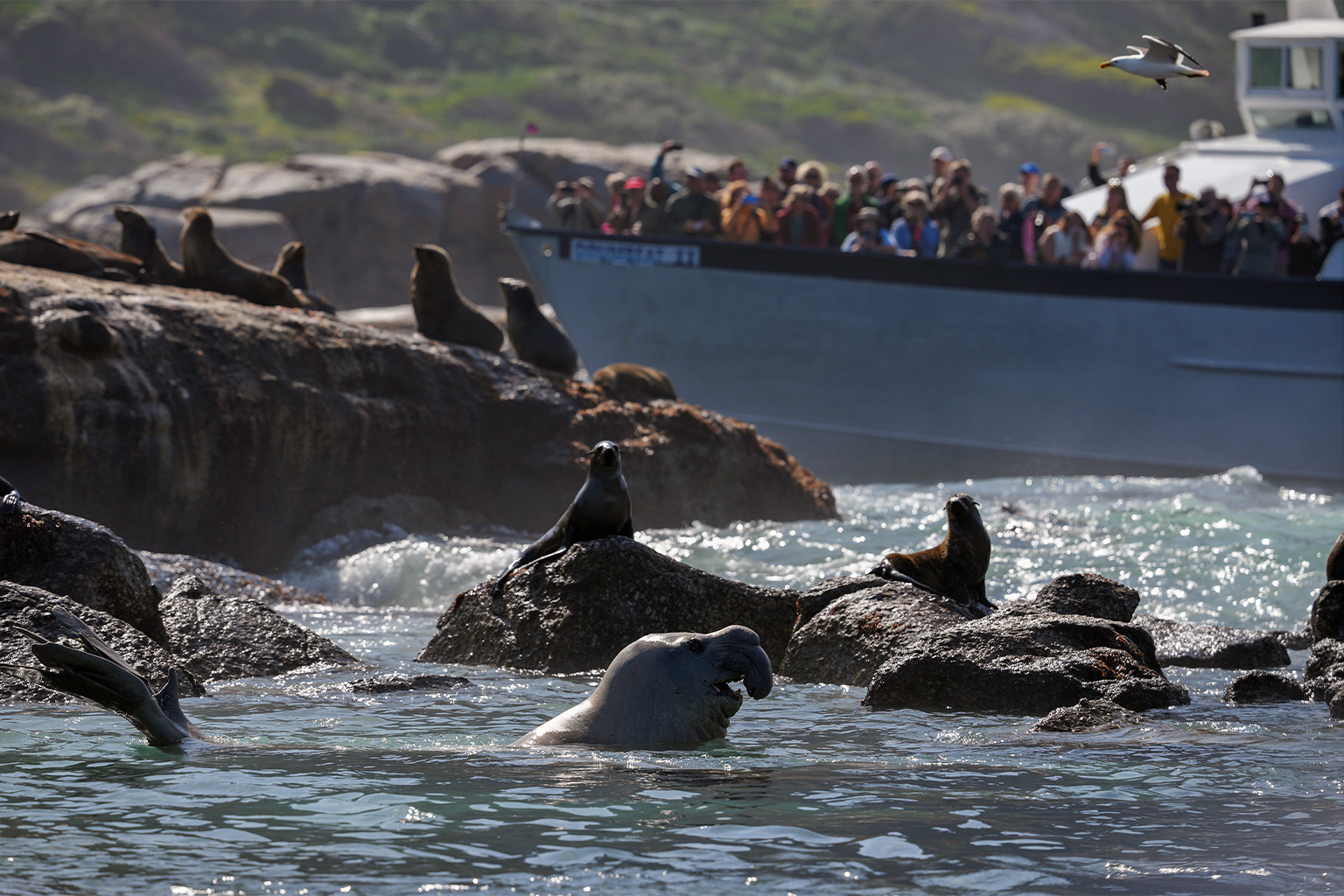
Authorities have started and continue to vaccinate Southern elephant seals (Mirounga leonina) on the Cape coast. Even though they are a different species and the virus has not been identified in them, officials fear they may contract the disease from fights with Cape fur seals. The concern driving this effort is that elephant seals can travel far: One tagged elephant seal vaccinated in Cape Town later turned up on Marion Island, deep in the Southern Ocean, demonstrating how far and fast the disease could travel if it took hold in a more mobile, far-ranging species. Between 15 and 20 elephant seals have been tagged and vaccinated to date, with booster shots given when possible.
There is another seal species that encounters Cape fur seals that has not been vaccinated: sub-Antarctic fur seals (Arctocephalus tropicali). These seals typically only come out of water to rest on land for a few hours at a time, which is not long enough for medical interventions.
The City of Cape Town’s primary operational focus, Oelofse said, remains rapid response and removing problem seals from the coastal environment as quickly as possible once an alert comes in. There are three reasons for this focus: To prevent transmission to people and to other seals, and to reduce the suffering of the infected animal.
Along with vaccinations, Cape Town euthanizes seals it suspects are rabid. To determine which seals may be infected, the team looks for four behavioral markers: aggression when approached, reluctance to retreat into the water, neurological signs such as head shaking, and biting a person, dog or another animal. If a seal exhibits any of these, the animal is euthanized. Oelofse estimates rabies is then found in those euthanized seals 95-96% of the time using the guidelines.
The city also advises the public to keep its distance from wild animals, including seals.
Beyond human health, the question haunting conservationists is what happens if the outbreak spreads further. The NICD notes that Cape fur seals breed along the entire southern African coastline between southern Angola and Algoa Bay in the Eastern Cape, a range of thousands of kilometres; and that seals travel extensively in the ocean, swimming hundreds of kilometers in a matter of days. That mobility is precisely what makes the virus’s potential reach so difficult to contain.
DALRRD’s July 2024 report explicitly raises the possibility that the virus could become an intercontinental problem. Cape fur seals share ocean space with orcas, dolphins and whales; in sub-Antarctic waters, they overlap with species that migrate to and from Antarctic territories.
Rabies has never been recorded in Antarctica. Its introduction would represent a major biosecurity event in the continent’s protected history.
Rabies may spread to other marine mammals not just because infected seals attack prey, but because they are also preyed upon.

Could an orca contract rabies by consuming a rabid seal? Or what if that seal, attacked by an orca, fights back and bites the whale, passing the disease that way?
“It may seem unlikely, but we must remember that they behave in unlikely ways, and ‘unlikely’ is not impossible,” Kotze said.
So far, South Africa’s NICD reports that rabies has not been found in any other marine mammal species
Today, Debbie Hendrikz, never forgetting when the rabid seal attacked her in Cape Town, takes her morning walks again along pristine Fish Hoek beach, she is cautious. She keeps a close eye on seals. And keeps her distance when photographing them.
Banner image: A colony of Cape fur seals during a euthanasia attempt of a Cape fur seal suspected of having rabies at Seal Island in False Bay in Cape Town, South Africa on August 07, 2024. Image by Matrix Images / Nic Bothma.
Peru’s only penguin species at risk from upcoming El Niño and bird flu, experts warn

