


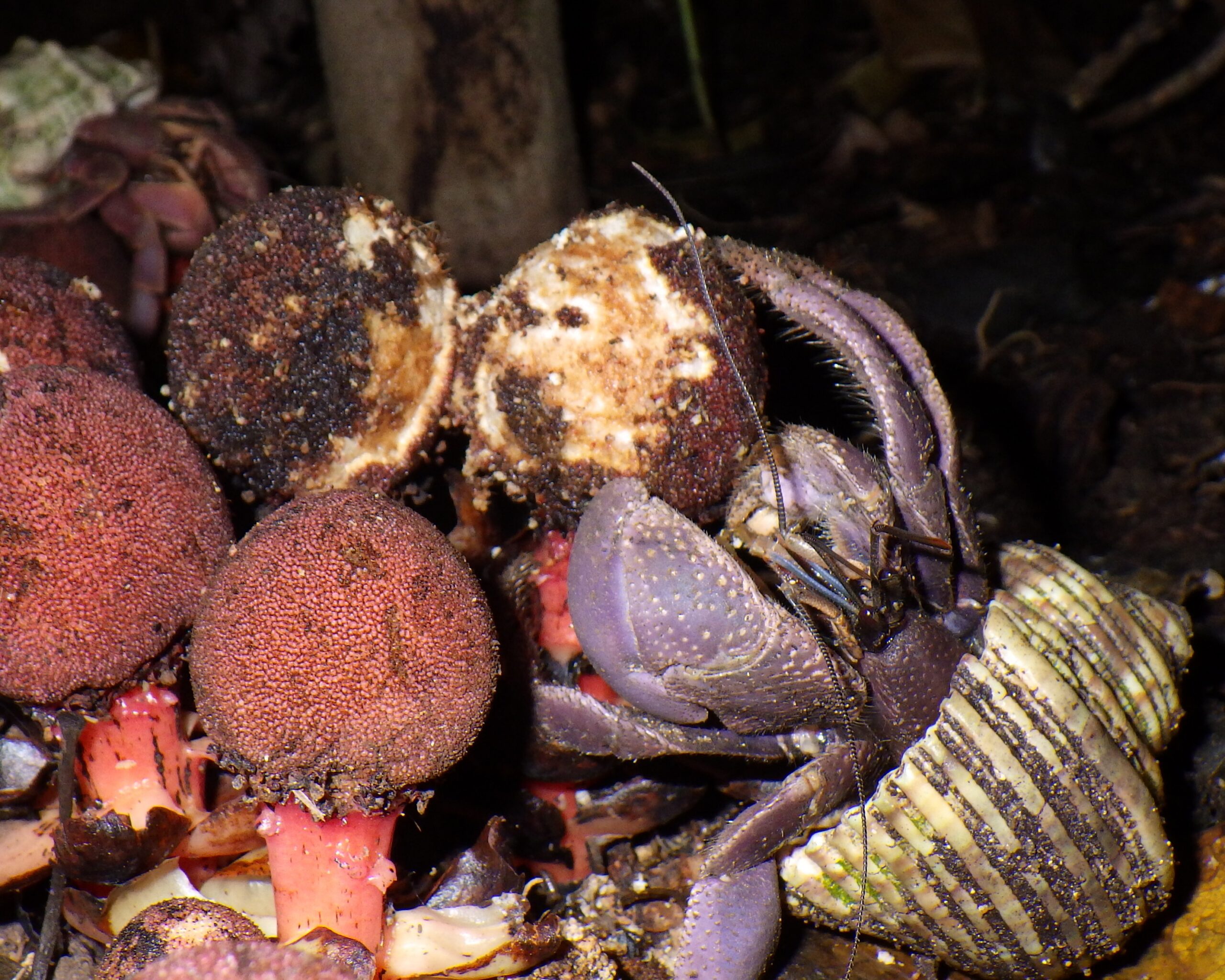
In the humid, coastal forests of Japan’s Ishigaki Island, near Okinawa, a parasitic plant relies on some unusual allies to spread its seeds: land hermit crabs and cockroaches, according to a recent study.
The plant, fungus root (Balanophora fungosa), is non-photosynthetic, meaning it lacks chlorophyll and can’t make its own food. Instead, it grows as a parasite on the roots of trees in island forests across Asia, Australia and the Pacific. The mushroom-like plant has fleshy, dull-colored fruits with millions of seeds inside.
Previously, scientists have suggested that gravity might be helping disperse those seeds. But in the latest study, researchers found that on Ishigaki, the seeds are primarily dispersed by the land hermit crab (Coenobita brevimanus) and the Australian cockroach (Periplaneta australasiae).
Initially, study author Kenji Suetsugu, a professor of biodiversity and ecology at Kobe University, Japan, told Mongabay by email that he expected ants to be the primary dispersers, due to the plant’s detachable fruit layer. To test this, he conducted “exclusion experiments” by covering some plants with mesh nets that allowed tiny ants inside but kept larger animals out. However, the fruits inside these ant-only nets went completely untouched. So Suetsugu set up a waterproof digital camera about 20 centimeters (8 inches) from the plants.
Programmed to snap photos every 50 seconds, the camera compiled 6,427 images over nearly 89 hours of monitoring. This time-lapse photography captured land hermit crabs and cockroaches aggregating under the cover of night to devour the fruits. “The biggest surprise was the identity of the main seed disperser,” Suetsugu said.
While feeding, hermit crabs carried an average of 86 fruits externally on their claws. They also ingested and defecated numerous intact seeds, some of which remained viable after passing through their digestive tracts.
“To our knowledge, this is the first empirical evidence that land hermit crabs can function as both external and internal seed dispersers,” Suetsugu said. “This expands the range of ecological roles known for these animals and, more broadly, adds to growing evidence that small-bodied invertebrates can make meaningful contributions to seed dispersal.”
The Australian cockroach also defecated seeds of fungus root, but they excreted fewer intact seeds than the hermit crabs. Both creatures are likely drawn to the fungus root by its smell, as mature fruits release a fermented odor that attracts the foraging animals.
“Seed-dispersal research has traditionally focused heavily on birds and mammals,” Suetsugu said. “Our findings suggest that this can leave important interactions unnoticed, particularly on shaded forest floors and on islands, where abundant ground-dwelling invertebrates may provide dispersal services that are easy to miss.”
He added that for him, “the broader lesson is that familiar animals can have ecological roles that remain hidden simply because nobody has watched them closely enough.”
Banner image: Seeds of Balanophora fungosa are dispersed by land hermit crabs and cockroaches, a recent study found. Image © SUETSUGU Kenji (CC BY).
