


Welcome back to World Brief, where we’re looking at last-minute U.S.-Canada trade talks, Ukraine’s depleted arsenal, and Taiwan’s record-breaking defense spending proposal.
Time Is Running Out
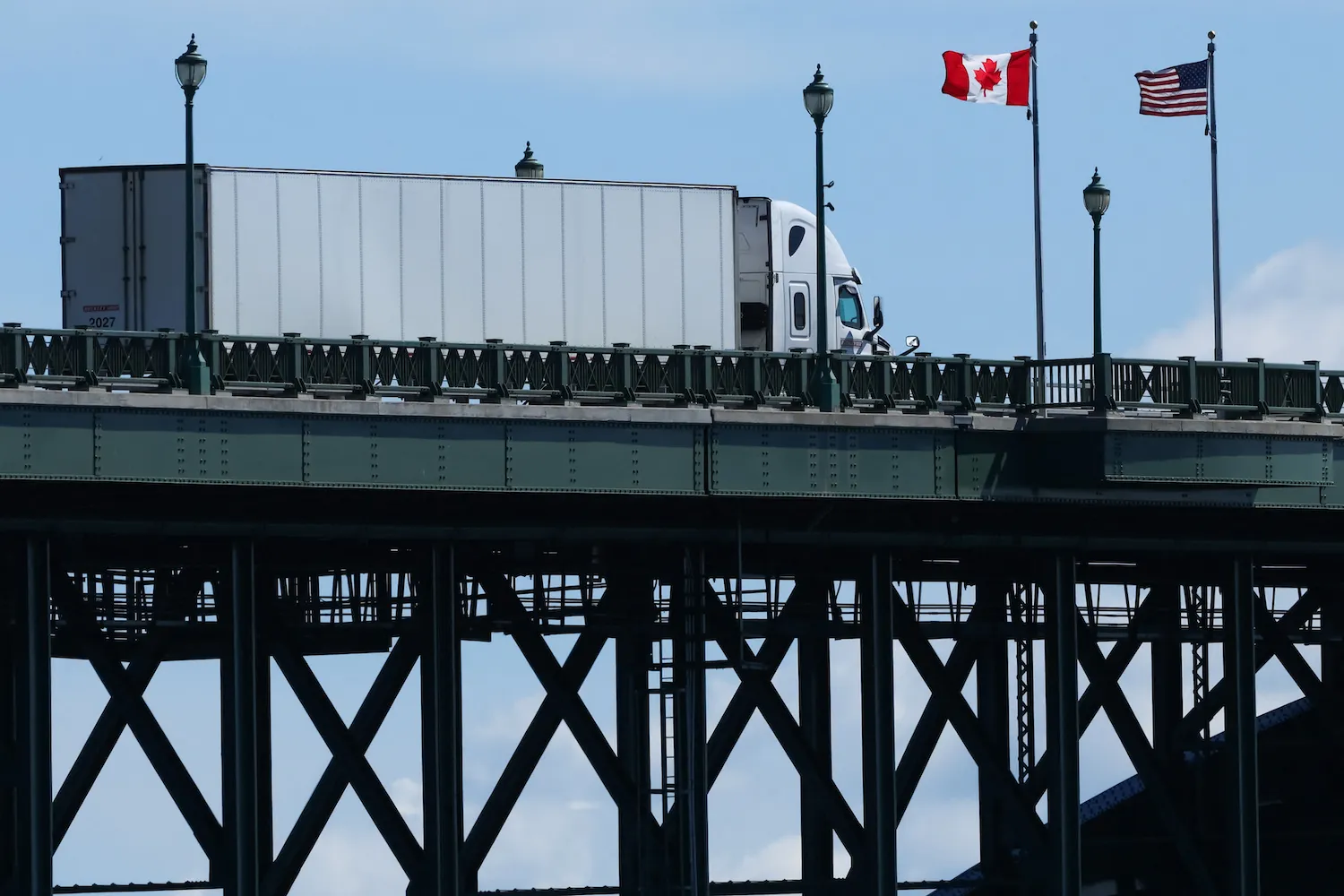
Less than 30 hours remain for Canada and the United States to negotiate trade terms to avoid another round of sweeping U.S. duties. With senior officials from both sides convening in Washington on Thursday to discuss a potential deal, experts are waiting to see if Ottawa will cave to the White House’s demands or choose to bear the brunt of another tariff war.
Welcome back to World Brief, where we’re looking at last-minute U.S.-Canada trade talks, Ukraine’s depleted arsenal, and Taiwan’s record-breaking defense spending proposal.
Time Is Running Out
Less than 30 hours remain for Canada and the United States to negotiate trade terms to avoid another round of sweeping U.S. duties. With senior officials from both sides convening in Washington on Thursday to discuss a potential deal, experts are waiting to see if Ottawa will cave to the White House’s demands or choose to bear the brunt of another tariff war.
On Wednesday, the United States was scheduled to impose 50 percent levies on roughly $20 billion worth of Canadian goods, from dairy products to electronics to hockey sticks. However, less than two hours before they were set to go into effect, U.S. President Donald Trump abruptly postponed the tariffs for a 72-hour period, citing progress in ongoing trade talks.
A third of that window has come and gone, though, and few details have emerged about what terms are on the table.
According to a White House proclamation posted on Tuesday, Canada has expressed willingness to remove certain tariffs on U.S. goods—such as alcohol, dairy, and automobiles—that Trump has previously called discriminatory. The U.S. president also hinted on Tuesday that any deal could include resurrecting talks over the Keystone XL oil pipeline, which the Biden administration scrapped in 2021 to reduce greenhouse gas emissions and prioritize green energy. Ottawa has yet to confirm these commitments.
But Canada isn’t the only one looking poised to make concessions. The Wall Street Journal reported on Wednesday that Washington appears likely to lower U.S. tariffs on Canadian steel and aluminum from 50 percent to 25 percent and on Canadian automobiles from 25 percent to 15 percent. Efforts to reduce U.S. duties on lumber and impose a potential credit system for Canadian auto parts are also reportedly under consideration.
“Canada entered these discussions with the best overall trade terms,” Canadian Prime Minister Mark Carney wrote on X on Wednesday. “We are now moving towards an agreement that reinforces that Canadian advantage, including by securing the best terms in each of Canada’s most important strategic sectors and providing greater certainty about our future trading relationship.”
On Wednesday, a White House official stressed that a deal is still “being finalized” and that any reported details “should be regarded as speculation” until there is an official announcement. However, that same day, Trump told reporters that “we may bring some of the tariffs down to the level where other countries are” because “Canada was paying a higher tariff.”
Thursday’s talks included U.S. Trade Representative Jamieson Greer; Dominic LeBlanc, Canada’s trade minister focused on U.S. relations; and chief Canadian negotiator Janice Charette. U.S. Secretary of State Marco Rubio separately met with Canadian Foreign Minister Anita Anand at the White House.
Today’s Most Read
What We’re Following
Deadly airstrikes. Russian forces launched a massive missile and drone strike on Kyiv on Thursday, killing at least 15 people and wounding dozens more. “This Russian strike was one of the most cynical, calculated, and large-scale” since the war began, Ukrainian President Volodymyr Zelensky wrote on X. Local officials reported ballistic and hypersonic missiles as well as more than 160 drones, damaging around 30 residential buildings as well as a children’s hospital, a school, and a kindergarten.
The assault cast light on Ukraine’s depleted missile defense arsenal and Kyiv’s repeated efforts to acquire more weapons from foreign allies. “The greatest threat is ballistic missiles,” Zelensky wrote. “And this is something that depends entirely on the supply of Patriot missiles to Ukraine and therefore depends on our country’s partners.” The U.S.-made Patriots are the only systems that Ukraine has with the ability to effectively intercept ballistic missiles.
European Commission President Ursula von der Leyen stressed on Thursday that the European Union is working to support Ukraine’s anti-ballistic capabilities. Yet the bloc is finding its attention divided, as overnight Russian attacks also bled into Romanian and Moldovan territory. In response, von der Leyen pledged on Thursday to scale up military defense production for member states to counter what she called Moscow’s “hybrid war.”
Prioritizing defense. Taiwan proposed increasing its annual defense spending on Thursday by 18 percent, bringing its total defense budget for 2027 to a whopping $35 billion. This would mark the first time that Taiwan’s proposal exceeds the symbolic 1 trillion Taiwanese dollar threshold. It signals Taipei’s growing determination to prepare for a potential Chinese invasion without having to rely on foreign allies, specifically the United States, which has repeatedly called on Taiwan to spend more on its own defense.
The proposed budget, which would increase defense spending to nearly 4 percent of Taiwan’s 2025 GDP, would focus on modernizing the coast guard, providing pensions, and buying more arms from Washington. In December, the Trump administration unveiled its largest-ever weapons package for Taiwan, totaling $11.1 billion. Then, earlier this year, the White House floated another arms deal—this one worth $14 billion—to Taiwan, but Trump ultimately held up its approval to use it as a “very good negotiating chip” with Chinese President Xi Jinping.
Thursday’s proposal must now be confirmed by Taiwanese lawmakers before it can take effect. This will likely prove challenging for Taiwanese President Lai Ching-te, whose government holds a minority in parliament. Only on Friday did Taiwan’s legislature finally approve a budget for 2026 after a record delay.
Evergrande’s downfall. A Chinese court sentenced Evergrande founder Hui Ka Yan to life in prison on Thursday after he pleaded guilty in April to charges related to large-scale financial fraud—including embezzlement, bribery, and inflated disclosures—between 2016 and 2021. Hui was also ordered to forfeit all of his personal assets, and his companies were fined a total of $2.35 billion.
Evergrande was once China’s fastest-growing property developer. However, its prospects soured in 2021, when the company collapsed under more than $300 billion worth of debt (or roughly 2 percent of China’s GDP at the time). The default triggered one of China’s biggest property crises in history and led to lasting economic effects that are still felt today.
“The amount involved in the crime is exceptionally large, the circumstances are particularly heinous, exceptionally heavy economic losses have been caused, and the harm to society is extremely grave,” Chinese state media outlet Xinhua wrote on Thursday. Although the ruling marks a dramatic end for Asia’s once second-richest man, it does not end the legal battles surrounding Evergrande, which now faces liquidation.
Odds and Ends
Six years after Prince Harry and his wife, Meghan, left London for the sunny beaches of California, the estranged royals are heading back to the United Kingdom. The Associated Press reported on Wednesday that the couple plans to move into a private home outside of London by the end of this month and will send their children to British schools come September.
Their return is expected to bring old hurts back into the limelight, as the two stepped down from official royal duties in March 2020, citing “toxic” press scrutiny, insensitivity toward Meghan’s mental health, and at least one instance of alleged racism. However, in recent months, Harry has expressed interest in reconciling with his family to spend more time with his father, King Charles III, who is battling an undisclosed type of cancer.
