


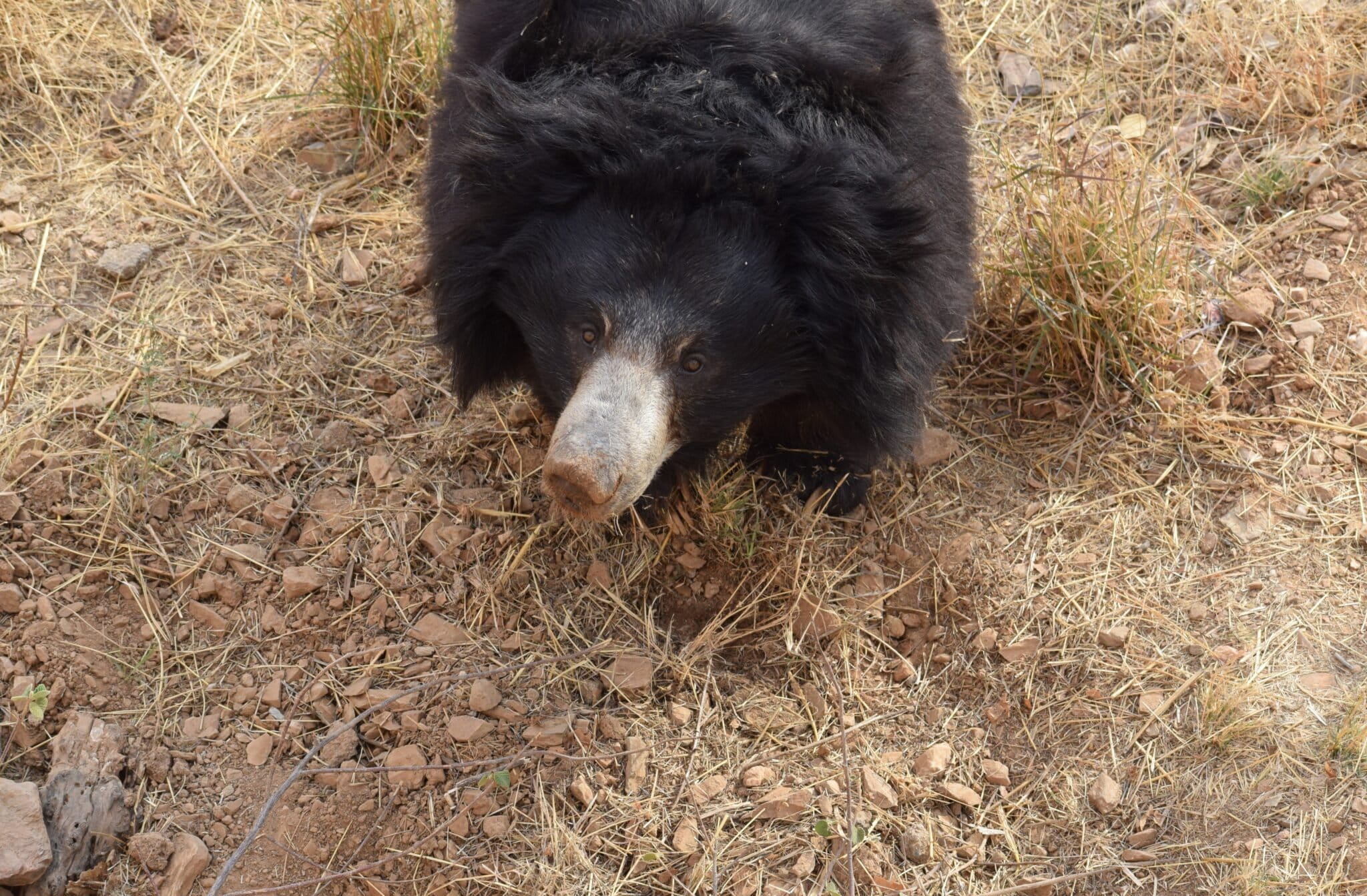
Sloth bears play a critical role in structuring India’s dry deciduous forests by dispersing viable seeds and influencing plant regeneration, reports contributor Sneha Mahale for Mongabay India.
“Dry deciduous forests’ plant compositions are a function of sloth bear presence, movement, and dietary habits,” study co-author K.S. Gopi Sundar, an independent scientist, told Mongabay India.
For the study, the researchers surveyed the mountainous south-central Aravalli range in the western state of Rajasthan between November 2021 and July 2022. They analyzed 180 droppings or scats of sloth bears (Melursus ursinus) and discovered that the bears’ diet shifted from plant-dominated in the winter to animal-dominated in the summer.
In winter, ants appeared in more than 80% of the scats, whereas termites dominated summer samples. Among fruits, donkey berry (Grewia flavescens) was the most critical food source in both seasons, while Ziziphus nummularia was favored in winter and the golden shower tree (Cassia fistula) in summer.
“The strong shift in diet was of great surprise,” said study co-author Utkarsh Prajapati, a senior project associate at the Wildlife Institute of India. “Previous studies on sloth bears in semi-arid regions have shown that they consume a lot of fruits during the summer.”
Study co-author Vijay Kumar Koli with the Department of Zoology at Mohanlal Sukhadia University, Udaipur, said this seasonal change “showed that bears were highly adaptable, switching to foods that were more available.”
To test whether bears help in seed dispersal, the researchers monitored the germination of eight plant species most important in the bears’ diet. They planted 50 seeds of each species — 25 removed from scats and 25 collected directly from fruits — and found that seeds of six species remained highly viable after passing through the bears’ digestive tracts.
In some instances, seeds obtained from scats germinated faster. For example, Ziziphus nummularia seeds from bear droppings germinated in just 50 days, compared to 100 days for seeds collected directly from tree fruits.
The researchers found that the bears may also act as vectors for invasive flora. Seeds of Lantana camara, one of India’s most aggressive invasive shrubs, collected from bear droppings germinated, while none collected directly from fruits did. (But they cautioned only three out of 25 scat-collected seeds germinated.)
“I was surprised that lantana germinated only after the sloth bear had eaten it,” Prajapati said. “Because sloth bears have relatively large home ranges, it is likely that they are dispersing lantana across large landscapes.”
While conservation efforts in India typically focus on predators and large herbivores, the study shows the overlooked ecological contributions of omnivores, Sundar said. “But being an omnivore gives species like bears a lot of dexterity to survive in harsh locations where most species would find it hard to live throughout the year.”
Read the full story by Sneha Mahale here.
Banner image: Sloth bears ate a plant-dominated diet in the winter and animal-dominated in the summer. Image by Utkarsh Prajapati.
