


- The Philippine Supreme Court struck down a regulation requiring commercial fishing vessels to continuously transmit their locations and submit electronic catch reports.
- The requirement was partially implemented before being suspended in 2022 during a court challenge, with devices installed on about 52% of targeted vessels.
- Small-scale fishers and scientists warn reduced oversight could increase commercial incursions into coastal waters where many fish stocks are already overexploited.
- Following the high court’s decision, the country’s Bureau of Fisheries and Aquatic Resources filed a motion for reconsideration, a procedural remedy that allows a party to ask the Supreme Court to review its ruling before it becomes final.
The Philippine Supreme Court has struck down a regulation requiring commercial fishing vessels to continuously transmit their locations and submit electronic catch reports, a decision small-scale fishers say could make it harder to protect coastal grounds already strained by overfishing and competition from larger operators.
The high court upheld a lower-court decision that invalidated Fisheries Administrative Order No. 266 (FAO 266), which required all Philippine-flagged commercial fishing vessels to install tracking systems and electronically report catches and other operational information. The court issued its decision on Jan. 21, 2026, and announced it publicly on Aug. 3, 2026.
The Department of Agriculture’s Bureau of Fisheries and Aquatic Resources (BFAR) filed a motion for reconsideration of the court’s decision on Aug. 14.
Without continuous tracking, fishers say authorities may struggle to detect commercial vessels entering municipal waters — the coastal zone generally extending 15 kilometers (9 miles) from shore and reserved primarily for small-scale local fishers.
“If some vessels could still enter municipal waters even when monitoring devices were installed, it could become even worse now that the Supreme Court has declared the requirement unconstitutional,” Pablo Rosales, president of Pangisda Pilipinas, a national fisherfolk alliance, told Mongabay by phone.
Some fishers and scientists also raised concerns that greater commercial fishing pressure could further reduce the number of fish available to coastal communities.
Tracking commercial fishing
FAO 266 formed part of Philippine regulations aimed at mitigating illegal, unreported and unregulated, or IUU, fishing.
The European Union, an important Philippine seafood market, issued the country a “yellow card” in 2014 over shortcomings in addressing IUU fishing. In response, the Congress of the Philippines strengthened monitoring, control and surveillance under the Fisheries Code in 2015, after which the EU lifted the warning.
BFAR introduced tracking in 2018 for commercial vessels targeting migratory stocks like tuna, mackerel, sardines and scad. FAO 266, which took effect in October 2020, expanded the requirement to all Philippine-flagged commercial fishing vessels.
Onboard transceivers sent vessel positions, catches and other fisheries data to regulators, supporting enforcement, traceability, investigations and fisheries management. In a statement reported by the state-run Philippine News Agency, BFAR called the system “a frontline enforcement tool” for monitoring vessels’ adherence to regulations and conservation measures, including temporary fishery closures aimed at protecting spawning and nursery areas.
The system was also intended to identify commercial vessels inside municipal waters, where local governments often lack patrol boats, personnel and fuel.
Three commercial fishing companies challenged FAO 266 in December 2020. The Malabon Regional Trial Court declared it unconstitutional on June 1, 2021, and BFAR and the National Telecommunications Commission appealed to the Supreme Court on June 25, 2021.
BFAR suspended implementation in February 2022 while the appeal was pending. By then, 1,566 of 2,997 targeted vessels — about 52% — had received government-provided transceivers. Because the rollout of FAO 266 was interrupted, its nationwide impact on IUU fishing and coastal fisheries remains unclear.

Oceana Philippines, the local arm of international marine conservation NGO Oceana, runs Karagatan Patrol, a monitoring platform that uses VIIRS satellite data to detect high-radiance lights associated with commercial fishing vessels operating inside municipal waters.
According to data compiled by the platform, detections rose to 44,924 in 2019, fell to 26,295 in 2022 during the COVID-19 pandemic, and totaled 27,351 in 2025.
“While there was a reduction in recent years, Karagatan Patrol data indicate a continuing apparent intrusion into municipal waters,” Jessie Floren, Oceana’s database administrator and the platform’s developer, told Mongabay by email. He said detections remained elevated and reinforced the need for continued monitoring, enforcement and protection.
Why the court rejected the rule
The companies challenging FAO 266 argued that continuous tracking violated protections against unreasonable searches, exposed confidential fishing grounds and trade secrets, and unfairly applied only to commercial vessels.
The Supreme Court ruled that FAO 266 failed the rational basis test, which assesses a regulation’s constitutionality by asking whether it serves a legitimate state interest and is reasonably related to that goal.
The court said the government had not sufficiently shown that the systems could detect IUU fishing beyond protected or restricted areas, while some data duplicated existing reports.
It also found no express legal basis for round-the-clock tracking, recognized specialized fishing grounds as potentially proprietary, and ruled that excluding municipal vessels violated equal protection. It cited due-process defects because stakeholders were not adequately informed of the supporting study or given sufficient opportunity to nominate experts and comment.
The court acknowledged that “combating illegal fishing and protecting the country’s marine resources are legitimate and compelling State interests,” but stressed that “these objectives cannot justify measures that unnecessarily infringe constitutional rights, particularly when the same goals may be achieved through lawful and less restrictive means.”
Senior Associate Justice Marvic Leonen dissented, warning that invalidating FAO 266 created a “legal void.” He proposed allowing agencies to correct the regulation’s defects.


Continuing pressure on coastal waters
Wilfredo Campos, a fisheries professor at the University of the Philippines Visayas, said many Philippine fishing grounds have been overfished since the 1980s. A 2017 BFAR assessment found that 88.6% of 166 fish stocks assessed nationwide were overfished.
Studies by OceanBio Laboratory, co-founded by Campos, in three major fishing grounds found declining sardine abundance and reproductive capacity, with younger fish producing fewer, smaller eggs and fewer surviving larvae.
“If current rates of fishing continue, stock abundance will continue to decrease,” Campos told Mongabay by email.
Campos said sardines, round scad (Decapterus macrosoma), short mackerel (Rastrelliger brachysoma) and tuna move between municipal and offshore waters, meaning commercial and small-scale fishers draw from the same stocks. In overexploited grounds, additional catch by one sector reduces what remains for the other. Commercial operations may harvest thousands or tens of thousands of kilograms during a single trip, compared with about 1-10 kg (2.2-22 pounds) per municipal operation, according to Campos.
Rosales of Pangisda Pilipinas identified competition inside municipal waters as one factor behind declining catches. He estimated members’ average daily catches had fallen from about 5 kg (11 lbs) to 3 kg (6.6 lbs), although he provided no comparison period or supporting dataset.
Oceana said commercial permits give operators access to fish stocks that remain a public resource.
“That permit should reasonably require transparency in return, not a right to opacity about where you exercise that privilege,” Oceana Vice President Von Hernandez said in a press statement.

Motions for reconsideration
BFAR and fisherfolk alliance Pangisda Pilipinas separately filed motions for reconsideration on Aug. 14, asking the Supreme Court to review its ruling before it becomes final. Under the Court’s rules, the motion may be filed within 15 days of receipt of the decision.
“We are fairly confident the Supreme Court will reconsider the ruling,” Philippine Agriculture Secretary Francisco Tiu Laurel Jr. said in a statement quoted by the Philippine News Agency. He described vessel monitoring as an internationally recognized system that relies on electronic rather than manually filed data.
BFAR said it would review its framework, adding that any future system would incorporate “constitutional safeguards.”
Campos said his laboratory’s simulations for the Visayan Sea indicate that a 20% increase in commercial catches could leave 10,400 municipal fishers with no catch. Since the analysis covered only one major fishing ground, Campos questioned whether authorities were prepared for similar pressures elsewhere in the country and how they would support the many artisanal fishing households that could be affected.
“Without the VMS [vessel monitoring system], commercial fishing in municipal waters is likely to increase from current levels,” Campos said. “Our simulations provide an idea of how the scenario would look.”
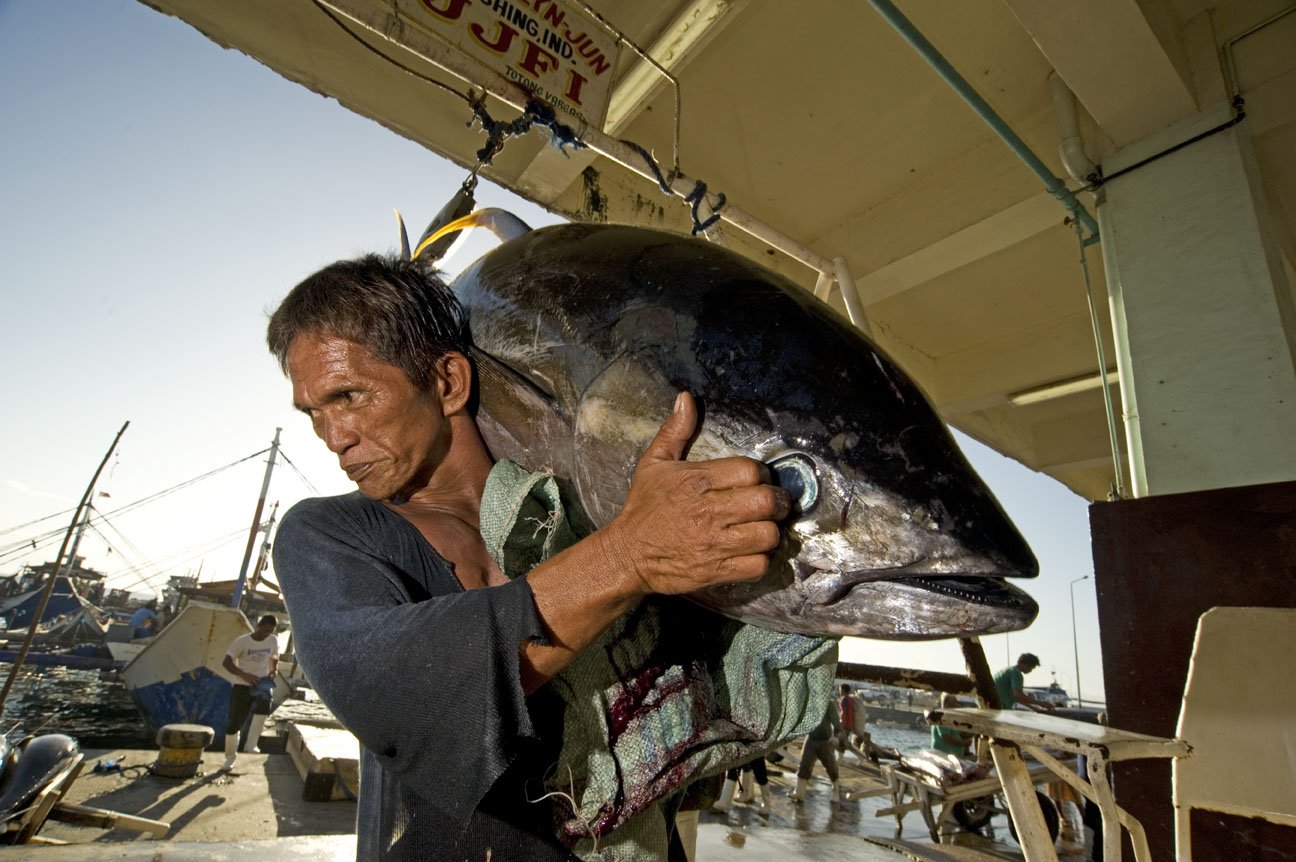
Banner image: A worker lifts a tuna after it has been weighed at a fish market. Image by Andy Maluche/Flickr (CC BY-NC 2.0).
As gas giants move in, Philippine fishers fight for their seas and survival
Fishing by dodgy fleets hurts economies, jobs in developing countries: Report
Citation:
Labaria, E. C., Fernandez de la Reguera, D., Poulain, F., Siar, S., … Vasconcellos, M. (2021). The risks and vulnerability of the sardine fisheries sector in the Republic of the Philippines to climate and other non-climate processes. Food & Agriculture Org. doi:10.4060/cb7506en
Feedback: Use this form to send a message to the editor of this post. If you want to post a public comment, you can do that at the bottom of the page.
Cite this article
Keith Anthony Fabro (2026). Philippine Supreme Court rules monitoring commercial fishing vessels is unconstitutional. Mongabay Conservation news. DOI: https://doi.org/10.66709/news-326635

