


The EU exists because its nations swore never to repeat the past. European integration is the insurance policy against the oldest temptation of power: that a majority, however large, decides who does not belong. So countries across the continent agreed to share power across borders, and to answer to laws that none of them individually controlled.
The European parliament is where that promise is meant to be kept. Directly elected by nearly 360 million citizens, it co-writes the EU’s laws, elects the president of the European Commission and can dismiss the closest thing Europe has to a government – the commission itself. For decades, a grand coalition of centre-right parties and socialists, later joined by liberals and greens, governed it on that premise. They were committed to closer cooperation, the rule of law and maintaining a firewall against the far right.
In June, in Strasbourg, that promise was broken by the parliament itself.
“Send them back! Send them back!” The chant rose from rightwing MEPs pumping their fists, as the chamber approved the harshest migration law in EU history. The “return regulation”, as this law is called, does exactly what European integration was designed to prevent: it lets a majority decide who does not belong, putting them beyond the law’s reach – and after Ceuta, Europe’s leaders are demanding it should be applied faster. The regulation allows EU countries to deport people to detention centres outside EU territory, placing them further from judicial protection, media scrutiny and public accountability.
Approval of this law was not a rightwing putsch. It was the clearest sign of a quiet shift within an institution that, however overlooked, shapes what kind of union Europeans get to live in.
The political coalition that shaped EU legislation for decades hasn’t formally collapsed, but its largest group, the European People’s party (EPP) – home to Germany’s governing Christian Democrats (CDU/CSU) and political “family” of the commission’s president, Ursula von der Leyen – now operates with two rival majorities. The legacy centrist majority gives it control of Europe’s principal institutions. A second, formed with Giorgia Meloni’s European Conservatives and Reformists (ECR), Marine Le Pen’s Patriots for Europe (PfE) and the more extreme Europe of Sovereign Nations (ESN), led by Germany’s Alternative für Deutschland, increasingly enables it to shape Europe’s laws. When socialists, liberals or green MEPs resist its terms, the EPP can turn to the right and pass legislation without them. When it needs centrist votes to control the commission and parliament, however, it turns back to them, and they continue to provide those votes without conditions. The EPP therefore pays no political price for crossing its supposed firewall.
Since 2024, the EPP has voted with the far right more than 20 times. In June alone, a far-right group was decisive in one in five final votes.
The return regulation passed through precisely this alignment. On one of the defining questions facing Europe, conservatives in the EPP – as well as a majority of MEPs from the centrist Renew group – chose not only to accommodate the hard right, but to make it part of its governing majority. This new majority is driving the most sweeping rollback of EU protective standards across migration, climate, corporate accountability and AI that Europe has seen. Under the banner of “simplification”, common European rules are being weakened, their scope narrowed and regulatory power returned to national authorities and private actors.
This is a different Europe, one that is coercive at the border and permissive towards corporate and environmental harm. It is being built by hollowing out the union from within, using European law to repeal European protections. The far right didn’t need to take over Europe’s institutions to do this; it only needed to find a mainstream party willing to translate its priorities into European law.
The hypocrisy is structural, and events in Ceuta exposed it. When tens of thousands of people tried to reach the Spanish exclave in late July, and at least 88 drowned in the process, national leaders raced each other rightwards. Meloni introduced border checks on third-country nationals arriving from Spain, 22 governments blamed Madrid, and Manfred Weber, who leads the EPP in the European parliament, demanded migrant deportation centres in Africa and the accelerated implementation of the return regulation.
At home, the EPP’s German members – Friedrich Merz’s CDU/CSU alliance – still invoke the Brandmauer, the firewall against cooperation with the AfD. In Brussels, its European political grouping breaches the firewall whenever hard-right votes are useful. Nor is the alliance confined to legislation. In July, the EPP joined the far right to block a criminal referral concerning €276,000 (about £236,300) in irregular spending by the PfE, allowing the group to repay the money and close the file. Days later, PfE MEPs helped shield the EPP’s Matej Tonin from prosecution sought by the Slovenian authorities.
after newsletter promotion
None of this works without the complicity of the pro-European mainstream. Socialists, liberals and greens provide the EPP with the votes that enable it to control the commission and the presidencies of parliament, and therefore allowing it to present itself as Europe’s responsible centre. Yet their support does nothing to prevent the EPP’s rightward turn. It only provides a useful cover. The EPP can govern from the right while running Europe under the guise of legitimacy provided by the centre. Granted, walking away would not automatically defeat the rightwing majority. But it would force the EPP to choose and to bear responsibility for the coalition on which it increasingly relies.
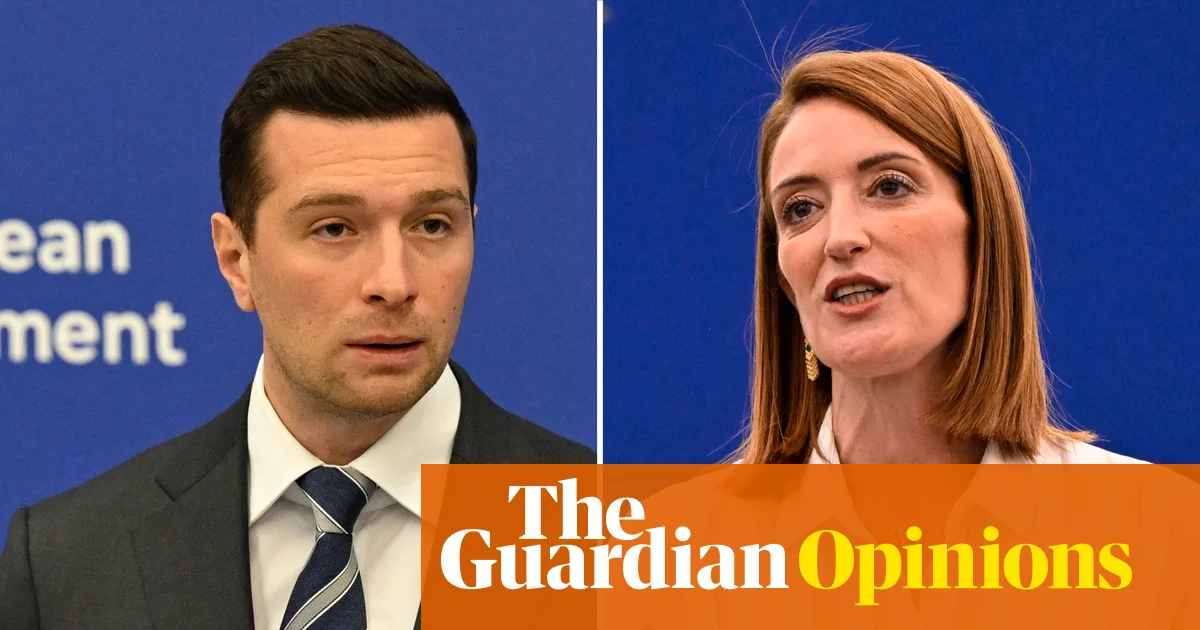
The first test will come in January 2027, when parliament elects its president. Roberta Metsola, from the EPP, is seeking a third term, although the socialists say they should get the presidency under a 2024 power-sharing agreement. The PfE has offered Metsola its votes in return for greater institutional recognition. The socialists, liberals and greens should refuse to support her unless the EPP commits to not forming legislative or institutional majorities with the hard right and accepts that any breach will end its institutional cooperation. Without these strings attached, another agreement would cost the EPP nothing to break. Polls already show that the centrist forces that have dominated European politics since the second world war are, for the first time, projected to fall short of a European parliamentary majority.
The fists raised in Strasbourg belonged to the hard right. The power and authority that turn its reactionary demands into European law are still supplied by the centre. In January, Europe’s socialists, liberals and greens can either let the union stray further away from the values they cherish, or end the agreement that has allowed this drift in the first place.
