


Unlock the Editor’s Digest for free
Roula Khalaf, Editor of the FT, selects her favourite stories in this weekly newsletter.
The cost of shipping goods through many of the world’s maritime chokepoints has soared in the past month due to war and climate change, fuelling fears of higher consumer costs and underlining concerns about the fragility of global supply chains.
The dual impact of conflict and low water levels caused by long periods of drought in Europe and Latin America has pushed up rates along key shipping routes including the Panama Canal, the Rhine, the Red Sea and Black Sea to record highs, according to pricing agency Argus.
The continuing conflict in the Middle East, which has all but shut the Strait of Hormuz to shipping, is also having ripple effects worldwide as vessels reroute to find alternative energy supplies. Around one-fifth of the world’s oil and gas previously passed through the waterway out of the Gulf.
“This is something which is unprecedented,” said Alexander Saverys, chief executive of Belgian shipping company CMB Tech, of the “freight rate boom”.
Factories would need to shut down or source goods from “more expensive parts of the world”, he said.
Rates for shipping oil from the Gulf to Asia hit $15.22 per barrel on August 10 because of the threat of attacks on Saudi Arabia-linked tankers attempting to transit the Bab al-Mandab Strait, according to Argus, the highest level since the agency began assessing the rates in 2005.
In the Black Sea, freight rates for tankers into the Mediterranean were also at their highest this week since at least 2005.
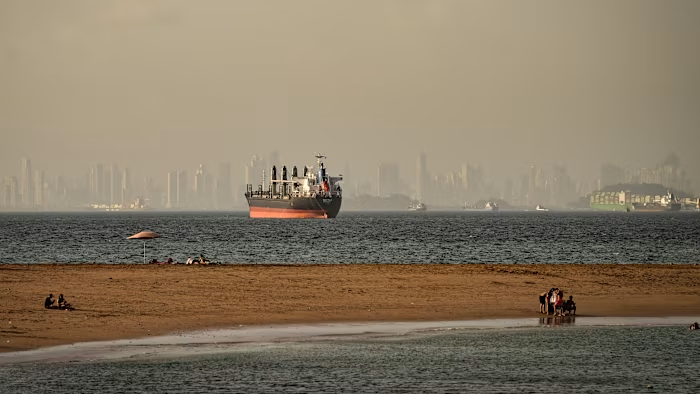
At the same time, slots to sail through the Panama Canal have hit record highs thanks to falling water levels resulting from the intense El Niño weather system and high levels of traffic — a knock-on impact of the conflict in the Middle East.
Prices to go through both sets of locks on the Panama Canal, which are designed to cater to different-sized ships, hit records of $1.1mn and $2.5mn in early August — the highest since Argus’s records began.
Meanwhile, droughts across Europe have caused water levels in the Rhine, a critical river serving Germany’s heavy industry, to fall perilously low. Freight rates for barges up the Rhine to Cologne, Duisburg, Frankfurt and Karlsruhe have reached their highest levels since 2012.
“This is without doubt the single greatest disruption that the shipping market has seen on record, eclipsing the Covid pandemic and Russia sanctions,” said John Ollett, head of Europe freight pricing at Argus.
The trend has been similar in the container shipping market.
Average spot rates for container freight going from the Far East to the US East Coast, for example, are also up 234 per cent year-on-year to $10,249 per 40-foot container.

“The disruption caused by war in the Middle East is becoming a deep-set and structural problem that will not go away any time soon,” said Peter Sand, chief analyst at analytics company Xeneta.
Costs would be passed through the supply chain, he added. “Someone must pick up the tab for increased freight rate costs and consumers can carry some of that burden, especially for low-margin goods.”
The leverage that Iran has exerted over the Strait of Hormuz, about which it is now negotiating a deal with Oman that could involve ships paying for passage, has increased fears worldwide about the fragility of waterways crucial to global trade.
“Chokepoints are becoming more critical largely because smaller countries now recognise the disproportionate political and economic leverage they can wield over global trade in an increasingly multi-polar world,” said Henry Curra, head of research at shipbroker Braemar.
Longer term charter rates for tankers were “at, or at least very near, the all-time records set in summer 2008,” he added.
