


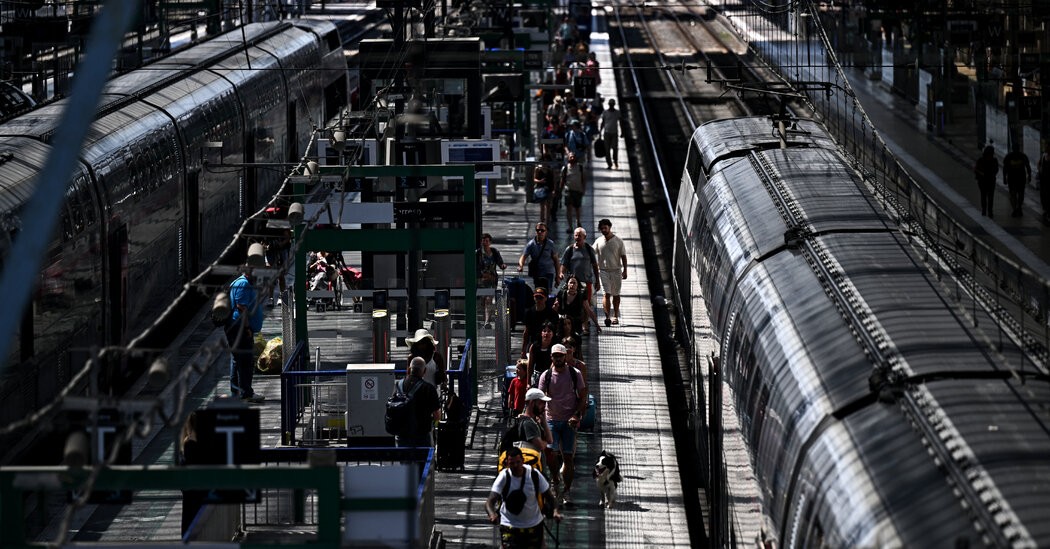
Tracks are buckling in Sweden. Highways are cracking in Germany. Commuters are sweltering in airless train carriages across the world’s fastest-warming continent.
This is the new reality in Europe, where much of the transportation infrastructure was not built to withstand the scorching summer heat that’s becoming routine.
“Europe’s transport systems were engineered for a climate that no longer exists,” Patrice Geoffron, who leads the energy and climate economics team at Université Paris Dauphine-PSL in France, wrote in an email.
Many of Europe’s tracks and roads desperately need upgrades to meet new extreme temperature thresholds, or delays and disruptions will become the norm, experts said. Rail services in Britain and France reduced services this week and warned of disruptions as Western Europe endured its fifth heat wave since May,
The changes needed to fully accommodate the effects of global warming would require vast amounts of money. And even if cash-strapped European governments had those funds, many countries are focused more on defense than on infrastructure, experts said. For now, they are mostly making smaller adjustments.
“The main challenge is actually not heat; the main challenge is funding itself,” said Prof. Felix Creutzig of the University of Sussex, who leads the working group on cities at the Potsdam Institute for Climate Impact Research near Berlin.
Bending tracks, sagging cables
Disruptions from the heat are most obvious on Europe’s trains, which hundreds of millions of people use in cities and to cross the countryside. Many of these rail systems are generations old, said Ian Mulcahey, the global director of cities at Gensler, an international architecture and planning firm. (London’s metro, the world’s oldest, opened in 1863.)
Many of these systems still rely, to some degree, on dated infrastructure. Many European train carriages don’t have air-conditioning.
But it’s not possible to start from scratch.
“The challenge for us in Europe is, how do you go back and retrospectively adapt your infrastructure for a new age?,” said Mr. Mulcahey, who specializes in large-scale city planning.
On Thursday, a train derailed near Lewes, in southern England, injuring two, as Britain recorded its hottest day of the summer so far. Another commuter train derailed but remained upright on Friday, in Wickford, a town 30 miles east of London, with no injuries immediately reported. It was not immediately clear whether either accident was heat related.
“We do know that the rail companies have been reporting that the extreme dry conditions have been affecting embankments and track conditions,” James MacCleary, a lawmaker representing Lewes, told Times Radio on Thursday. “We had a lot of speed restrictions in the area recently, which is directly related to the heat.”
For trains, extreme heat poses three main problems:
Most aren’t air-conditioned. Europe is not known for air-conditioning — until recently, summers seldom got hot enough to need it with any regularity — and generally speaking, the continent’s trains are no exception.
That is changing, often as part of broader upgrades, but it is a slow and expensive process. London is spending an estimated £3.4 billion ($4.6 billion) to replace the carriages on another metro line, the Piccadilly, with a streamlined new fleet whose features include air-conditioning. And that is just one of the 11 lines in the city’s underground system, known as the Tube.
Mr. Mulcahey said Londoners were starting to modify their commutes to spend at least part of them on air-conditioned routes, like the Elizabeth Line or the city’s overground trains.
Discomfort aside, overheated trains can lead to heat exhaustion and worse. Many carriage windows don’t open, and if a train should lose power, the situation could become dangerous under a scorching sun. Although heat — like fire — can be deadly, it probably wouldn’t occur to passengers to use emergency hammers to break the windows, said Jennifer Schooling, a professor at Anglia Ruskin University and a director of DARe, a research center in Britain that studies the effects of global warming on transportation.
Heat can warp the tracks. Tracks are made of metal, which expands in the heat. Many of Europe’s were built decades ago, designed for less extreme temperatures, and lately they have been buckling and twisting.
A “sun curve” — that is, a rail bending sideways in extreme heat — is believed to have caused a freight train derailment in Sweden in June, the Swedish Transport Administration said.
Experts say a cheap adaptation to this problem is available by painting the tracks white, which creates a cooling effect by reflecting back sunlight. (Britain does this for “hot spots” on its rails.)
But that stopgap fix is no substitute for an expensive, wholesale replacement of track, said Prof. François Gemenne, the academic director of the master’s program in sustainability and social innovation at HEC Paris, a business school.
“You can win a couple of years with that,” Professor Gemenne said of lighter coloring. “But at some point, you will need to have rails that can withstand much higher temperatures.”
Power lines are vulnerable, too. The overhead wires that supply power to electric trains can expand in extreme heat, just as tracks do. Sometimes, older or badly maintained lines droop so low that they get caught on a moving train.
That can cause a power outage and, occasionally, a cascading series of problems along the rail network. “One incident can block a busy corridor, trap rolling stock and crews in the wrong locations and generate delays and cancellations,” Professor Geoffron said. One such incident in the Netherlands last month disrupted traffic between Britain, France, Belgium and Germany, he said.
Some newer cables have automated systems that adapt to temperature fluctuations, using balance weights or springs to loosen or tighten as needed. But the tension in older cables is fixed, and if they’re too tight, they can snap in the wintertime, Professor Schooling said.
“We’re in this conundrum,” she said. “The impacts of climate change seem to be happening faster than we were expecting.”
Melting roads, skidding sand
Many of Europe’s roads weren’t built for today’s extreme temperatures, either. Roads made with concrete can crack if they don’t have room to expand in the heat. Such “blowups” forced the partial closure of German highways this summer.
Road surfaces can melt, too, a phenomenon that has caused disruptions from Britain to Sweden. During Europe’s June heat wave, trams were halted in the German city of Leipzig because asphalt had melted and gummed up the tracks.
As with railroad tracks, lighter colors can keep road surfaces cooler, Professor Geoffron said. Roads can also be made with materials that are more heat resistant than traditional asphalt. But those materials are often more expensive and require more exacting construction, he said.
During recent heat waves, trucks that spread salt during winter storms laid down sand or dust on some English streets to keep melting road surfaces from getting too sticky.
Even that low-budget fix can be tricky, Professor Schooling said. Too much sand, and cars could start to skid.
