


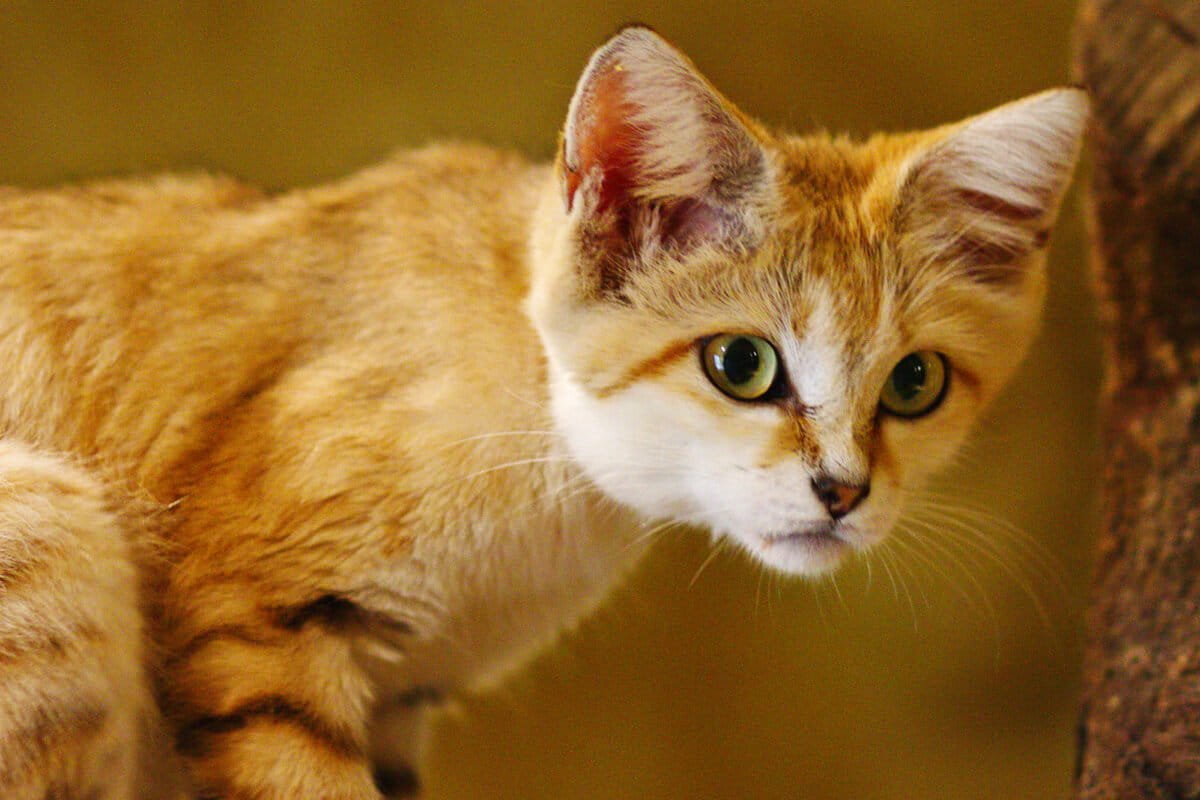
- The tiny, seldom-studied sand cat is the only feline adapted to survive in harsh deserts: It lives across Southwest and Central Asia, northern Africa and the Arabian Peninsula.
- Because of its large geographic range, this cat isn’t classified as threatened by the IUCN, but data is difficult to come by. Some scientists want to uplist the species to near-threatened status.
- The sand cat is difficult to see, day or night. After scattered anecdotal reports, scientists used camera traps to document the first systematic record of the sand cat in Qatar. Their findings offer valuable glimpses into this elusive species’ distribution and preferred habitat.
Muhammad Ali Nawaz didn’t expect to see so many cats.
Nawaz, a wildlife ecologist at Qatar University, had set out to survey Qatar for the sand cat, a tiny, seldom-studied felid that lives in deserts across Southwest and Central Asia, northern Africa and the Arabian Peninsula. Though there were anecdotal reports of the species in Qatar — some cats photographed, some not — there were no systematic records. So, Nawaz and his collaborators set out an array of cameras and waited.
“When I collected the cameras, it was a big surprise,” he told Mongabay on a video call.
Between 2022 and 2025, the cameras photographed sand cats (Felis margarita) more than 100 times, all in Qatar’s Al-Ureiq Reserve — a protected area of roughly 55 square kilometers (21 square miles). Though it’s unclear how many individual cats triggered cameras, these images provide solid evidence of the species’ range and information on its habitat preferences, data that was recently published in the journal Frontiers in Conservation Science.
“This is a remarkable kind of a discovery and gives hope for the terrestrial wildlife in the country,” Nawaz said.
A resilient desert-dweller
Sand cats are perfectly suited for their desert homes. These diminutive felids’ sand-colored fur provides stellar camouflage. Dense fur on their paws insulates against hot sand. Their keen hearing can detect prey underground. They eat small mammals, birds and insects, and can even take down venomous snakes. Hunting provides all the water sand cats need to survive; so, they can go without drinking for weeks on end.
But this elusive cat inhabits a wide swathe of arid land, and with little research, their conservation status is in question. The sand cat’s last IUCN assessment was published in 2016, when scientists listed the species as “least concern.” Alexander Sliwa, who led the assessment and serves as a curator for Germany’s Cologne Zoo, is working on an update that he hopes to publish next year. On a call with Mongabay, Sliwa said he and his collaborators want to uplist the species to “near threatened” status.
There are still unknowns about sand cats, and they tend to avoid habitat with high human activity, like busy roadways or areas occupied by herders, he said. Shepherd’s dogs also kill sand cats, and feral dogs and cats can pass diseases.
For all these reasons, the new research “comes at the right time,” Grégory Breton, a director for the nonprofit Panthera, told Mongabay.
Breton is also working on the updated assessment, and for this, he said, “we will have very good, robust data regarding Qatar. And we can now say that the species is really present in the country.”

Sand cats are markedly difficult to study since they’re small, solitary creatures that are spread thin across a vast expanse in rough terrain — and fond of remote areas with intense weather, Nawaz and his collaborators wrote. They’re notoriously difficult to track, leaving nearly invisible pawprints thanks to their furry soles. Sand cats are mostly nocturnal and have been known to crouch and close their eyes when light is shined at them, eliminating the reflective eyeshine that would mark their presence.
And they roam large distances. Nawaz guessed a normal home range might be 10-15 kilometers (6-9 miles). In Morocco, a male cat once moved more than 14 km (8.7 mi) “in a straight line in less than 30 hours.” Nawaz, Sliwa and Breton note that the photographed cats might be ranging into neighboring Saudi Arabia.
Sliwa said that in the Sahara Desert, the home ranges of female sand cats he studied were at least 275 km² (106 mi²) and males were at least 320 km² (124 mi²). The team didn’t track enough cats for long enough periods of time to pin down exact ranges, he wrote in an email. For instance, the researchers lost contact with many males as they moved out of range, so “it is reasonable to assume that their ranges are in fact larger,” he said. While individual ranges seem to overlap, the cats’ social system remains unclear, he added.
The species is almost migratory in parts of its range, he said, so returning to where you previously found one might not yield the same result.
“You might not see one for 10 years in the same spot again,” he said.
To get around these challenges, the researchers set up motion-trigger cameras in four regions around Qatar, baited them with a mix of castor and fish oils, and left them up for years, from 2022-2025. Cats triggered the cameras 106 times, including a mother and two kittens in April 2024.

Counting cats
Researchers identify individual animals captured on camera traps by any scars they may bear and by the patterns in their fur. Since sand cats have fewer distinguishable markings than other wild felids, it’s unclear how many individuals were photographed. Nawaz said he thinks there is a “sizable population.”
“There are multiple cats. That is for sure,” he added. “But how many? Whether there are 20, there are 50 or 100 — that I cannot tell.”
Sliwa praised the research but was hesitant to label the population sustainable. Al-Ureiq Reserve is a fraction of the size of Saharan sand cat ranges, he said, and it’s possible that the cameras only photographed two or three individuals that walked the same routes and triggered cameras again and again.
“We have to find out over longer time periods — the whole time a sand cat lives and a population develops — to really say what is viable,” he said. “Can it be stable over a certain period, or not?”
The researchers advocated for expanding camera trap studies across Qatar and better managing Al-Ureiq Reserve’s stray dog population, which can compete with, prey on and potentially transmit diseases like rabies and canine distemper virus to sand cats.

Medium and small cats are often overlooked by conservationists and governments in favor of larger ones like leopards and tigers, Nawaz said. These more diminutive felines deserve focus, he argued.
“They may be driving the whole functionality of the ecosystem in Qatar,” he said. “Because the larger mammals are not there.”
Banner image: Sand cats are the only desert-dwelling wild feline. The study noted that in deserts without any large mammals, they may be driving the functionality of the ecosystem in Qatar. Image by zoofanatic via Flickr (CC BY 2.0).
Big cats get the press, but small wildcats are being poached and trafficked in silence
Getting rewilding right with the reintroduction of small wildcats
Citation:
Nawaz, M. A., Ahmad, S., AlEssa, G., Badrunnahar, S., Chatziefthimiou, A. D., AlHajri, S., … Alkhayat, F. (2026). First empirical record of the sand cat (Felis Margarita thinobius) in Qatar: Resolving distribution, habitat preferences, and conservation needs. Frontiers in Conservation Science, 7. doi:10.3389/fcosc.2026.1746427
FEEDBACK: Use this form to send a message to the author or editor of this post. If you’d like to post a public comment, you can do so at the bottom of the page.

