


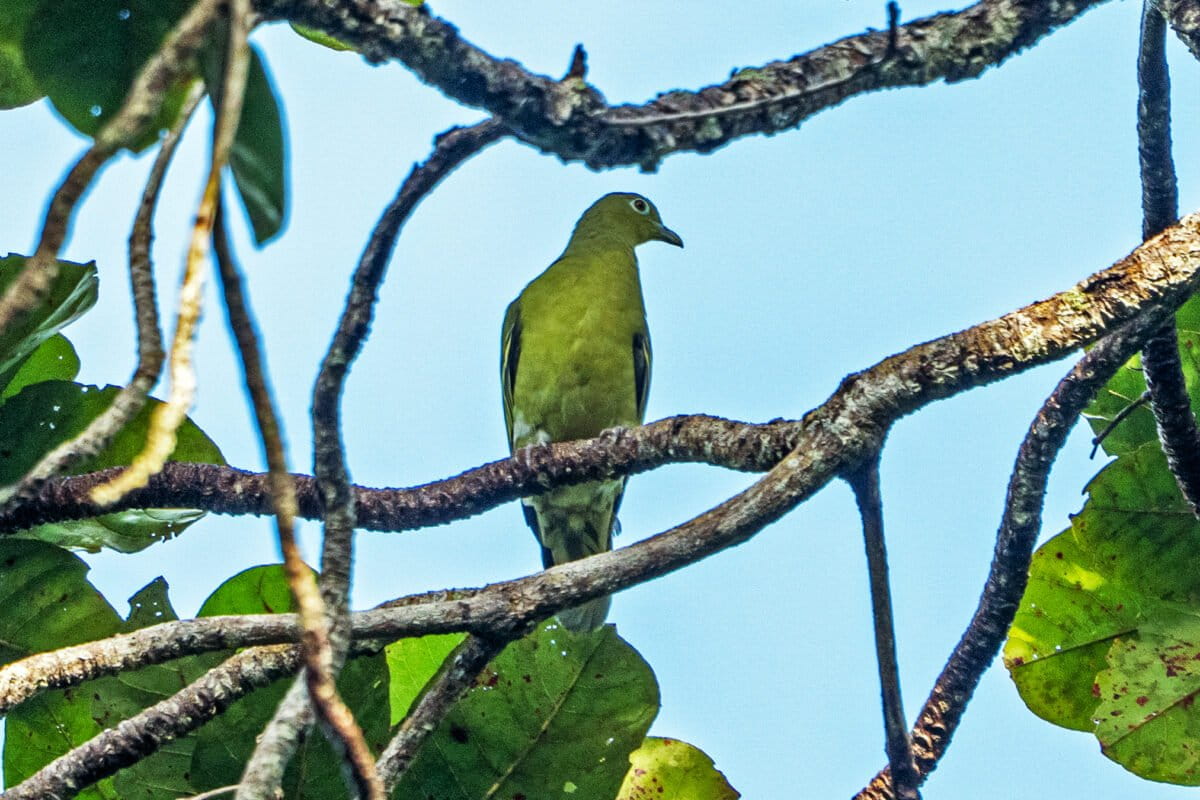
- A new study warns the Timor green pigeon is on the brink of extinction after decades of neglect, despite being listed as endangered since 2000.
- Researchers estimate just 100-500 birds remain, with Timor-Leste now the species’ last viable stronghold after it has all but disappeared from Indonesia.
- Scientists say hunting has been the biggest driver of the bird’s collapse, while the absence of a recovery program, regular monitoring and sustained funding have allowed its decline to continue.
- Conservationists argue the species can still be saved, but only through urgent action that combines stronger enforcement with community-led protection rooted in Timorese customary conservation.
On April 20, Jafet Potenzo Lopes was surveying the south coast of Manatuto municipality, in Timor-Leste, when he recorded something he had not seen in years: three Timor green pigeons, alive, in a location where the species had never been documented before.
Lopes is one of Timor-Leste’s few field ecologists. He was born and raised in the village of Com, inside Nino Konis Santana National Park — the last place on Earth where a viable population of this species, Treron psittaceus, still survives. He has spent more than a decade walking through forests, coastal habitats and mountains across the country, documenting what remains.
“Rediscovering the Timor green pigeon was one of the most emotional moments of my life,” he says. “I was almost crying when I saw them in the wild. In my heart and mind, I kept saying, ‘Yes, yes, they still exist.’”
Researchers estimate that only 100-500 Timor green pigeons remain globally, and believe the true number is probably toward the lower end of that range.
“Seeing them alive gave me hope,” Lopes says. But despite decades of concern for the endangered bird, the species still lacks a dedicated recovery program, regular population monitoring and sustained conservation investment.
T. psittaceus inhabits the lowland forests of Timor, a Southeast Asian island divided between Timor-Leste and the Indonesian region of West Timor. Less than 10% of the island’s original forest cover remains. A recent survey of the species published in the journal Oryx, the most comprehensive ever conducted, compiled more than two decades’ worth of field observations and concluded that the Timor green pigeon has likely disappeared from Indonesia almost entirely. The remaining population is concentrated in Timor-Leste, with its last viable stronghold in the forests of Lautém district and Nino Konis Santana National Park.
Colin Trainor, the study’s lead author and a researcher at Charles Darwin University in Australia, has spent more than 1,400 field days surveying the species across its range. During his doctoral fieldwork in the early 2000s in what later became Nino Konis Santana National Park, he recorded the species almost daily — an abundance that, he later acknowledged, may have given him an overly optimistic view of its status. Years passed without a targeted survey. It was only at a subsequent IUCN assessment that other observers reported very few records in areas where the bird was expected to occur. Trainor went back through his own data. His last record outside Lautém district was 22 years ago.
On Rote Island, once part of the species’ Indonesian range, Trainor made his only record in 2004. In 2025, just two individual birds were spotted there on separate occasions, on an island where the species once occurred regularly.
“Functional extinction does not mean that a species has disappeared completely,” Trainor says. “Rather, it means that the remaining population is so small and fragmented that it is no longer playing a meaningful ecological role and has little realistic chance of maintaining a self-sustaining population without intervention.”
The primary driver of the collapse was not habitat loss alone, though the forests are nearly gone. Repeated, largely unaddressed hunting of a bird that often does not flee from the sound of a gun has done the rest.
The Timor green pigeon feeds in flocks, gathering in fruiting trees in groups that can number in the dozens. Hunters in eastern Timor-Leste call them “deaf.” When gunfire breaks out, the birds sometimes continue feeding. They have not learned to fear the sound of their own extinction.
Lopes, a co-author of the new study, witnessed this firsthand. Between the ages of 7 and 9, he watched as his uncles and cousins hunted Timor green pigeons with air guns in their native village of Com, inside what is now the national park. In a single 30-minute session, in two trees, they killed 60-70 birds, he estimates. “My uncle said it’s easy to shoot a lot of them in one tree within 30 minutes,” Lopes says. “But now he has never seen one.”
This curious behavioral trait provides a clue to what the true driving force is behind their rapid decline. Unlike many hunted species, these birds never developed a strong avoidance response to humans. A bird that has not learned to flee from the sound of a gunshot is one that remains especially vulnerable to hunting pressure.
And if the Timor green pigeon is lost to hunting, the people of Timor-Leste will lose far more than just a species of bird.

For generations, the Timor green pigeon occupied a place in Timorese cultural life that extended beyond the forest. Its call appears in traditional poetry and oral storytelling, and birds have long served as symbols within local culture. During the struggle for independence from Indonesia, resistance fighters frequently adopted bird names as noms de guerre — among them Berliku, a fighter whose nickname, meaning “a bird that sings every morning,” was given to him by independence leader Xanana Gusmão because he liked to sing during lulls in fighting, according to Al Jazeera reporting on Timor-Leste resistance music.
In Timor-Leste, customary law known as lulik — and in the Fataluku dialect of Lautém, Alivana Iteini, a term describing places, objects, and natural features protected by customary beliefs and ancestral spiritual values — designates sacred forests, springs and coastal areas protected by the authority of clans that have stewarded them for centuries. Lopes has lived among these forests his entire life: stands of large trees intact not because of any conservation program from on high, but because the local community considers them inviolable.
“This has already existed since our ancestors’ time,” he says. “It was meant to preserve and protect the habitat for young generations, even before the concept of modern conservation existed.”
Rather than creating an entirely new conservation model, these customary systems could provide a culturally rooted foundation for protecting the Timor green pigeon’s remaining habitat. Lopes says that foundation already exists.
“While the customary system is not perfect,” he says, “the demonstration of conservation is not a foreign concept in Timor-Leste.”
That existing conservation ethic may be especially important because the primary threat facing the Timor green pigeon is one that can still be addressed. Unlike the loss of an entire forest ecosystem, hunting pressure is concentrated among a relatively small number of communities, creating an opportunity for targeted conservation action.
Alex Berryman, head of IUCN Red List assessments for BirdLife International in Asia and a co-author of the Oryx study, has spent time thinking about why that cultural infrastructure has not been enough to save the bird thus far. In his experience, it is rarely the level of threat alone that determines whether a species receives attention and resources.
“Public appeal matters, as does whether a species overlaps with an already-funded landscape or a charismatic flagship species, the accessibility of its habitat, and crucially whether there are local champions and institutions with the capacity to carry out the work,” he says.
The Timor green pigeon, he wrote in a message, is “far from the most aesthetic or charismatic” even among the world’s pigeons and doves. Most of its remaining individuals live in a country that, he suspects, “few westerners could point to on a map.”
The proposed uplisting from endangered to critically endangered could shift that calculus. But Berryman draws a careful line between designation and action. “Uplists do not trigger action automatically — the category is a flag that raises a species’ profile and underscores the urgency with which it needs help, but whether this translates into resources still depends entirely on people and institutions choosing to act on it.”
José Teixeira served as secretary of state for environment and tourism in Timor-Leste and now practices environmental law in Dili, the capital. He does not excuse the inaction, but he contextualizes it. During his time in government in the early 2000s, the entire environment ministry operated on an annual budget of approximately $100,000. Government investment has since increased substantially, but resources alone have not translated into species-level conservation.
“The challenge today is not primarily the absence of laws,” he says. “It is ensuring those laws can be effectively implemented and enforced.”

Timor-Leste now has a modern conservation framework — the Environmental Basic Law, the Protected Areas Law, the Biodiversity Law — but turning legal powers into field-level action requires specialist capacity and community partnerships that have been slow to develop.
Teixeira sees the path forward in the same place the researchers do: in the communities where the bird still lives.
“Conservation in Timor-Leste works best when modern environmental regulation is combined with traditional community mechanisms,” he says. “A government response that treats local communities only as subjects of regulation will be weaker than one that makes them partners in conservation.”
Trainor shares that view. He points to a model from elsewhere in Asia where former hunters were employed as citizen scientists, transforming their knowledge of local forests into a conservation asset. He says the green pigeon can still be saved — but only if hunting pressure is reduced quickly through community-based engagement.
“A combination of education, law enforcement, and community-based conservation measures may prove most effective,” he says. “But management of hunters is currently the key.”
Mongabay contacted Timor-Leste’s Ministry of Agriculture, Fisheries, Livestock and Forestry for comment but received no response.
“Without action, Timor green pigeon will almost certainly go extinct,” Berryman says. “For me it’s a reminder that the gap between knowing a species is threatened and actually doing something about it can persist for decades. This bird has been listed as threatened with extinction since 2000 with little targeted action to show for it.”
“My country is now carrying a global responsibility,” Lopes says. “Because we can’t lose one of the species that Mother Nature gave to us. If it disappears from Timor-Leste, it also disappears from our planet. No second chance.
“The future of the Timor green pigeon will not only be decided by local and international scientists or the Timor-Leste government,” he adds. “It will be decided by whether the world chooses to support people on the ground like me who are fighting to protect what remains.”
Banner image: A Timor green pigeon is seen on Apr. 20, 2026 during a wetland survey on the south coast of Timor-Leste. Image courtesy of Jafet Potenzo Lopes.
Unregulated tourism risks disrupting Timor-Leste’s whale migration
On the brink of extinction, the Javan green magpie gets a conservation lifeline
Citations:
Trainor, C. R., Lopes, J. P., Pinto, P., Pinto, R. M., & Berryman, A. J. (2026). The Timor green pigeon Treron psittaceus of eastern Indonesia and Timor-Leste may be on the verge of extinction. Oryx, 1-11. doi:10.1017/S0030605326102877
Cite this article
Timothy Mihocik (2026). Timor green pigeon nears extinction after decades of inaction, study warns. Mongabay Conservation news. DOI: https://doi.org/10.66709/news-326043

