


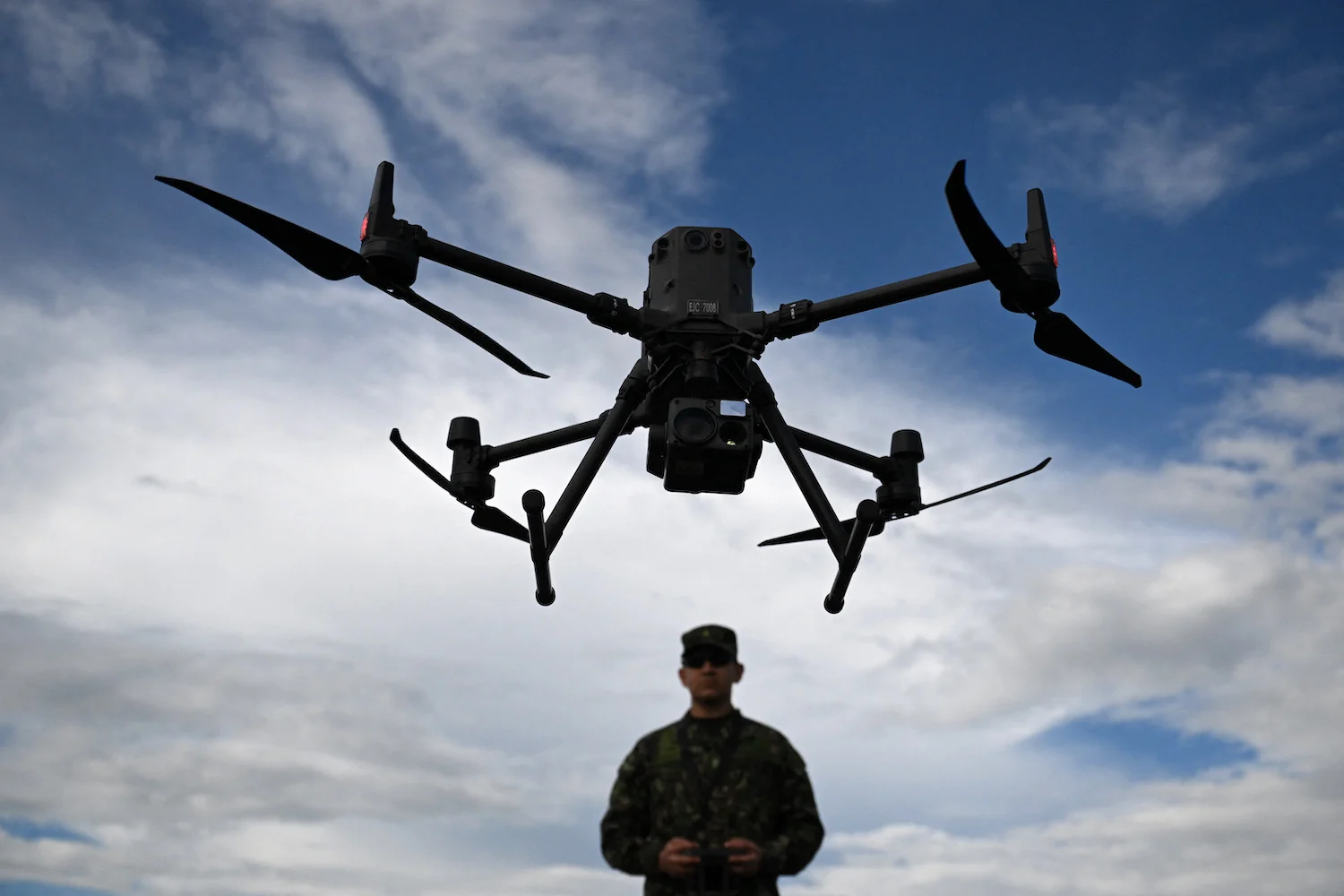
Ten-year-old Dilan Camilo Erazo Yela gathered with friends to play soccer on a Tuesday night in July 2024 in El Plateado, Colombia. Around 9:20 p.m., a drone appeared overhead and dropped an explosive on the turf field where the children played. Video footage posted on social media the next day showed Dilan lying on a gurney with his light blue T-shirt pulled up to his neck, as medical personnel tried unsuccessfully to resuscitate him.
Dilan’s fifth-grade teacher described him as quiet and respectful. “He was a boy who had dreams, and one of them was to be a great cyclist,” Dilan’s uncle, Rubiel Yela, told Colombia’s Caracol Radio after his nephew died. “He loved riding his bike around town. He loved his studies, spent time with his family and friends, and was very affectionate.”
The drone attack that killed Dilan injured 12 others, including an 11-year-old boy who suffered a chest wound and a 2-year-old girl who was diagnosed with post-traumatic stress disorder, according to regional authorities. Colombia’s military blamed the attack on the Jacobo Arenas Western Bloc of the Central General Staff, or EMC, a coalition of dissident groups from the demobilized Revolutionary Armed Forces of Colombia (FARC).
The EMC was formed of dissident FARC commanders and fighters who rejected the group’s 2016 peace agreement with the Colombian government. The rebel faction was “sowing despair and terror” in the area in retaliation for the military targeting the group, Colombian army Brig. Gen. Federico Mejía said in a video posted on social media. After first denying responsibility for Dilan’s killing, the EMC later acknowledged that it was to blame, calling the attack accidental.
More than two years later, the strike has become emblematic of how armed groups in Colombia and elsewhere in Latin America are increasingly using commercial-grade aerial drones to launch attacks, with civilians caught in the crossfire as security forces struggle to catch up. In a region long marred by conflict, drones “have further tilted the scales toward impunity,” said Henry Ziemer, a fellow in the Americas program at the Center for Strategic and International Studies.
Dilan was the first person in Colombia known to be killed in a strike by a weaponized drone, according to the Armed Conflict Location and Event Data (ACLED) monitoring organization. ACLED has logged a sharp rise in drone attacks in Colombia in recent years, reporting one in 2023, 38 in 2024, and 149 in 2025. This year through July 17, ACLED recorded 137 drone attacks in Colombia. Several strikes in the country have been deadly.
Thirteen police officers were killed when a drone attacked their helicopter in Antioquia in August 2025. Seven soldiers were killed and 30 others were injured last December when drones attacked a military base in the city of Aguachica, near the border with Venezuela. In February, a woman and her two adult sons were killed in the mining town of Segovia when a drone dropped a mortar shell on their home. Injuries caused by drone attacks include a February 2025 strike in Cauca that injured a health care worker at a field hospital set up by Doctors Without Borders.
Armed groups in Colombia have learned how to deploy drones from their counterparts in Mexico, where criminal organizations have used them since at least 2015, said Tiziano Breda, a senior analyst for Latin America and the Caribbean at ACLED. Mexican drug traffickers have used commercially available drones to smuggle narcotics into the United States and avoid cross-border tunnels targeted by authorities, he said. Groups often use U.S.-manufactured technologies due to the proximity of the two countries.
However, more recent innovation on drones has come from Ukraine. The Russia-Ukraine war has become a “proving ground” for drone warfare, Ziemer said, showing Latin American criminal groups “just how useful this technology is.” As of mid-2025, drones accounted for 69 percent of the attacks on Russian forces in Ukraine, Reuters reported, citing Ukrainian estimates. At the time, a Ukrainian medic said that most battlefield injuries that she and her colleagues had treated were also caused by drones.
Colombia is the single largest source of mercenaries who have traveled to Ukraine from abroad to fight alongside the country’s armed forces, the Times of London reported in February. More than 7,000 Colombians—many of them retired military personnel looking to supplement meager state pensions—have done so since Russia invaded the country in 2022. After fighting in Ukraine, some Colombian mercenaries are recruited by Mexican drug cartels, to whom they pass on knowledge on drone use.
Colombian armed groups, in turn, learn by watching the drone tactics of Mexican cartels and the Ukrainian military, frequently through social media, Ziemer said. Colombian armed groups have also reportedly attempted to send fighters to Ukraine to gain experience with drones. Instead of the sophisticated military drones that Ukraine and Russia use, Latin American criminal groups are buying consumer-grade drones and outfitting them with grenades or other explosives, he said.
Colombia’s armed groups, primarily the EMC and the National Liberation Army (ELN), “have identified in drones the perfect tool to gain a tactical advantage vis-à-vis security forces, which have traditionally had the upper hand in air combat,” Breda said. Armed groups use drones to maximize the impact of their attacks while minimizing their own casualties, he added.
Though armed groups in Colombia have mainly used drones to target state security forces, drug trafficking groups in Mexico have used them not only to transport drugs but also to fight each other and terrorize civilians. “In Mexico, if the cartels want to displace someone … they don’t need to send a gunman to the door. They can simply fly over a drone and drop a bomb once a day, twice a day, three times a day, until that family leaves,” Ziemer said, adding that civilians in Mexico are also frequently targeted mistakenly. ACLED recorded 37 fatalities in incidents involving weaponized drones in Mexico in 2024, 40 in 2025, and 17 so far in 2026, as of July 17.
Elsewhere in Latin America, gangs in Ecuador have attempted to attack rivals by using drones to drop explosives in prison yards and have used them to deliver drugs and weapons into prisons through open windows. In Brazil, gangs have used drones to ship contraband into prisons and conduct surveillance against police and rival criminal groups. ACLED has recorded at least eight instances in which Brazilian armed gangs launched grenades from drones against security forces or rivals, Breda said.
From September 2023 through July 17, ACLED recorded eight incidents involving drones in Ecuador, but no fatalities directly caused by the aerial devices. From last June until July 17, the organization logged 11 drone-related incidents in Brazil, one of which resulted in 121 deaths.
In that incident, which occurred last October, Brazilian civil and military police launched raids against the Comando Vermelho (CV) criminal organization in two Rio de Janeiro favelas. CV members used drones to drop explosives on officers and civilians. Four police agents were killed in the clashes, and police claimed that the rest were suspects, though relatives of some of the deceased disputed that version, according to ACLED.
Most Latin American countries’ security forces are on the back foot, but they are trying to fight back, Ziemer said. Last year, Colombia debuted its first domestically built military drone, the Dragom, which can be used for both reconnaissance and precision strikes. On the policy front, Mexico’s government has sought to fight criminals’ drone use by reforming its firearms law to introduce prison sentences of as long as 30 years for using drones to attack people or property.
In January, the Colombian government announced a $1.68 billion anti-drone project that then-Defense Minister Pedro Sánchez called “one of the boldest and most innovative strategies for our national security and defense.” That project includes radar and signal-jamming systems, Breda said. However, he added that new fiber-optic drones used by some armed groups, such as the ELN, “are already rendering some of these systems obsolete.” Such drones are connected to a controller on the ground by fiber-optic cable, allowing them to resist signal-jamming technology.
Colombia’s efforts against drones are likely to intensify under President Abelardo de la Espriella, who took office on Aug. 7. On the campaign trail, de la Espriella vowed to strengthen Colombia’s armed forces through the use of drones and artificial intelligence.
To gain the upper hand against criminal groups’ use of drones, security forces in Latin America need better military training, Ziemer said. The rapid pace of criminals’ use of drones means that few militaries have trained for how to fight them. “Security forces need to actually train with and against drones” to develop tactics against them, he added. Countries also need tougher regulations, such as mandatory background checks, to restrict armed groups’ ability to acquire drones. Ziemer said that drones can be equipped with trackers to determine how they are being transported to armed groups.
All the while, the civilian toll of drone attacks in Latin America is escalating. Octavio Guzmán, the governor of Cauca, called for peace after Dilan’s death. “Our children and grandchildren are falling victim to the war, even though they are not participants in it,” he said. “We cannot accept a situation where boys and girls never return to school because their lives have been cut short.”
Last October, after a drone attack on his home that nearly killed his brother and his housekeeper, Farid Camilo Castaño, the mayor of Calamar, called for the Colombian government to act and for armed groups “not to drag civilians into their conflicts” in a video posted on social media. He added: “Today, it was the mayor and his family. Tomorrow, it could be any one of our citizens.”
