


- The Forest Department of Bangladesh has recently installed five ropeway bridges at a fragmented national park, with plans to replicate the idea in other vulnerable reserved forests.
- Pioneering conservationists have seen both successes and failures in previous ropeway-based projects.
- Researchers appreciate the Forest Department’s move but recommend well-assessed site selection, incorporation of modern equipment for sharper surveillance and community engagement.
As Bangladesh is rapidly being urbanized, more and more forests are getting fragmented, resulting in the construction of more roads, which means more wildlife are being killed in collisions with vehicles. To address these wildlife deaths, the Forest Department’s Tangail Divisional Office has recently facilitated a low-cost solution.
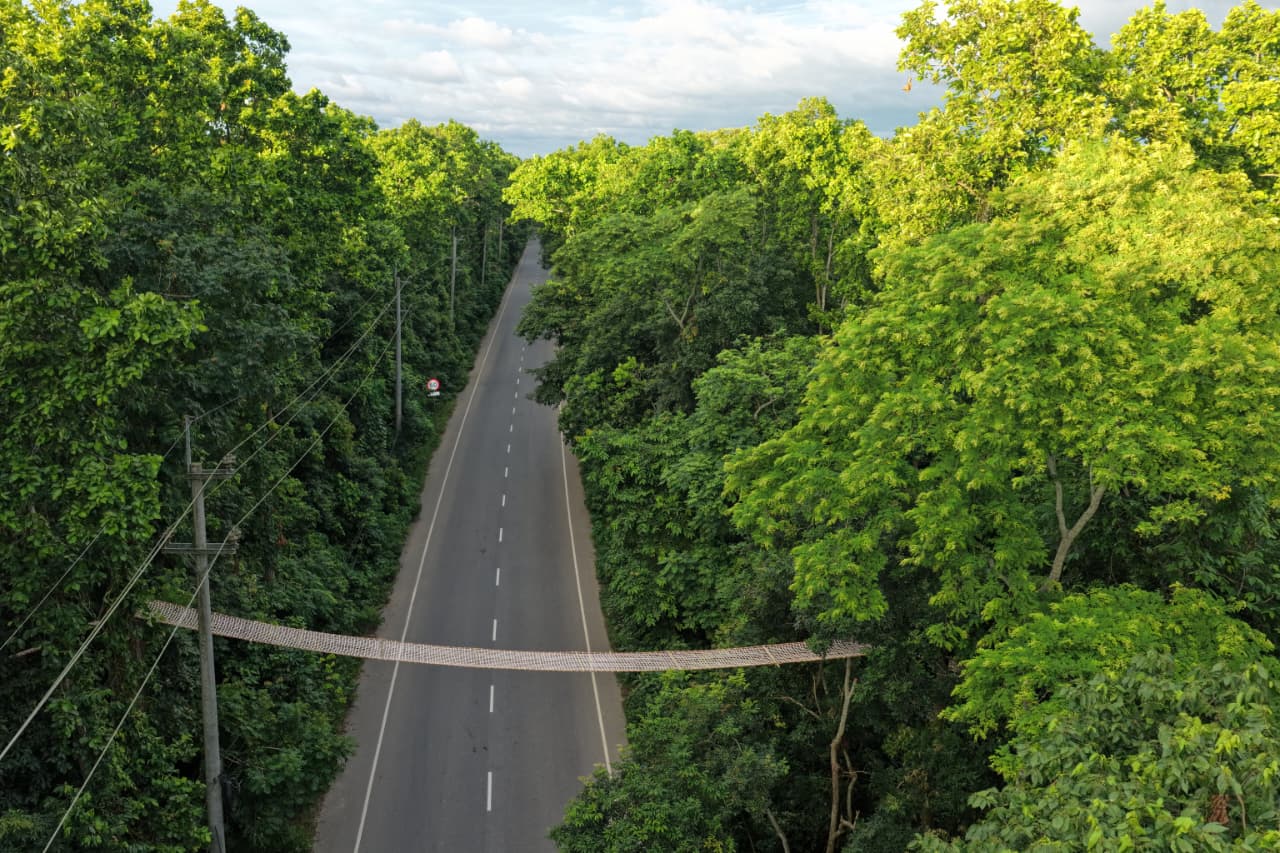
At a total cost of 625,000 takas (around $5,000), ropeway bridges have been installed in northern Bangladesh at five locations along an 8-kilometer (5-mile) stretch of the Mymensingh-Tangail Highway N401, which slices through the reserved forest of Madhupur National Park, where heavy-duty vehicles regularly collide with wildlife, especially primates.
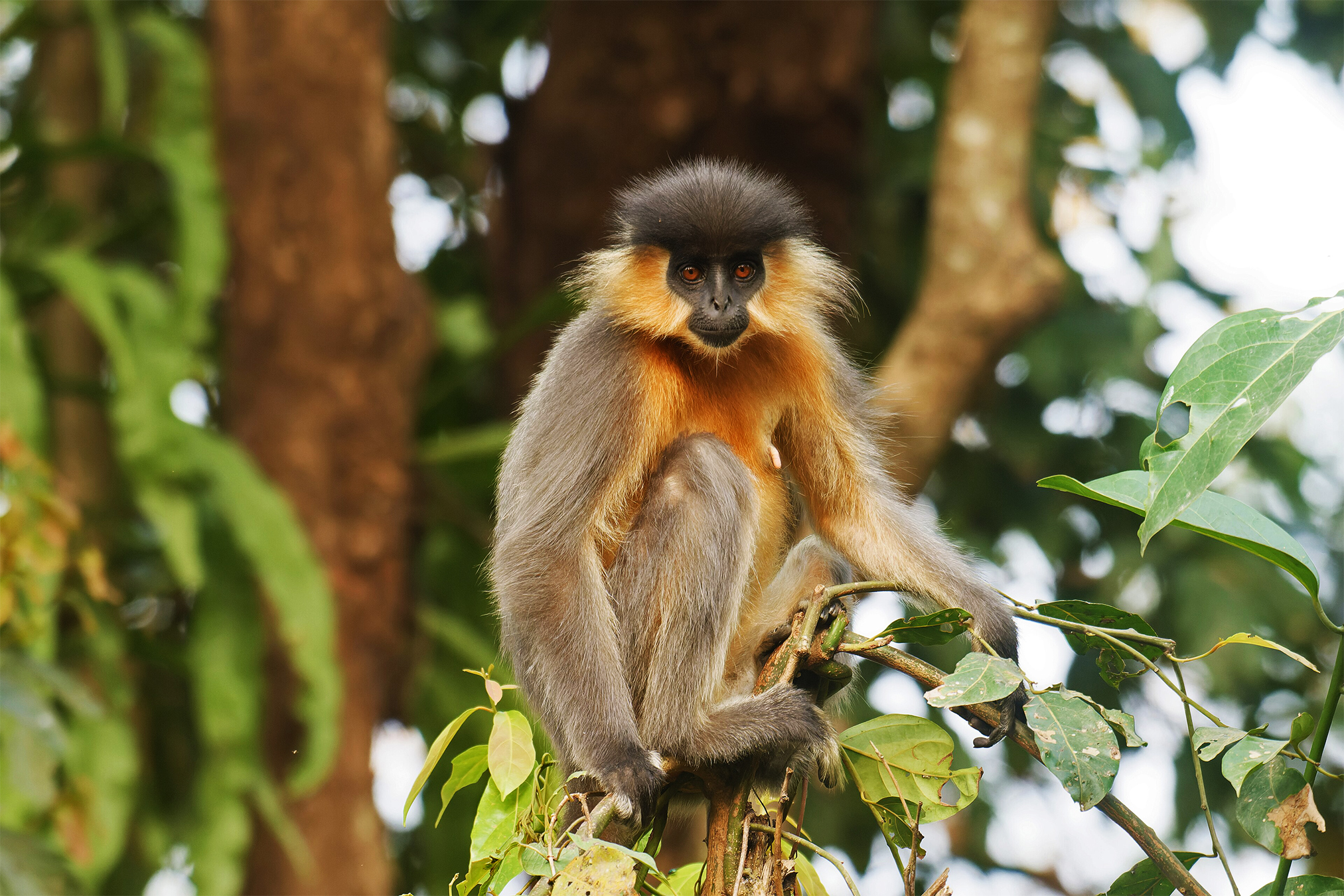
“These ropeways are expected to protect rhesus macaques, capped langurs, Indian civets and small carnivores like fishing cats from roadkill,” Tangail divisional forest officer Abu Naser Mohsin Hossain told Mongabay.
According to a 2018 study, the 8,436-hectare (20,845-acre) Madhupur National Park, the largest deciduous forest of Bangladesh, supports 151 wildlife species belonging to 23 orders and 62 families.
According to available data that the Forest Department has from local sources, rhesus macaques (Macaca mulatta) are most frequently killed in road accidents during the day.
However, none of the roadkill in Madhupur can be documented, because the forest dependent Indigenous community here consumes the carcasses soon after an accident, said Md. Mossarrof Hosain, a deputy ranger at the Madhupur National Park.
Naser said that the nylon-rope bridges are expected to provide safe aerial corridors for arboreal animals, both nocturnal and diurnal. Each is 30 meters (100 feet) long and almost 1-meter (3-feet) wide and hung just more than 6 meters (19 feet) over the highway.
After assessing the potential benefits of the aerial corridors, the Roads and Highways Department has planned to finance more ropeway bridges for the protection of Madhupur-based wildlife. The department’s Tangail executive engineers office confirmed the decision.
Connecting forest canopies is important, because frugivorous primates disperse small and large seeds if they find their habitat non-fragmented. The absence of zoochorous seed dispersal by primates causes decreasing plant heterozygosity, according to a 2017 study.
Pioneering project
The Madhupur ropeway bridge project marks the Forest Department’s first initiative, and the department is eyeing replication at other forests. There are two previous canopy bridge projects implemented by non-government entities.
Assessing that roads and power supply lines were major sources of primate mortality in two forests of northeastern Bangladesh, primatologist Hassan Al Razi Chayan and his team installed eight single nylon-rope canopy bridges — three in Satchari National Park and five in the adjacent lemon orchards in Habiganj — between 2019 and 2020. German nonprofit Plumploris e.V. and the Explorers Club Grant supported the project.
Hassan said, “Following the news reports on wildlife fatalities, we planned a low-cost solution and implemented it successfully.” The project was the first of its kind in Bangladesh.
The Satchari National Park has also been fragmented by the Jagadishpur-Chunarughat-Shaistaganj Highway N204 that witnesses roadkills regularly.
Between 2015 and 2017, Hassan and his team recorded fatalities of Phayre’s langur (Trachypithecus phayrei), pig-tailed macaque (Macaca leonina), Bengal slow loris (Nycticebus bengalensis), rhesus macaque and capped langur (Trachypithecus pileatus) from roadkill and electrocution at the Satchari National Park.
The single-rope canopy bridge like those installed at Satchari is used by animals for safely crossing over human settlements.

Along with setting up the canopy bridges at the national park, the team installed an infrared camera at one site and recorded 1,150 crossings of animals, including Phayre’s langur, rhesus macaque, slow loris and squirrel, in one year.
The five canopy bridges over the lemon orchards — scattered along Indigenous Tripura villages inside the forest — have been installed so that slow lorises can frequent Jhika trees (Lannea coromandelica) and eat the saps they highly rely on.
“Pet dogs at the Tripura villages used to attack slow loris. Now, they can [using the canopy bridges] evade the attack,” said Hassan, who is currently a Ph.D. student at the School of Human Sciences under the University of Western Australia.
Of the eight canopy bridges, one was damaged a couple of years ago due to the collapse of the linked trees.
Hassan’s teacher and zoology professor at Jagannath University, Habibon Naher, also implemented a similar project in 2020 with funds from the Forest Department.
Naher and her team installed six single-rope canopy bridges at the Lawachara National Park, which is fragmented by the Sreemangal-Bhanugach Road and the Akhaura-Kulaura-Chhatak rail track.
“Of the canopy bridges, four were installed along the rail track and the remaining two over the road where canopy density was thin,” Naher said.
According to a 2013 study, Lawachara National Park boasts threatened species including hoolock gibbon, slow loris, pig-tailed macaque, Phayre’s langur, capped-langur and leopard cat (Prionailurus bengalensis).
The zoology professor said she was unable to document the use of the bridges as the outdated cameras provided by the Forest Department produced poor-quality images.
Fund shortage prevented regular monitoring of the bridges. Currently, none of the bridges remain at Lawachara, as they were either stolen or damaged.


What’s next?
Canopy bridges have already proven effective in reducing wildlife roadkills elsewhere in the world.
Eight canopy bridges over the MT-208, which cuts through the Amazon town Alta Floresta in Brazil, have protected marmosets and other arboreal animals from roadkill. Camera-trap footage recorded more than 15,000 safe crossings with no roadkill since 2024.
In Bangladesh’s neighboring country India, ropeways connecting forest canopies have also been used to help primates, including the endangered golden langur (Trachypithecus geei), cross roads safely.
Inspired by global trends and the primary assessment in the Madhupur National Park project, divisional forest officer Naser said he hopes that similar ropeway bridges will be installed in other fragmented forests across Bangladesh.
Naser said, “I would recommend installation of such bridges at Teknaf Wildlife Sanctuary, Chunati Wildlife Sanctuary, Bhawal National Park and again at Lawachara National Park.”
According to a 2024 study, the Teknaf Wildlife Sanctuary — fragmented by the Dhaka-Chattogram-Teknaf Highway N1 — hosts rich fauna including 198 invertebrates, 27 amphibians, 54 reptiles and 43 mammals.
Meanwhile, in the Chunati Wildlife Sanctuary — fragmented by the N1 highway and the Chattogram-Cox’s Bazar rail track — a total of 178 wildlife species, including six amphibians, eight reptiles and 27 mammals were found by a 2020 study.
The Bhawal National Park, despite losing much of its biodiversity to rapid industrialization and encroachment by the city of Gazipur, still supports primates, including rhesus macaques. The park is fragmented by the Dhaka-Mymensingh Highway N3.
Primatologist Hassan said experts’ feedback should be taken before implementing the next projects with ropeway bridges.
“Careful site selection is critical,” he said. “Installing a bridge too close to overhead power lines could expose animals to the risk of electrocution.”
He also suggested using a single-rope bridge instead of the ladder-style structures installed in Madhupur National Park.
“Our pilot project with a ladder-style bridge in Satchari showed that primates avoided using it, because they found the structure unstable,” he said.
Banner image: A capped langur in Bangladesh. Image by Shiv’s fotografia via Wikimedia Commons (CC BY 4.0).
In Malaysia, a bridge helps endangered langurs and humans coexist
Zero roadkill as Amazon canopy bridges secure 15,000 crossings
Why a New England city is building tunnels to protect an imperiled salamander
Citations:
Monirujjaman, M., & Khan, M. A. R. (2018). Wildlife diversity of Madhupur National Park, Bangladesh. Jahangirnagar University Journal of Biological Sciences, 7(1), 1–13. doi:10.3329/jujbs.v7i1.37967
Estrada, A., Garber, P. A., Rylands, A. B., Roos, C., Fernandez-Duque, E., Fiore, A. D., … Li, B. (2017). Impending extinction crisis of the world’s primates: Why primates matter. Science Advances, 3(1), e1600946. doi:10.1126/sciadv.1600946
Al-Razi, H., Maria, M., & Bin Muzaffar, S. (2019). Mortality of primates due to roads and power lines in two forest patches in Bangladesh. Zoologia, 36, e33540. doi:10.3897/zoologia.36.e33540
Aziz, M. A. (2011). Notes on the status of mammalian fauna of the Lawachara National Park, Bangladesh. Ecoprint: An International Journal of Ecology, 18, 45–53. doi:10.3126/eco.v18i0.9398
Miah, M. D., Hossain, M., & Ali, Y. (2024). Assessment of the degradation of Teknaf Wildlife Sanctuary, Bangladesh: Use of remote sensing and geographic information system techniques. Forestist, 74, 354–364. doi:10.5152/forestist.2024.24002
Rahman, M. S., & Obaydullah, A. K. M. (2020). Causes for degradation to Chunati Wildlife Sanctuary and its restoration strategy. Intl J Res Innov Soc Sci (IJRISS), 4(5), 90–97. Retrieved from: https://rsisinternational.org/journals/ijriss/Digital-Library/volume-4-issue-5/90-97.pdf
Feedback: Use this form to send a message to the author of this post. If you want to post a public comment, you can do that at the bottom of the page.
Cite this article
Sadiqur Rahman (2026). New ropeways aim to save wildlife in Bangladesh’s fragmented habitats. Mongabay Conservation news. DOI: https://doi.org/10.66709/news-325875

